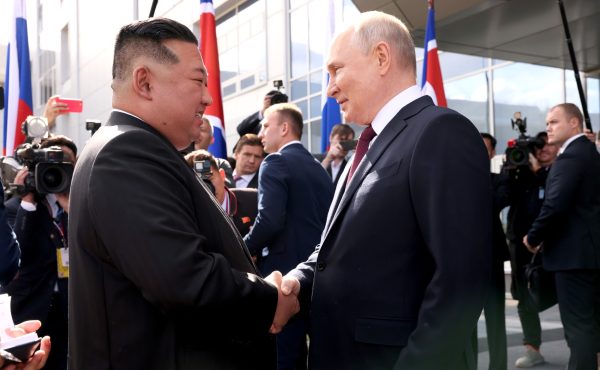
Russia May Share Intelligence, Not Satellites, With North Korea
The strengthening partnership between Russia and North Korea may lead to intelligence sharing from Russia's existing satellite network, rather than the transfer of military satellite technology. This could be a more practical and strategically advantageous form of cooperation for both nations.
Rather than helping North Korea build military satellites, what if Moscow simply shares the intelligence collected by its existing satellite network? Russia’s growing partnership with North Korea has fueled speculation that Moscow may eventually help Pyongyang build a more capable military satellite program. But that assumption may miss the more important development. Rather than asking whether Russia will transfer sophisticated satellite technologies to North Korea, policymakers should ask a different question: Could Moscow simply share the intelligence collected by its existing satellite network? Such an arrangement would provide Pyongyang with many of the military benefits of an advanced reconnaissance capability while allowing Moscow to retain control over some of its most sensitive technologies. That possibility deserves far greater attention. Intelligence sharing would represent a more practical, politically sustainable, and strategically attractive form of cooperation than technology transfer. Recent developments in Russia’s security partnerships – including its expanding intelligence cooperation with Belarus and its deepening strategic relationship with North Korea – suggest that the institutional foundations for such an arrangement are steadily taking shape. North Korea’s Satellite Problem North Korea has repeatedly declared its ambition to build a constellation of military reconnaissance satellites. Following the launch of Malligyong-1 in November 2023, Pyongyang announced plans to deploy multiple reconnaissance satellites capable of monitoring the Korean Peninsula and key U.S. military hubs in the Western Pacific, including Guam and Okinawa. Such a constellation would significantly improve North Korea’s ability to monitor military activities across the region and support the targeting requirements of its expanding missile forces. Achieving that objective, however, is far more difficult than placing a single satellite into orbit. An operational military reconnaissance constellation requires multiple satellites operating in coordinated orbits, reliable launch capabilities, sophisticated ground infrastructure, and the capacity to process and distribute imagery rapidly and securely. Even countries with advanced space industries typically require years to build such an integrated capability. North Korea remains far from that goal. Although Malligyong-1 represented an important technological milestone, one satellite alone cannot provide continuous surveillance. Because satellites in low Earth orbit pass over the same location only periodically, they leave significant gaps between observations. This limitation is particularly problematic for monitoring time-sensitive military targets such as transporter-erector-launchers (TELs), mobile missile units, aircraft deployments, and naval movements. This leaves Pyongyang with a widening mismatch between its growing demand for timely military intelligence and the capabilities of its own satellite infrastructure. Bridging that gap through indigenous technological development will likely take years. Access to Russian intelligence products, however, could narrow it almost immediately. Why Intelligence Sharing Makes More Sense Than Technology Transfer Most discussions assume that Russia will gradually transfer sophisticated satellite technologies to North Korea. There are good reasons to question that assumption. The technologies required to build advanced military reconnaissance satellites – including high-resolution optical sensors, synthetic aperture radar (SAR), and secure satellite communications – remain among Russia’s most strategically sensitive capabilities. Transferring such technologies would not only expose Moscow to greater international scrutiny and sanctions but also erode technological advantages that Russia has little incentive to relinquish. Sharing intelligence products derived from Russia’s existing satellite network offers a far more practical alternative. Russia already possesses an extensive network of military and civilian Earth observation satellites capable of monitoring Northeast Asia. Providing processed intelligence from these existing assets would enable Moscow to strengthen North Korea’s reconnaissance capabilities without transferring its most sensitive technologies. For North Korea, the practical benefits would be substantial. For military planners, ownership of the satellite itself is less important than access to accurate and timely intelligence. What ultimately matters is whether they can monitor troop deployments, missile defense systems, air bases, naval movements, and other strategic targets. Receiving processed reconnaissance data from Russia could significantly enhance Pyongyang’s situational awareness without requiring it to develop an equivalent indigenous satellite constellation. For Moscow, such an arrangement offers important strategic advantages. Satellite-derived intelligence can be calibrated, restricted, or suspended according to Russia’s political and military objectives. Unlike transferring sensitive space technologies, intelligence sharing allows the Kremlin to strengthen North Korea’s operational capabilities while retaining full control over both the underlying technologies and the information itself. Russia would decide what intelligence is shared, when it is shared, and under what conditions, enabling it to support Pyongyang while avoiding the irreversible risks associated with technology transfer. The Belarus Precedent Russia is already doing this with another close partner. In recent years, Russia and Belarus have developed a model of satellite cooperation centered not on technology transfer but on intelligence sharing. Rather than helping Belarus build an independent military reconnaissance satellite industry, Moscow has integrated Belarus into a broader intelligence architecture that provides access to satellite-derived information while leaving Russia in control of the underlying space capabilities. In early 2024, Russia and Belarus announced plans to develop a joint Earth observation satellite constellation designed to integrate their space-based reconnaissance capabilities. The initiative integrates Earth observation satellites, ground infrastructure, and image-processing capabilities from both countries into a single network designed to improve the speed and quality of intelligence collection. Belarusian officials argued that integrating Russian and Belarusian satellite assets would dramatically shorten revisit intervals and enable near-real-time Earth observation. The Belarus experience illustrates an important point: Russia does not need to export sensitive space technologies to strengthen a partner’s intelligence capabilities. It can instead provide
多角的分析
ロシアと北朝鮮間の協力強化は、直接的な経済的影響よりも、地政学的な安定性への影響を通じて間接的な経済的波及効果をもたらす可能性がある。軍事技術の移転は国際的な制裁リスクを高め、経済活動を阻害する要因となりうるが、情報共有に留まる場合は、そのリスクは低減される。しかし、地域における軍事的緊張の高まりは、投資家心理を冷え込ませ、経済活動に不確実性をもたらす可能性がある。
ロシアが北朝鮮に衛星技術を移転した場合、国際社会からの制裁強化リスクが高まり、ロシア経済への投資はさらにリスクの高いものとなる。情報共有に留まる場合でも、地政学的な不安定要因として認識され、特にアジア太平洋地域への投資には慎重な姿勢が求められるだろう。日本企業にとっては、サプライチェーンの安定性や、地域情勢の悪化による市場への影響を注視する必要がある。
北朝鮮への情報共有は、同国の軍事能力向上に寄与する一方で、核・ミサイル開発への懸念を一層高める。これは、朝鮮半島および周辺地域の住民の安全保障に対する不安を増大させる。また、ロシアと北朝鮮の連携強化は、国際社会における非核化への取り組みや、人権問題への懸念を深める可能性もある。インドネシアのような地域大国は、こうした国際的な課題への対応を迫られる。
北朝鮮市民にとって、ロシアからの情報共有は、外部からの情報へのアクセスが限定されている状況下で、限定的ながらも外部の状況を知る機会となりうる。しかし、それが体制強化に繋がる場合、市民生活の自由度や人権状況の改善には繋がりにくいと考えられる。一方、ロシアやベラルーシの国民にとっては、国家間の軍事協力の拡大は、経済的な負担や国際社会からの孤立を招く可能性があり、生活への影響が懸念される。
背景・歴史的文脈
ロシアと北朝鮮の関係は、冷戦時代からの歴史的経緯を持つ。ソ連崩壊後、両国関係は一時的に希薄化したが、近年、特にウクライナ侵攻以降、ロシアは北朝鮮との関係を急速に強化している。これは、ロシアが国際社会からの孤立を深める中で、新たな軍事・経済的パートナーを求めていること、そして北朝鮮がロシアからの支援を必要としているという相互の利害が一致した結果である。特に、北朝鮮の核・ミサイル開発能力と、ロシアの宇宙技術・情報収集能力の組み合わせは、地域安全保障に新たな懸念をもたらしている。
原文ソース
The Diplomat Indonesia