General articles are free for 24 hours after publish.
Sinabung Volcano Erupts, Alert Level Raised to III, Residents Advised to Avoid Danger Zones
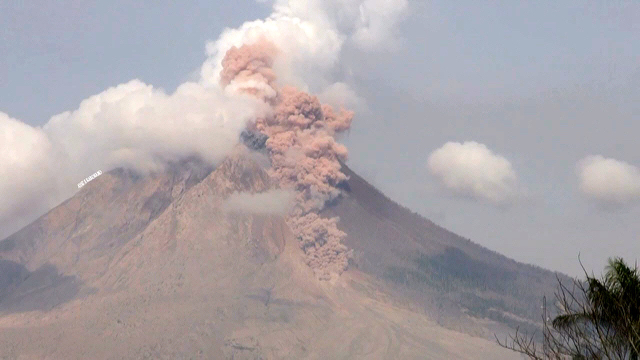
Mount Sinabung in North Sumatra, Indonesia, has erupted, prompting an upgrade of its alert level to III (Siaga). Local residents, recalling past eruptions, express concerns about prolonged activity while continuing to farm the volcano's fertile soil.
Mount Sinabung in North Sumatra, Indonesia, erupted on Monday, August 31, 2026, at 10:17 AM Western Indonesian Time (WIB). Following the eruption, the Geological Agency raised the volcano's alert level to Level III (Siaga), or Alert. Residents of Sukanalu Village in Karo Regency, Kembaren Ketaren, reported witnessing the eruption around 10:00 AM. He and his wife took shelter in a hut, monitoring the ashfall. While he had observed thin smoke emanating from the peak for the past two months, he did not consider it alarming until the eruption. At the time of the eruption, he was harvesting over 75 kilograms of carrots and approximately 42 kilograms of passion fruit, intended for sale in Berastagi market and to local collectors. "We hope Sinabung calms down and does not erupt again like in 2023," Ketaren stated. He acknowledged the risks of living near Sinabung, recognizing that while volcanic activity enriches the soil, it also poses a threat to residents' lives. Scientific studies describe Sinabung as a stratovolcano formed during the Pleistocene to Holocene epochs. Its primary constituent rocks are basaltic-andesite to andesite, rich in minerals like plagioclase, pyroxene, and hornblende. The weathered volcanic material contains high levels of nutrients such as calcium, magnesium, potassium, and phosphorus, contributing to highly fertile soil for agriculture. The National Disaster Management Agency (BNPB) noted that residents from Kuta Tengah Village in Simpang Empat District are currently taking refuge at a post. Authorities have urged residents to avoid danger zones following the eruption. Source: Mongabay Indonesia
Original source
Mongabay Indonesia