General articles are free for 24 hours after publish.
Vietnam's First Climate Change Relic: Seaside Ruins Designated as Tourist Site
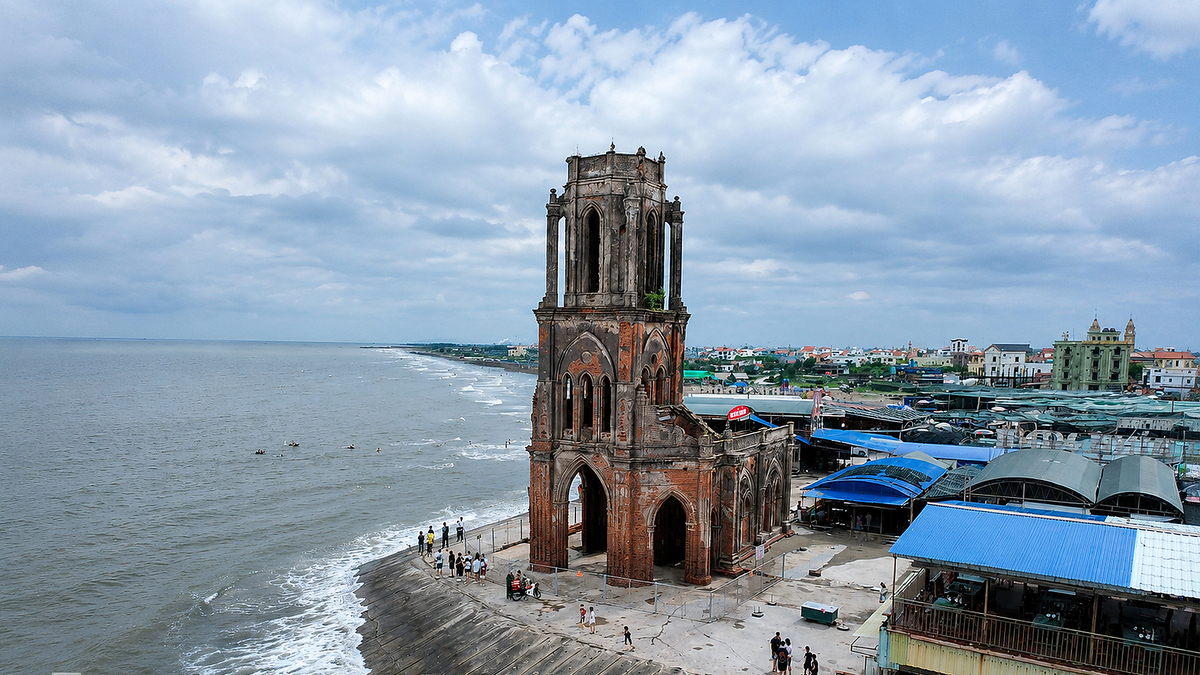
A nearly century-old ruined church on Vietnam's coast, the 'Hai Ly's Collapsed Church,' has been designated a tourist site as the country's first relic of climate change. This site stands as a testament to coastal erosion and rising sea levels, with expectations for its use in education, research, and tourism.
Ninh Binh Province in northern Vietnam has designated the 'Hai Ly's Collapsed Church,' a nearly century-old ruined structure standing on the coast, as a tourist site, recognizing it as the country's first relic of climate change. The church, originally built inland, now stands at the water's edge due to years of coastal erosion and rising sea levels. This church is deeply connected to the history of Xương Điền, a former coastal settlement. From the late 17th and early 18th centuries, people settled here, expanding their land and building dikes to protect their villages. However, over nearly 100 years of severe storms, waves, and erosion, the coastline has continuously receded, with the land lost to the sea. Notably, since 1990, coastal erosion has become more pronounced, reaching about 700 meters by 2005. Dr. Vũ Cao Minh, former Deputy Director of the Institute of Geology under the Vietnam Academy of Science and Technology, points out that the current state of the church serves as living evidence of coastal changes and the human efforts to reclaim and protect coastal areas. He explains that the fact a structure built about 100 years ago now stands on the beach, outside the dike, is valuable material for studying coastal biến động history and illustrates the continuous human endeavor to reinforce dikes against natural threats. Dr. Minh emphasizes that the church's value lies not only in its remaining architecture but also in its connection to the coastline, the dike system, and the history of human habitation. Such relics affected by climate change and natural disasters are rare globally. International examples show their use in research, education, and tourism. For instance, church towers in the UK are preserved as traces of coastal erosion, while in the US, memorials and parks commemorate extreme natural events. Taiwan has also established a relic park for landslides and debris flows, aiding disaster prevention education and research. According to Dr. Minh, the significance of a climate change relic lies in helping people understand why it is there, how the coastline has changed, and how humans have responded. When this is achieved, the relic gains scientific, educational, and tourism value. Around Hai Ly's Collapsed Church are Thịnh Long beach, and characteristic coastal culture, cuisine, and fishing life. Dr. Minh believes that if properly preserved, restored, and promoted, the area could become a tourist destination linked to its habitation history, land preservation efforts, and coastal transformations. The designation as a tourist site opens opportunities to exploit the relic's value while also imposing the responsibility to protect the remaining structure, the landscape, and documentation of coastal changes. Source: VnExpress
Original source
VnExpress