General articles are free for 24 hours after publish.
Indonesia's Whoosh High-Speed Rail Faces Persistent Losses in 2025
Indonesia's first high-speed rail, Whoosh, which opened in October 2023, continues to incur significant losses, a trend expected to persist in 2025. While the government has the fiscal capacity to cover these deficits, concerns are rising over the increasing burden on state-owned enterprises.
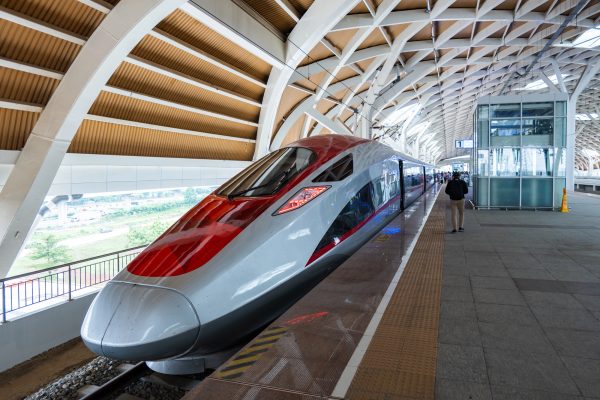
Indonesia's inaugural high-speed rail line, Whoosh, which commenced operations in October 2023, continues to operate at a significant loss, a situation projected to persist through 2025. The 143-kilometer line connecting Jakarta and Bandung, capable of speeds exceeding 300 kilometers per hour, was delivered late and over budget, with a final cost of approximately $7 billion. Whoosh has been under intense scrutiny since its opening, with questions raised about the sustainability of its debt and the justification of its substantial costs, especially given the relatively short distance between Jakarta and Bandung, which were already adequately served by existing transport modes including buses, toll roads, and conventional rail. Whoosh is structured as a joint venture called PT Kereta Cepat Indonesia China, or PT KCIC. Chinese firms hold 40 percent of the joint venture, while Indonesian firms, through an entity called PT Pilar Sinergi BUMN Indonesia (PT PSBI), hold 60 percent. The two main Indonesian partners are state-owned railway operator Kereta Api Indonesia (KAI) and state-owned construction company Wijaya Karya (WIKA), which also participated in the railway's construction. From KAI's 2025 financial report, PT PSBI lost a total of IDR 5 trillion, which is around $279 million at current exchange rates. Of this, KAI absorbed around $162 million, an increase from $124 million in 2024. Wijaya Karya reported a loss of IDR 1.6 trillion in 2025 from its participation in the joint venture, which is about $90 million. It is highly probable that Whoosh will continue operating at a loss in the coming years, with the figure likely to remain under $300 million annually. The subsequent question is whether this poses an unsustainable burden on Indonesia's fiscal resources. In my opinion, the answer is no. While Indonesia's fiscal space is tightening, the government can clearly afford to allocate $300 million a year to cover Whoosh's losses. Other transportation modes, including long-distance rail and urban transit systems like Jakarta's commuter rail, are already heavily subsidized. While there may be reasonable disagreements about the propriety of this public fund allocation, especially amidst mounting fiscal pressures, it is unlikely to pose a systemic risk to Indonesia's fiscal solvency or its ability to repay foreign debts. While the Indonesian government has the fiscal capacity to cover Whoosh's operating losses, the critical question is how these losses should be allocated. Currently, they fall upon the state-owned companies within the joint venture, an arrangement that is becoming increasingly untenable. KAI has a reasonably healthy balance sheet with $5.9 billion in total assets and equity of $2.2 billion. The railway operator posted a net income of $128 million in 2025 and positive operating cash flow of around $400 million. As state-owned companies go, this is not a poor performance. However, if they are required to absorb nearly $200 million in losses annually from their share of the Whoosh joint venture, this will gradually deplete their equity buffer. The situation is far more precarious for the other main Indonesian partner, Wijaya Karya. Many of Indonesia's state-owned construction companies, including Wijaya, are not in robust financial health following years of debt-fueled construction activity during the Jokowi administration. Wijaya reported a net loss in 2025 of $565 million and a very thin equity position of just $94 million. With assets barely exceeding liabilities, the state-owned contractor will find it difficult to absorb another $90 million loss from Whoosh in 2026. The government can offset these losses through capital injections indefinitely. However, a larger question arises: "Should they?" Is the value created by the high-speed rail commensurate with the incurred costs? Whoosh ridership in 2025 was reported at 6.2 million passengers. For comparison, the Jakarta MRT (constructed and financed in partnership with Japan) had a ridership of 45 million, and the Greater Jakarta LRT (constructed by a consortium of Indonesian state-owned firms and financed mainly through domestic sources) had 35 million. Both projects cost significantly less than $7 billion. Beyond ridership, other metrics are important, such as the participation of Indonesian firms like Wijaya Karya in the construction process. The logic behind this joint venture model, as opposed to a direct government-to-government deal, was that Indonesian SOEs would become more active stakeholders and participants in construction and operation, thereby expanding their capabilities and skills. Of course, even if Wijaya expanded its capabilities by participating in the joint venture, one wonders how much value that creates if the company cannot continue as a going concern. Indonesia, through its state-owned investment fund Danantara, is reportedly in talks with China to restructure the debt on the Whoosh project. Furthermore, Indonesia's major state-owned construction companies, including Wijaya, are likely to be merged or restructured soon. One way or another, the state will probably end up absorbing more of the financial burden from the Whoosh project, simply because the Indonesian joint venture partners (especially Wijaya) cannot continue to absorb the losses. While this is unlikely to impose a serious financial strain on the state, it does little to answer the big question that has loomed over this project from the outset: in the end, was it all worth it? Information Source: The Diplomat Indonesia
Original source
The Diplomat Indonesia