General articles are free for 24 hours after publish.
Across a border and into a war: A Karenni leader’s final journey
Once the funeral procession passed a border checkpoint from Thailand into the jungles of Myanmar, the road changed abruptly. The path connecting the two countries became a deeply rutted dirt track, muddy and uneven benea
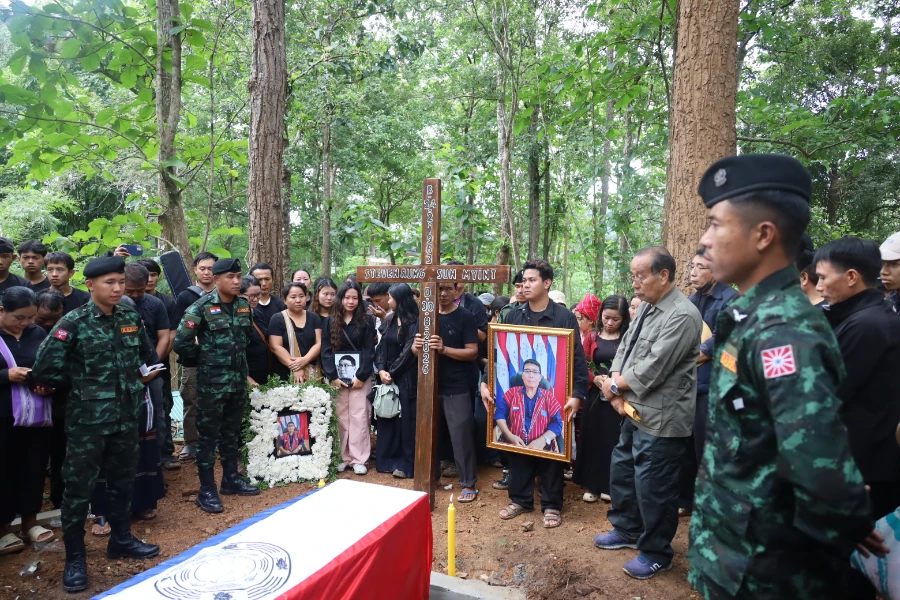
Once the funeral procession passed a border checkpoint from Thailand into the jungles of Myanmar, the road changed abruptly. The path connecting the two countries became a deeply rutted dirt track, muddy and uneven beneath a thick canopy of tropical forest. Pickup trucks decorated with wreaths and flowers crawled along the narrow road, while mourners dressed mostly in black followed on foot. I was riding in one of the trucks. I had come to attend the funeral of Steven Aung San Myint, a senior leader of the Karenni National Progressive Party (KNPP), one of Myanmar’s oldest ethnic political organisations and part of the broad collection of forces now fighting the country’s military junta. Aung San Myint, 63, died of natural causes at a hospital in Chiang Mai. His funeral was held last Saturday in a village in Mae Hong Son Province in northwestern Thailand, close to the mountainous frontier with Myanmar. Hundreds of mourners gathered beneath temporary awnings erected for the ceremony. Most wore black, but among them were young Karenni women dressed in vivid red and pink traditional clothing. The hall where Aung San Myint’s coffin lay was draped in red, white, and blue and crowded with floral wreaths bearing the names of political organisations, resistance bodies, and civil society groups. But his final resting place was to be on the other side of the border, in the land he had spent much of his life fighting for. His coffin was therefore carried from Thailand along a route that, in a matter of minutes, crossed not only an international boundary but also between two very different political worlds: from territory administered by the Thai state into an area of Myanmar controlled by Karenni resistance forces. The funeral offered a rare glimpse of the extraordinary web of military, political, and civil society groups that has emerged around Myanmar’s long-running conflicts—and which has expanded dramatically since the military seized power in 2021. During the ceremony, a KNPP official announced that the group had received letters of condolence from a staggering 78 organisations. They came largely from ethnic armed organisations, resistance forces, and civil society groups that today form much of the backbone of the struggle against military rule. The scale of those relationships was visible around his coffin. Floral wreaths crowded almost every available space. Others were strapped to the sides and roofs of pickup trucks for the journey to the cemetery, their white, pink and yellow flowers standing out against the deep green of the forest. Among those sending condolences were some of Myanmar’s most powerful ethnic armed organisations: the Kachin Independence Army in the north, the Karen National Union in the southeast, the Arakan Army in the west and the Ta’ang National Liberation Army in the northeast. The National Unity Government (NUG), the parallel administration formed by lawmakers and activists opposed to the 2021 coup, also sent its condolences. Wreaths laid at the funeral of KNPP leader Steven Aung San Myint (Photo: Saw Reh / Myanmar Now) These organisations operate hundreds of kilometres apart. They have different histories, political ambitions, and relationships with one another. Some have been fighting the Myanmar military for generations; others emerged only after the coup. Yet here, in a remote corner of the Thai-Myanmar border, their representatives had gathered to honour a fellow traveller in a war that now appears to have no end in sight. One of them quietly told me that the prospects for the resistance were looking increasingly bleak—an assessment, he added, that some within the movement would rather not hear. Many had travelled from Chiang Mai and Mae Sot, two Thai cities that have become important centres for Myanmar’s exiled political networks since the coup. Among those attending were the NUG’s home affairs minister Lwin Ko Latt and finance minister Tin Tun Naing. Their presence also illustrated something about Thailand’s complicated relationship with the conflict next door. Thailand has recently faced criticism for what many Myanmar democracy supporters see as a pliant attitude towards the military regime, particularly after the Thai government welcomed junta leader Min Aung Hlaing with considerable ceremony. But the reality along the border is more complicated. Thailand continues, in practice, to provide a sanctuary for large numbers of people connected to the anti-junta movement. Political activists, civil society organisations, journalists, and representatives of resistance groups operate from Thai territory, particularly in the northern provinces. This cannot be understood simply as a matter of Bangkok’s foreign policy. The border itself has never been as clean as the line drawn on a map. Karenni, Karen, and other ethnic communities have lived for generations in mountains and villages straddling what are now Thailand and Myanmar. Families, trade routes, political movements, and armed organisations have long moved through this terrain. A harsher Thai policy towards the border could therefore disrupt communities in ways that extend well beyond politics. The route we travelled in Mae Hong Son showed how this works in practice. The Thai side of the crossing was guarded by Thai soldiers. On the Myanmar side, the adjoining terrain was controlled by Karenni forces, which maintained a military base nearby. By the time the funeral cortege approached the border, it included hundreds of mourners. The Thai soldiers watched us pass. Nobody asked for my passport. As far as I could see, they did not check the identity of anyone else either. Hundreds of us crossed into Myanmar and, hours later, crossed back into Thailand the same way. On the Myanmar side, mourners left the vehicles and carried wreaths up a steep forest path to the cemetery, where the burial took place beneath the trees. Mourners with wreaths climb a path inside Karenni State (Photo: Saw Reh / Myanmar Now) Karenni women in
Original source
Myanmar Now