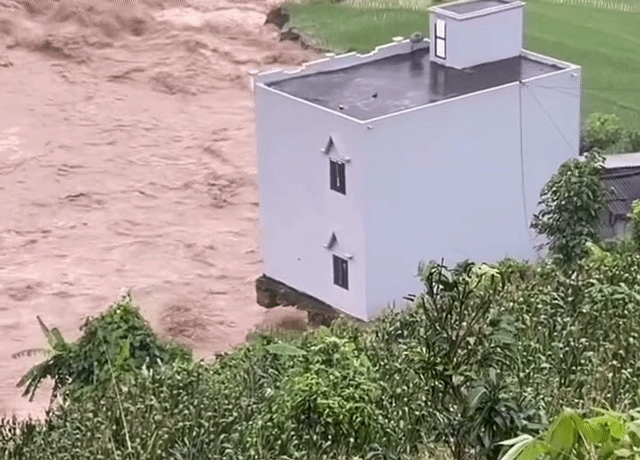
Floodwaters Swallow Two-Story House in Northern Vietnam Amid Heavy Rains
Record rainfall in northern Vietnam has led to a house being swept away in Lao Cai Province. The incident highlights infrastructure vulnerabilities and the challenge of adapting to extreme weather events driven by climate change.
At around 8:15 a.m. on July 8, a family of six in Giao Chan Hamlet, Khong Lao Commune, Lao Cai Province, narrowly escaped their two-story home just minutes before it tilted sharply and toppled into the Nam Lum Stream. The house, situated on a branch of the stream, succumbed to the relentless erosion of its foundation after three days of heavy rain caused the water levels to rise significantly. According to an official from the commune's People's Committee, the sustained rainfall, a consequence of a low-pressure trough, has wreaked havoc across Lai Chau Province. The downpour damaged 24 houses and inundated nearly 10 hectares of rice and vegetable crops. An additional 11 hectares of crops and 0.8 hectares of aquaculture facilities were also ruined, as reported by the province's Department of Dyke Management and Disaster Prevention. The severe weather has not only impacted residential areas but also crippled transportation networks. Landslides have blocked sections of National Highways 4D, 4H, and 12, underscoring the fragility of the region's infrastructure. Rainfall data highlights the intensity of the storm. Mong Cai in Quang Ninh Province recorded an astonishing 580 mm of rain over three days, followed by Doan Tinh with 572 mm and Quang Lam with 541 mm. In Lai Chau, Hua Bum logged 396 mm, Nam Pam in Son La Province received 356 mm, and Huoi So in Dien Bien Province recorded 272 mm. Specific hourly and daily totals further illustrate the deluge. From 7 p.m. on July 7 to 8 a.m. on July 8, Quang Lam registered 273 mm, the Tan Binh reservoir 250 mm, and Ban Lang 2 in Lai Chau 141 mm. In the six hours leading up to 8 a.m. on July 8, Ban Lang 2 recorded 136 mm and Cam Pha in Quang Ninh 101 mm, according to the National Center for Hydro-Meteorological Forecasting. The center forecasts continued precipitation, with 20 to 40 mm expected across the mountains and midlands of northern Vietnam and Quang Ninh through the night of July 8, potentially exceeding 100 mm in some locations. Other parts of the north are predicted to receive 10 to 30 mm, with amounts topping 70 mm in spots. With the ground already near saturation, the center has issued a stern warning about the heightened risk of flash floods and landslides in Lai Chau, Lao Cai, Tuyen Quang, Thai Nguyen, and Quang Ninh provinces. The incident serves as a stark reminder of the increasing challenges posed by extreme weather events in Vietnam, exacerbated by climate change.
多角的分析
ベトナム北部で発生した豪雨による住宅流出とインフラ被害は、短期的な経済的損失に加え、長期的なインフラ投資の必要性を浮き彫りにした。特に、河川沿いの開発や既存インフラの老朽化対策は喫緊の課題であり、気候変動への適応策を組み込んだインフラ投資計画の策定が求められる。これは、ベトナム政府が掲げる持続可能な開発目標達成に向けた重要なステップとなる。
今回の災害は、ベトナム北部、特に山岳地帯や河川沿いに投資を行う際のインフラリスクを再認識させるものとなった。製造業や農業分野への投資を検討している投資家は、サプライチェーンの寸断リスクや、災害復旧にかかるコスト増加の可能性を考慮する必要がある。政府によるインフラ強化策や、気候変動への適応策への投資動向は、今後の投資判断において重要な指標となるだろう。
ラオカイ省での住宅流出は、気候変動による異常気象が人々の生活基盤を直接的に脅かす現実を示している。特に、インフラ整備が遅れている地方部では、住民の安全確保が喫緊の課題となる。政府は、災害リスクの高い地域への新規開発抑制や、住民の移転支援、早期警報システムの強化など、より実効性のある対策を講じる必要がある。SNS上では、被災者への支援を呼びかける声も上がっており、地域社会の連帯も重要となる。
今回の豪雨被害は、ベトナム国民、特に地方に住む人々の生活の脆弱性を浮き彫りにした。インフラの老朽化や、気候変動による異常気象への対応の遅れは、人々の生命や財産を危険に晒している。政府は、単なる経済成長だけでなく、国民の安全・安心な生活を守るためのインフラ整備や防災対策に、より一層注力する必要がある。被災者への迅速な支援と、今後の同様の被害を防ぐための具体的な対策が求められている。
背景・歴史的文脈
ベトナムは、メコンデルタ地域を中心に、海面上昇や塩害、そして近年頻発する豪雨や台風による洪水・土砂災害といった気候変動の影響に脆弱な国である。特に北部山岳地帯では、急速な開発に伴う森林伐採や、不適切な土地利用が土砂災害のリスクを高めている。政府は、インフラ整備を経済成長の柱の一つとして推進してきたが、その多くは都市部や主要幹線道路に集中しており、地方部や脆弱な地域における防災インフラの整備は遅れがちである。今回のラオカイ省での住宅流出は、こうした構造的な課題が、異常気象によって顕在化した事例と言える。
原文ソース
VnExpress International