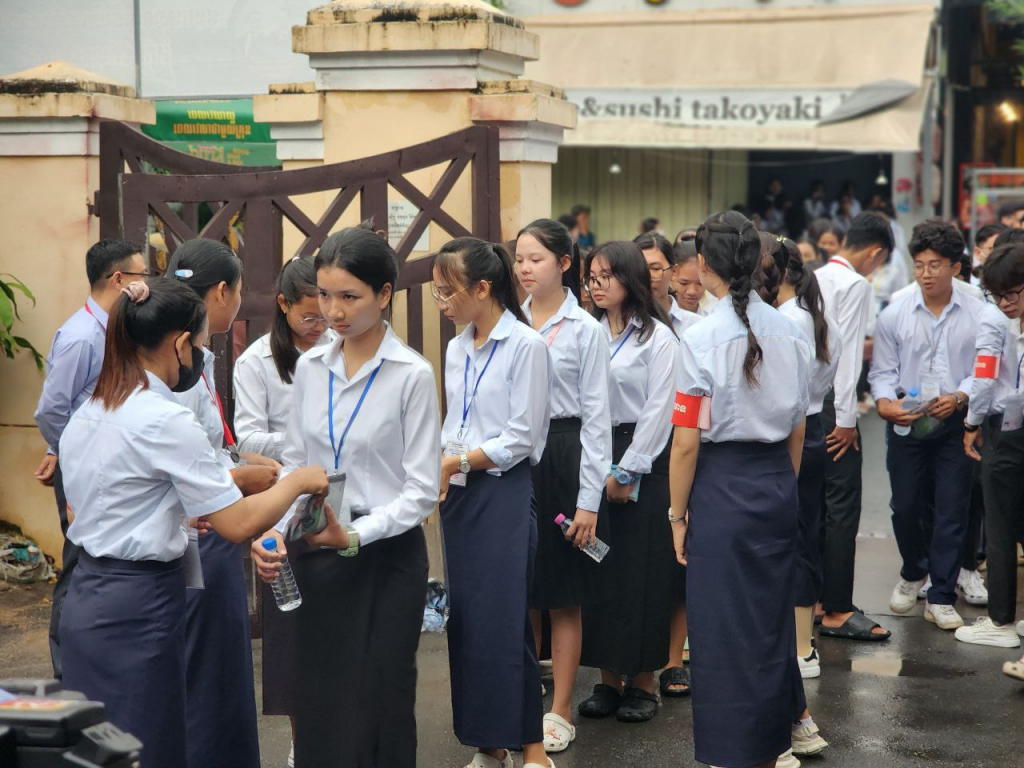
Cambodia Bans 17 Acts of Misconduct in High School Exit Exams; Minister Directs Strict Implementation
The Ministry of Education, Youth and Sports in Cambodia has reminded candidates for the High School Exit Exam (Bak Doep) on August 10 to strictly adhere to 17 prohibited acts, aiming for a fair and transparent examination process.
This article requires PRO
This article is outside the free access window or is a special report. PRO unlocks it and the full archive.
Related articles
- Cambodia Reaffirms Stance on Border Issue with Thailand, Emphasizing Sovereignty
Prime Minister Hun Manet reaffirmed the Cambodian government's stance on the border conflict with Thailand, emphasizing continued efforts to normalize the situation for people in affected areas. He stated that Cambodia did not seek war but acted to defend its rights and territorial integrity.
- Hun Sen Urges Cambodian, Lao Youth to Deepen Solidarity and Exchanges
Cambodian Senate President Samdech Techo Hun Sen encouraged Cambodian and Lao youth to strengthen solidarity and exchanges during a meeting with Lao People’s Revolutionary Youth Union Secretary-General Thongly Sisoulith. The call comes amid the 70th anniversary of diplomatic ties between the two nations.
- KOICA and CDC Consult on New Country Partnership Document for 2026-2030 to Strengthen Long-Term Strategic Development Cooperation
The Korea International Cooperation Agency (KOICA) Cambodia office and the Council for the Development of Cambodia (CDC) held consultations on the new Country Partnership Document (CPD) for 2026-2030. This aims to strengthen long-term strategic development cooperation between the two countries. The consultations involved exchanging views on KOICA's proposed 5-year strategic cooperation framework and ensuring alignment with Cambodia's national development priorities.
- Cambodian Government Emphasizes 'Light of Truth' to Maintain Public Trust Amidst Disinformation
The Cambodian government has stressed its commitment to maintaining public trust through the 'light of truth' in response to disinformation spread by a small group of extremists. A government spokesperson asserted that factual information dispels the breeding ground for fake news and solidifies public confidence in the administration, aligning with development goals to become a high-income nation by 2050.