General articles are free for 24 hours after publish.
Vietnam Advances Integrated Marine Governance to Unlock Blue Economy Potential
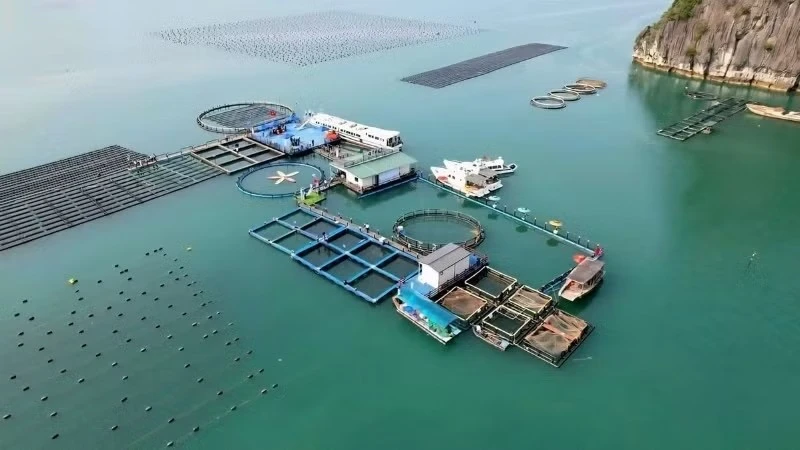
Vietnam is enhancing its marine spatial governance, underpinned by science, technology, and international cooperation, aiming to ensure sustainable development of marine resources and secure long-term development space. The country is focusing on high-value product development in fisheries, aquaculture, and processing to unlock the potential of its blue economy.
When marine spatial governance is implemented through effective cross-sectoral coordination, strengthened by science and technology and supported by expanded international cooperation, the sea will become not only a resource to be exploited but also a long-term development space for the nation. With a coastline stretching nearly 189 kilometers, featuring a network of straits, bays, lagoons, and seaports with significant development potential, Dak Lak is well positioned to advance its marine economy, particularly through the harvesting, aquaculture, and processing of high-value seafood products. The 14th Party Central Committee on July 22 considered proposals on building a disciplined, safe, civilised, harmonious and development-oriented society, and developing a national security strategy, as well as discussed the establishment of Quang Ninh and Bac Ninh as centrally-governed cities. As an active WTO member, Vietnam has been making active contributions to the organisation's agenda, including ratifying the first phase of the Agreement on Fisheries Subsidies, negotiating entry into the expanded Information Technology Agreement (ITA2), and preparing for its next Trade Policy Review scheduled for late 2026, Deputy Prime Minister Nguyen Van Thang said. Shipbuilding is increasingly viewed as an important component of Vietnam's marine economy. More than simply a manufacturing sector, it forms part of an integrated industrial ecosystem closely linked with metallurgy, mechanical engineering, electrical and electronic industries, automation, information technology and maritime logistics. The State Bank of Vietnam set the daily reference exchange rate at 25,306 VND/USD on July 28, up 13 VND from the previous working day. Resolution No. 10-NQ/TW, issued by the Politburo in 2026 on the development of the foreign-invested sector, identifies foreign direct investment (FDI) as “an important component of the national economy” and “a key driver of economic development and international integration.” The story of Vietnam’s economy in 2026 is not just one of faster GDP growth. It is about higher productivity, industrial upgrading, stronger capital formation, and a more prominent role in Asia’s strategic economic landscape. With measures revolving around investment in integrated logistics infrastructure, multimodal transport expansion and digital transformation acceleration, the strategy is intended to reduce logistics costs, enhance competitiveness and support sustainable growth in external trade. If the Central Highlands harvest proceeds smoothly and pending issues related to growing-area and packing-house codes are resolved promptly, exports could generate an additional 2 billion USD in the remaining months of the year, pushing the whole-year figure beyond 4 billion USD, up from 3.8 billion USD last year. The ministry has taken steps to immediately inspect locations reporting shortages and identify the cause. Localities where shortages are taking place must examine the entire supply chain, including contracts between retailers and wholesalers, actual supply volumes, delivery schedules and the reasons for any failure to provide fuel. This progress has been built on mutual respect, transparency and Vietnam's sustained efforts to improve its legal framework and comply with international standards. However, the US' recent tariff decision appears to overlook realities regarding Vietnam's labour environment and manufacturing practices. According to the Airports Corporation of Vietnam (ACV), after 14 months of construction, the cement concrete pavement for the runway and taxiways has been substantially completed. Contractors are mobilising hundreds of workers and construction equipment to finish the remaining works on schedule. Issued on July 24, Resolution No. 66.23/2026/NQ-CP amends and supplements a number of provisions in the 2022 Law on Anti-Money Laundering and related guiding documents. The revisions focus on key areas, including the definition of beneficial ownership, verification of customer information, transparency of legal arrangements, risk-based customer classification and the frequency of updating customer information. With Hanoi's overall GRDP growing by 8.2% during the period, the digital economy contributed approximately 1.1 percentage points to the city's economic expansion, underscoring its increasingly substantive role in driving growth rather than remaining merely a policy objective. Sun PhuQuoc Airways (SPA) on July 25 operated its inaugural Singapore - Phu Quoc flight, marking the airline's fourth international route and making it the first full-service carrier to fly directly between two of Asia's most celebrated island destinations. VIS 2025 enabled Nordic businesses to directly explore Vietnamese suppliers while facilitating deeper engagements with management agencies, localities, industry associations, seaports, factories and logistics partners. The programme showed that Vietnam-Nordic cooperation is expanding beyond trade to supply-chain development, investment, logistics and digital transformation. Viewed from above, Runway No. 2 has taken clear shape within the overall layout of Phu Quoc International Airport. Measuring 3,300 metres long and 45 metres wide, the new runway has been built parallel to the existing one. Its pavement and markings have been completed, and the project is now undergoing final technical inspections. At night, the lighting system has been switched on at full intensity for testing. With the current trading band of +/- 5%, the ceiling rate applicable for commercial banks during the day is 26,558 VND/USD, and the floor rate 24,028 VND/USD. VASEP said Brazil had become the fastest-growing market for Vietnamese tilapia, helping drive export growth as global demand for whitefish continues to increase. A key proposal is to introduce a mechanism to regulate windfall gains from differences in land values, while imposing high taxes on vacant land and property transactions conducted within a short period. India is one of Vietnam’s leading economic partners in South Asia and its eighth-largest trading partner of the Southeast Asian nation. Bilateral trade accounts for about 80% of Vietnam’s total trade with other South Asian countries. Meanwhile, Vietnam is currently India’s 22nd-largest trading partner globally and the fourth-largest in ASEAN. Vietnam has some of the world’s largest bauxite resources, with total reserves estimated at 5.8 billion tonnes, concentrated mainly in the Central Highlands. Copyright, VietnamPlus, Vietnam News Agency (VNA) Editor-in-chief, Mr. Tran Tien Duan.
Original source
VietnamPlus English