Cambodia and Japan Unite: 800 Participate in Tree Planting to Protect Angkor Heritage
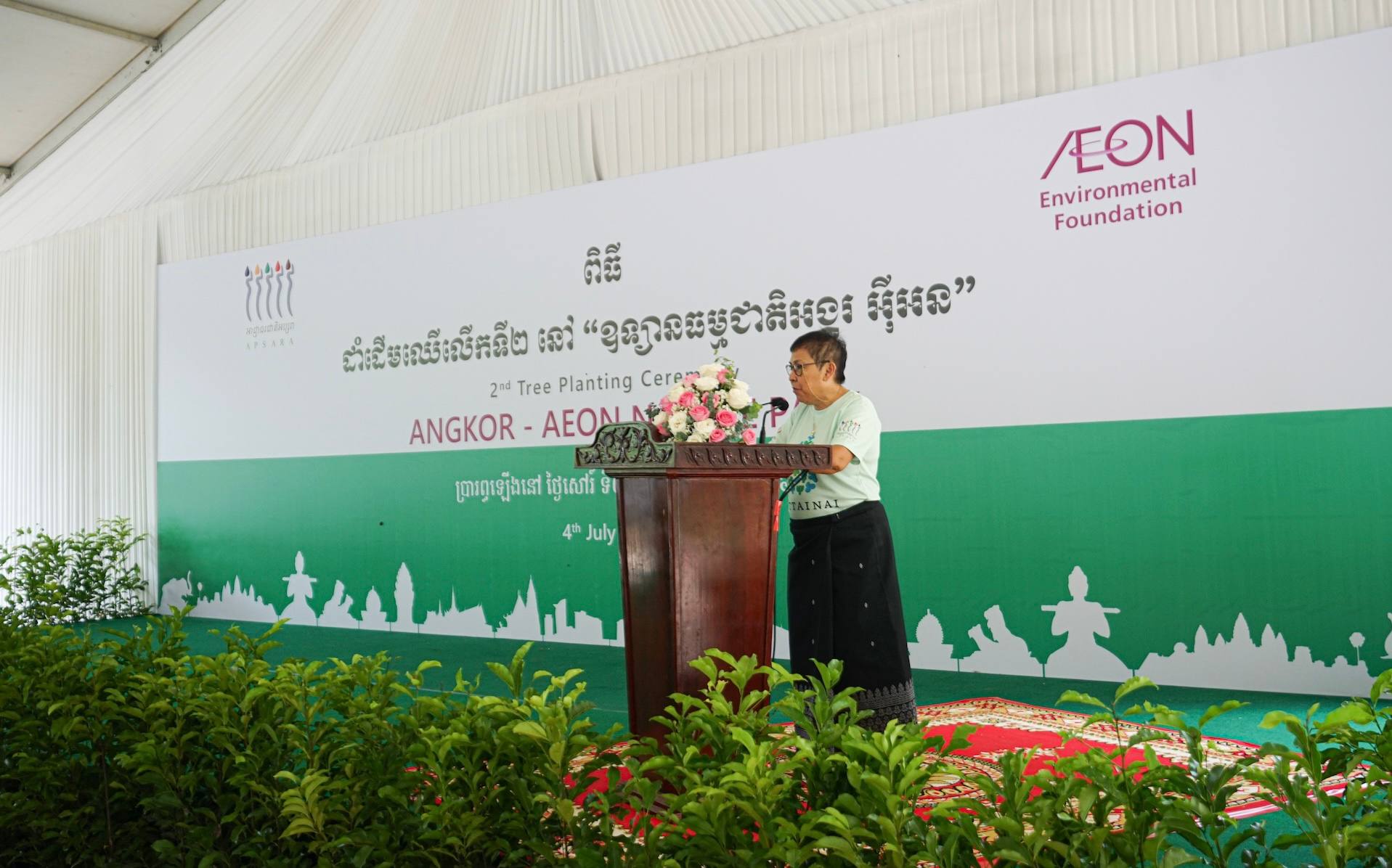
Cambodian Minister of Culture and Fine Arts, Dr. Pheung Sakona, and the Japanese Ambassador to Cambodia, along with 800 Cambodian and Japanese participants, planted approximately 10,000 saplings of over 20 varieties in the Angkor-AEON Natural Park on July 4, 2026, to protect World Heritage site. The event was organized by the AEON Environmental Foundation.
On July 4, 2026, Dr. Pheung Sakona, Minister of Culture and Fine Arts of Cambodia, and the Japanese Ambassador to Cambodia, along with 800 Cambodian and Japanese participants, jointly planted approximately 10,000 saplings of over 20 varieties in the Angkor-AEON Natural Park. The event, organized by the AEON Environmental Foundation, aimed to protect the World Heritage site of Angkor. Minister Dr. Pheung Sakona stated that this second tree-planting event serves as further evidence of the model cooperation between the private sector and government institutions in strengthening and expanding the green area of the Angkor resort, fully responding to the priority principles of Angkor conservation, where continuing to plant new trees and care for old forests is their work approach. The Minister of Culture affirmed that in addition to the conservation and restoration work of hundreds of ancient temples in the Angkor area, the Authority for the Protection and Management of Angkor and the Region of Siem Reap (APSARA National Authority) is also focusing on sustainable development, restoring and valuing ancient irrigation systems and natural resources for the benefit of both the conservation of ancient temples and the people living in the World Heritage site area. Concurrently, Minister Dr. Pheung Sakona added that to date, the APSARA National Authority has cultivated and distributed approximately 3 million saplings of various species within the Angkor Park to the public free of charge. This includes cooperation with AEON Company for forest cover restoration in the past, as well as today's event. Minister Dr. Pheung Sakona highlighted that in the Angkor area, trees, beyond their role in attracting rainfall, maintaining underground water sources, absorbing carbon dioxide to produce oxygen, and providing shade for the benefit of communities and national/international tourists, also play a crucial role in protecting ancient temples. This is because Khmer ancient temples are built on sandy foundations, which require underground water and rainwater to maintain and fill the canals, moats, barays, and ancient embankments surrounding them. This process keeps the temple foundations moist and stable, preventing collapse. According to Mr. Motoya Okada, President of the AEON Environmental Foundation, this tree-planting project is a five-year initiative starting in 2025, with the goal of protecting the World Heritage site from the impacts of wind and rain, as well as conserving biodiversity. The first tree planting in 2025 had over 800 participants from Japan and Cambodia, and this second event, planting 10,000 trees, saw approximately 1,000 participants. He further stated that the foundation will continue to actively participate in environmental protection activities, including tree planting, to preserve the rich natural environment for future generations. Tree planting with volunteers has also taken place in other areas of Cambodia since 2002, including at Chau Srei Vibol Temple, along the road leading to Angkor Wat Temple, in the Siem Reap forest park, at the Preah Norodom Sihanouk-Angkor Museum, at Phnom Tamao Zoo and Wildlife Rescue Center in Takeo Province, and at other locations. The AEON Environmental Foundation, established 36 years ago, focuses on environmental protection and has planted over 12.87 million saplings worldwide to protect the environment, restore forests, and conserve biodiversity. In addition, the AEON Foundation supports the prosthetic center in Battambang Province, the construction of 151 schools, donations to the Preah Norodom Sihanouk-Angkor Museum, and clean water campaigns. Trees also act as a protective barrier against climate change, the erosion of temple stones, and natural disasters such as storms and floods. Trees and green spaces are integral to the cultural landscape and an inseparable component of Angkor's Outstanding Universal Value. Source: CPP Cambodia
多角的分析
イオン環境財団による植樹活動は、カンボジアの観光産業と環境保全への投資として評価できる。世界遺産アンコール遺跡群の持続可能な保全は、長期的な観光収入の確保に不可欠であり、こうした取り組みは地域経済の安定に寄与する。また、イオングループのCSR活動は、企業イメージ向上だけでなく、地域社会との良好な関係構築を通じて、将来的な事業展開におけるリスク低減にも繋がる可能性がある。
この植樹活動は、直接的な投資リターンを期待するものではないが、カンボジア、特にアンコール地域への投資環境の安定化に間接的に貢献する。世界遺産としての価値維持は、観光客誘致の基盤となり、ホテル、レストラン、運輸業など関連産業への投資魅力を高める。イオングループ自身も、カンボジアで長年にわたり事業を展開しており、地域社会への貢献を通じて、その事業基盤を強化していると見られる。
今回の植樹祭には、カンボジア国民と日本国民が共に参加し、世界遺産保護という共通の目標に向かって協力した。これは、両国間の文化交流を深め、地域社会の連帯感を育む貴重な機会となった。特に、イオン環境財団が過去20年以上にわたりカンボジア各地で植樹活動や地域支援を行ってきた実績は、地域住民の生活環境改善や環境意識の向上に貢献している。子供たちへの環境教育の機会としても機能していると考えられる。
アンコール遺跡群周辺の住民にとって、植樹活動は直接的な生活改善に繋がるものではないかもしれないが、将来的な観光資源の保護、ひいては地域経済の安定に繋がるという期待感はあるだろう。また、イオン環境財団が地域に根差した活動を継続していることは、地域社会との信頼関係を築き、安心感を与える要因となっている。より多くの市民が環境保全活動に参加する機会が増えることで、地域全体の環境意識の向上も期待される。
背景・歴史的文脈
カンボジアの世界遺産アンコール遺跡群は、その文化的・歴史的価値の高さから、多くの観光客を惹きつける一方で、自然環境の変化や観光客の増加による負荷、さらには気候変動による影響など、保存に向けた様々な課題に直面している。特に、遺跡の基礎を支える砂質の地盤は、水分の維持が不可欠であり、森林の減少は地下水位の低下を招くリスクがある。イオン環境財団は、2002年からカンボジアでの植樹活動を継続しており、過去には森林被覆の回復や生物多様性の保全を目的としたプロジェクトを複数実施してきた。今回の活動は、こうした長年の取り組みの一環であり、カンボジア政府(文化・芸術省、アプサラ機構)や在カンボジア日本大使館との連携を強化し、遺跡保全に向けた国際的な協力体制を推進するものである。
原文ソース
CPP Cambodia