General articles are free for 24 hours after publish.
Dak Lak Province Strengthens Border Sovereignty and External Information Dissemination
Dak Lak Province held a training conference for local officials aimed at promoting border sovereignty and enhancing external information dissemination capabilities. This reflects Vietnam's emphasis on border management and international communication.
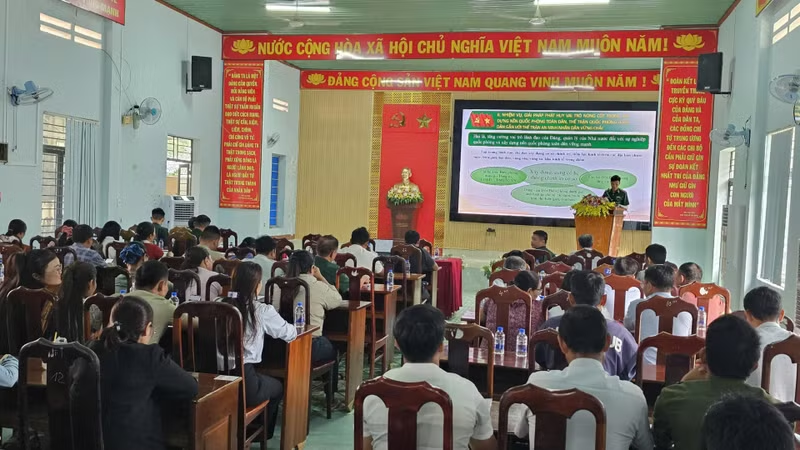
On September 23, 2026, in Dak Lak Province, in the Central Highlands of Vietnam, the Department of Culture, Sports, and Tourism, in coordination with the Border Guard Command of Dak Lak Province and the People's Committee of Buôn Đôn commune, a border commune, organized a conference on external information dissemination and border sovereignty propaganda. This conference aims to enhance information dissemination capabilities at the local level and raise public awareness regarding border sovereignty. Vietnam, under its one-party system, prioritizes social stability and national unity. The management of border areas and the promotion of sovereignty are considered extremely important from the perspective of national security and territorial integrity. In recent years, while achieving rapid economic growth, Vietnam has faced issues such as the South China Sea dispute with China, making border management and sovereignty assertion key pillars of its foreign policy. Under these circumstances, it is essential for local administrative officials to understand the importance of external information dissemination and become agents of sovereignty propaganda to accurately convey the nation's messages domestically and internationally. Previous reports indicate that Dak Lak Province and the Vietnamese Border Guard have actively engaged in community outreach and capacity building, including rescue operations for fishing vessels, support for learning Khmer, and organizing competitions for young propagandists. This conference is expected to further deepen these activities, aiming for a unified understanding and dissemination of the sensitive topic of border sovereignty among local residents and relevant agencies. Source: Nhan Dan
Original source
Nhan Dan