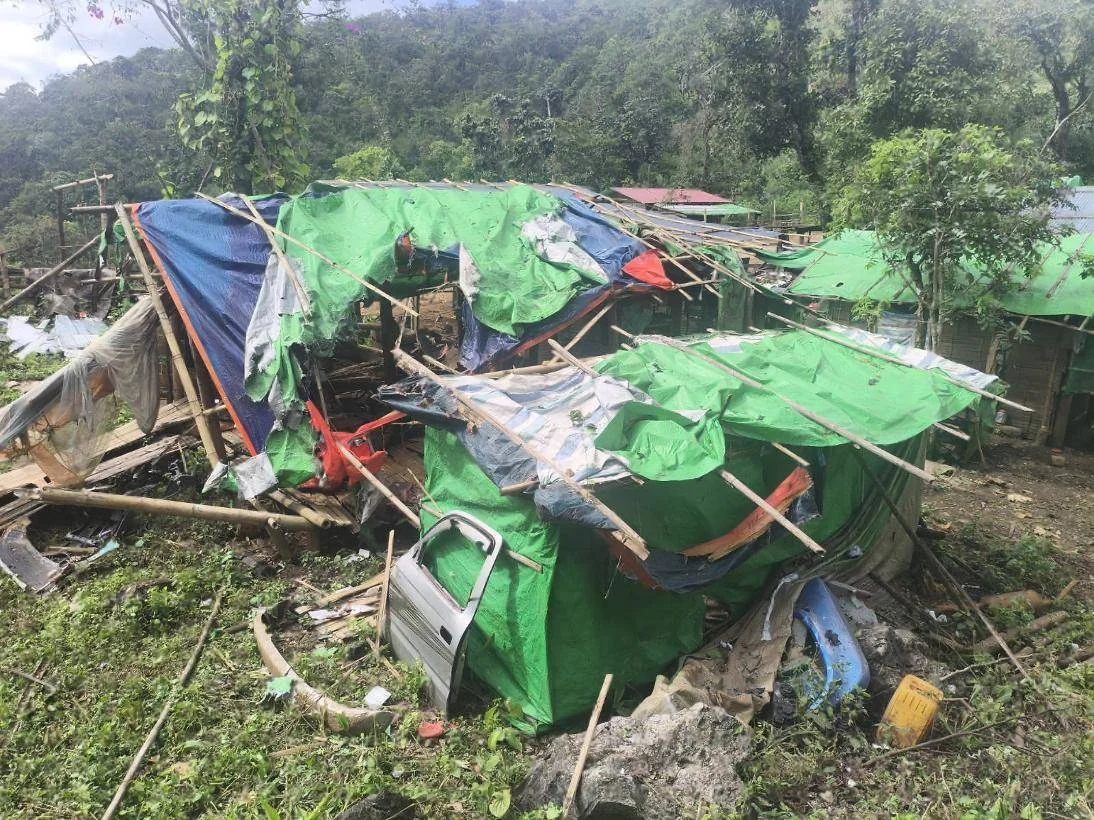
カレンニ州の主要イベントの月次概要 (10 月)
- PDF ファイルのダウンロード – カレンニの主要な出来事の月次概要 (10 月) 軍事政権、民間人への攻撃に自爆用ドローンの使用が増加 カンタラワディ・タイムズがまとめた記録によると、軍事政権は民間人に対する標的型攻撃に自爆用ドローンの使用を増やしている。 10月には民間人を狙った攻撃が少なくとも12件あり、民間人5人が死亡、20人が負傷した。
Read up to 3 eligible full articles per Japan day (JST) for free
Create a free account to open up to 3 eligible full articles per Japan calendar day (JST). Headlines and summaries remain available across ASEAN 7.
Related articles
- Thailand warns Myanmar military attaché ‘to exercise caution’ over border airstrikes
The Royal Thai Armed Forces’ Commander-in-Chief Ukrit Boontanon summoned the Myanmar regime’s military attaché to Thailand, Win Thu Lin, to his headquarters in Bangkok on Nov. 2 to urge Naypyidaw to exercise caution in i
- Shwe Kokko Phase II continues demolishing online scam hubs
THE government is plac- ing particular emphasis on working with neigh- bouring and regional countries to crack down on online scams and online gambling, which threaten global socioeco- nomic affairs and nation- al securi
- People’s Military Servicemen Honoured Upon Completing Service Term
PERSONNEL who served under People’s Military Service Training Batch 6, along with those granted service-term reductions, have successfully con- cluded their designated military tenures. To mark their service, honouring c
- The ASEAN Five Point Consensus has failed, but justice must not
ASEAN’s Five Point Consensus on Myanmar is dead. Only accountability can rescue it, and the Philippines can lead the way. Guest contributors Salai Za Uk and Chris Gunness More than five years ago, the Association of Southeast Asian Nations (ASEAN) promised the people of Myanmar a plan. It had five points: an end to violence, dialogue among all parties, a special envoy, humanitarian aid and an envoy’s visit. Min Aung Hlaing sat at the table in Jakarta, Indonesia, and agreed. Then he went home and ignored it. The killing continues. The dialogue never began. The aid is blocked or stolen. The Five-Point Consensus failed because it asked a man accused of atrocity crimes to police himself. This week, we test a different idea in an Appeals Court in Manila. Three years ago, five survivors from Chin State filed a criminal complaint at the Philippine Department of Justice. They accuse 10 junta members, Min Aung Hlaing among them, of war crimes: murdering civilians, mutilating bodies, burning homes, destroying churches and using aid as a weapon. One complainant is the daughter of Pu Ral Tu, a Baptist elder shot dead as he carried medicine to Thantlang, a town the junta destroyed in a mass arson attack. Another is the uncle of Pastor Cung Biak Hum, killed trying to put out the fires; his body was then mutilated. Three years on, they are still waiting. That is not a legal difficulty. It is a failure of political will. Their lawyers, Romel Bagares and Gilbert Andres, are appealing. The law is clear. The Philippines’ International Humanitarian Law Act obliges its authorities to prosecute war crimes wherever they are committed, once properly brought to their attention. It does not matter that the victims are not Filipino, or that the crimes happened in Chin State. The same provision was invoked against former president Rodrigo Duterte, handed over to the International Criminal Court and now facing justice in The Hague. If it applies to him, it applies to a foreign general whose troops commit atrocity crimes on an industrial scale. Anything else is a double standard. Universal jurisdiction is not an abstraction. Some crimes are so grave that no border can shelter those who commit them. For survivors in Myanmar, it is the only door not yet slammed shut. Meanwhile, ASEAN’s engagement with Min Aung Hlaing has a price, and the region is paying it. Look at the scam centres. Industrial fraud compounds in Myanmar’s border areas hold tens of thousands of people, many trafficked from across Asia and beyond, forced to cheat strangers worldwide. They flourish where the junta and its allied militias profit from lawlessness. Their victims come from your country; their money moves through your banks. Look at the drugs. Myanmar is the world’s largest opium producer, and its synthetic drugs flood Southeast Asia. Look at the refugees. The Rohingya, driven out in their hundreds of thousands in 2017, still languish in Bangladesh. Tens of thousands of Chin have fled into India. Every offensive pushes more people over a border. Engagement does not tame a criminal state. It lets it grow. Every handshake tells the generals that atrocity carries no cost, and that a seat at the region’s top table is theirs to keep. Impunity is a profitable business model, and ASEAN is underwriting it. The alternative is not isolation. It is accountability. Sanctions and statements have had their day, and so has patient diplomacy with the architects of the violence. The missing question is simple: how are those responsible to be brought to justice? The courts of ASEAN’s own member states can begin to answer. Cases are advancing in Indonesia and Timor-Leste, and the evidence gathered by the UN’s Independent Investigative Mechanism for Myanmar is ready to use. A prosecutor in Manila can open an investigation tomorrow. To the Philippine authorities: you have the law. You have the evidence. You have survivors who trusted your justice system with the worst moments of their lives. Act. They are fellow Christians. Their priests are being killed; their schools, churches and hospitals bombed from the skies. Hear their prayers. Have mercy. To ASEAN: stop waiting for the generals to keep their word. They never will. Back the courts. Support the survivors. Treat Min Aung Hlaing not as an interlocutor but as a suspect. The people of Myanmar do not want aid dependency or endless dialogue with their killers. They want their full political rights, including justice. Five points failed. More time brings more failure. What is needed is justice. Salai Za Uk is Executive Director of the Chin Human Rights Organisation (CHRO). Chris Gunness is Director of the Myanmar Accountability Project (MAP). DVB publishes a diversity of opinions that does not reflect DVB editorial policy. We’d like to hear what you think about this or any of our stories: [email protected] The post The ASEAN Five Point Consensus has failed, but justice must not appeared first on DVB.