Min Aung Hlaing's Laos Visit Widens ASEAN Divide
Diplomacy
2026年7月3日
4
The Diplomat Indonesia
Relations
🇮🇩Indonesia🇲🇲Myanmar🇰🇭Cambodia🇱🇦Laos🇨🇳China🌐United Nations / ASEAN

Min Aung Hlaing's Laos Visit Widens ASEAN Divide

AI サマリー

Myanmar's Commander-in-Chief Min Aung Hlaing made his first official visit to an ASEAN member state, Laos. This move is seen as a strategy to weaken ASEAN's unity and strengthen China's influence. Laos, like Myanmar, has high dependence on China, suggesting a move to deepen isolation within ASEAN.

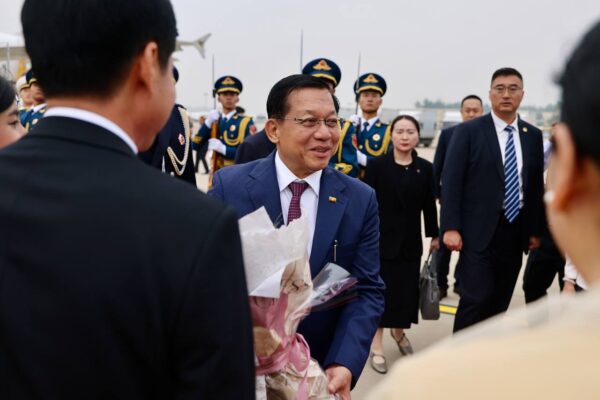
Myanmar’s “president” is embarking on his first official visit to an ASEAN country since his appointment in April. Min Aung Hlaing, the leader of Myanmar’s military-backed government, is greeted on his arrival to Beijing, China, Jun. 15, 2026. Shortly after the military-backed government in Myanmar thumbed its nose at the ASEAN chair and denied its request to meet with ousted leader Aung San Suu Kyi, the regime in Naypyidaw went one step further and announced that Laos was next on the agenda. No date was given for the first official visit to an ASEAN country by self-anointed President Min Aung Hlaing in the Global New Light of Myanmar, which said on July 1 that the visit would take place over the “next few days.” But official scribes across the border had a bit more to say. The state-run Vientiane Times announced that Min Aung Hlaing would make the trip during July 3-5 “to mark the 70th anniversary of the establishment of diplomatic relations between Laos and Myanmar,” after an invitation was extended by Lao President Thongloun Sisoulith. In denying access to Suu Kyi – and rejecting the proof of life campaign that has been launched by her son Kim Aris – and then traveling to Laos in an official capacity, Min Aung Hlaing has neatly driven a wedge into ASEAN, not unlike a lumberjack felling a tree. The fault lines within ASEAN have only widened ever since mainland countries Cambodia, Laos, and Myanmar, known as the “CLM Club,” were granted entry into the regional bloc in the late 1990s. Rifts with maritime ASEAN, including Vietnam, were often centered on the Code of Conduct in the South China Sea, where the CLM Club acted as a proxy and spoiler on China’s behalf. ASEAN’s relations with Naypyidaw then all but collapsed with Min Aung Hlaing’s coup in early 2021, which ousted Suu Kyi and tipped the country into a civil war that to date has claimed almost 100,000 lives. His stage-managed election that made him president has not been endorsed by ASEAN and a ban on his regime attending ASEAN summits remains in place. But Laos and Cambodia have stuck by Myanmar as all three countries emerged as havens for organized crime, with their ruling elites profiting off the back of ubiquitous human trafficking networks and industrial-scale scam compounds. Meanwhile, Thailand, by virtue of its geography, is stranded and squeezed by its mainland neighbors and has emerged as a flashpoint for ASEAN unity with its Cambodian border remaining closed. That follows last year’s six-month Thai-Cambodian border war that had its origins in a decision by former Cambodian Prime Minister Hun Sen to flout ASEAN doctrine and leak what was supposed to be a private conversation with his then Thai counterpart Paetongtarn Shinawatra. Unity within ASEAN is little more than an illusion but it is one to which ASEAN chairs, whether mainland or maritime, continue to cling, as the Philippines – the current chair – recently did with its resurrection of the Five-Point Consensus (5PC). The 5PC was ASEAN’s way of finding a resolution for the civil war in Myanmar but had slipped from view as the toll mounted amid the bloody carnage and bombing of civilians as Min Aung Hlaing ignored all international efforts to deliver some respite to his own people. In acknowledging the junta’s recent release of political prisoners and the transfer of Suu Kyi from jail to a “designated residence,” it was the Philippines’ foreign affairs spokesperson Dominic “Dax” Imperial who sounded optimistic, if out of date. “As Myanmar takes steps in a positive direction, we reiterate the importance of releasing all other prisoners, particularly the elderly and infirm, including Daw Aung San Suu Kyi,” he said. “Such actions are essential to advancing meaningful political dialogue as envisioned in the 5PC.” For more than five years the regime in Naypyidaw has ignored the 5PC and ASEAN attempts to end the conflict. That includes genuine efforts by Hun Sen, who once described Min Aung Hlaing as a “brother.” The former general has few friends he can count on and that’s why his first “official” ASEAN tour as a self-made president is to Laos, another one-party state that, like the military regime in Myanmar and the government in Cambodia, is heavily dependent on China. Min Aung Hlaing will continue his quest for legitimacy in defiance of most of ASEAN and much of the international community. But at the end of the day he can only return to a country where he is widely loathed for the carnage inflicted since his coup five years ago. An official trip to Phnom Penh may well follow. Subscribe today and join thousands of diplomats, analysts, policy professionals and business readers who rely on The Diplomat for expert Asia-Pacific coverage. Get unlimited access to in-depth analysis you won't find anywhere else, from South China Sea tensions to ASEAN diplomacy to India-Pakistan relations. More than 5,000 articles a year. Already have an account? Log in. Luke Hunt is a Southeast Asia correspondent for The Diplomat. He has spent three decades working in the region and produces the Beyond the Mekong podcast. He can be followed on Patreon and X – formerly Twitter. Get briefed on the story of the week, and developing stories to watch across the Asia-Pacific.

多角的分析

経済的影響

ラオスはミャンマーと同様に経済的に脆弱であり、中国への依存度が高い。ミン・アウン・フライン氏のラオス訪問は、経済的支援や貿易ルートの確保といった実利を伴う可能性があり、両国間の経済的結びつきを強化する狙いがあると考えられる。これは、ASEAN共通の経済基盤を弱め、中国主導の経済圏への編入を加速させる動きとも解釈できる。

投資家心理

ミャンマー軍事政権との関係強化は、ASEAN全体への投資リスクを高める要因となる。特に、人権問題や民主化の遅れは、ESG投資を重視する国際的な投資家にとって懸念材料となる。ラオスとの関係強化も、同様の懸念を共有する可能性があり、ASEAN地域への直接投資を躊躇させる可能性がある。

社会的影響

ミン・アウン・フライン氏のラオス訪問は、ミャンマー国内の政治的混乱と人権侵害に対する国際社会の懸念を無視する姿勢を改めて示すものだ。ラオス国民や、ミャンマーからの難民、あるいはミャンマー国内で人権侵害の被害に遭っている人々にとっては、さらなる不安定化や抑圧の懸念を高める可能性がある。また、ASEANの民主的価値観の共有という理念にも反する動きであり、社会的な分断を深める。

市民の声

ラオス国民は、ミャンマー軍事政権との関係強化が、自国の政治的自由や経済的自立にどのような影響を与えるか、懸念を抱く可能性がある。特に、中国への依存度が高まることで、国内の意思決定における主導権が失われることを危惧する声も出かねない。ミャンマー国民にとっては、軍事政権の国際的な孤立がさらに深まることを期待する一方で、ラオスとの連携強化が軍事政権の延命につながるのではないかという不安も抱くだろう。

背景・歴史的文脈

ミャンマーでは2021年2月、ミン・アウン・フライン氏率いる国軍がクーデターを起こし、民政移管を覆した。これに対し、ASEANは「5項目のコンセンサス」を採択し、暴力停止や対話の促進を求めたが、軍事政権はこれを無視。ASEANはミン・アウン・フライン氏の首脳会議への参加を禁止するなどの措置を取った。しかし、カンボジアやラオスといった一部の加盟国は、ミャンマー軍事政権との関係を維持し、ASEAN内の意見の相違が顕著になっている。今回のラオス訪問は、こうしたASEAN内の亀裂をさらに深め、中国の影響力を強めるための戦略的行動と見られている。

原文ソース

The Diplomat Indonesia

原文を読む