General articles are free for 24 hours after publish.
Cambodia Confirms Presence of Three Rare Wildlife Species, Boosting Conservation Hopes
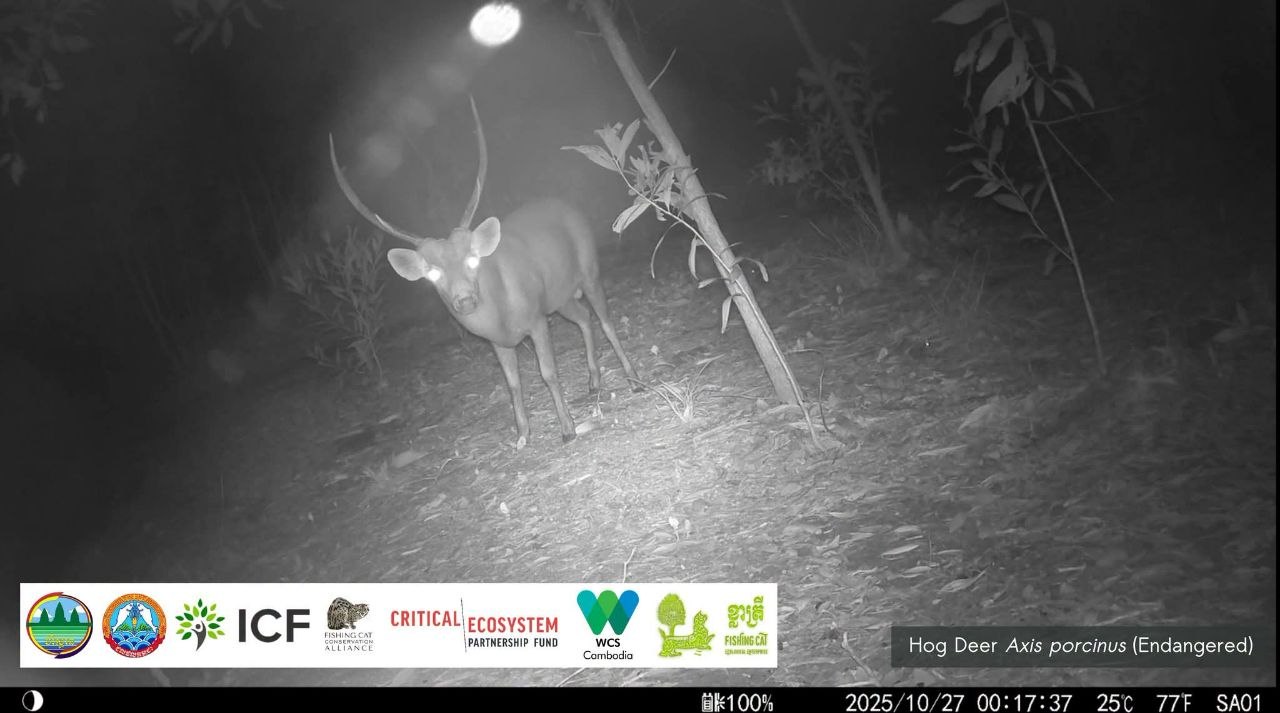
For the first time, three endangered species – the sambar deer, large civet, and Oriental pied hornbill – have been captured by automatic cameras in Cambodia's Koh Kong province. This marks a historic achievement for the country's biodiversity conservation efforts and provides significant momentum for future conservation initiatives.
In a historic achievement for Cambodia's natural resource conservation, three of the rarest mammal species – the sambar deer, large civet, and Oriental pied hornbill – have been recorded for the first time in the protected and conserved areas of Sre Ambel district, Koh Kong province, by automatic camera traps. This discovery has brought immense joy to all involved. The photographs and videos were captured between October 2025 and January 2026 during a research study using automatic camera traps in the area. This initiative was a collaborative effort between the General Department of Nature Conservation and Protection of the Ministry of Environment, the General Department of Fisheries of the Ministry of Agriculture, Forestry and Fisheries, Fishing Cat Ecological Enterprise Co., Ltd. (FCEE), and the Wildlife Conservation Society (WCS). The three species identified are all critically endangered or extremely rare. The sambar deer, last rediscovered in Kratie province in 2006, adds to the positive news. Notably, the Oriental pied hornbill is one of the rarest species globally, found only in Southeast Asia, yet little is known about its ecology. Its population is feared to be declining due to threats such as habitat loss, pollution, and illegal hunting. In Cambodia, past records have come from flooded forests in Tonle Sap Lake and mangrove forests along rivers in the Peam Krasaop Wildlife Sanctuary, Koh Kong province. The large civet, while experiencing a drastic global decline, is thought to have a significant population in Cambodia, with Mondulkiri province's Srepok Wildlife Sanctuary being one of its last potential strongholds. The first-ever record of a family unit – one adult and two young – in the Sre Ambel multi-use area is a rare and crucial piece of evidence for breeding activity. Ms. Vanessa Herranz Muñoz, Director of FCEE, stated that their mission focuses on the mangrove, highland, and scrub forests of the Sre Ambel river system to find rare species like the large civet and Oriental pied hornbill. She expressed pride in the discovery, which contributes to scientific knowledge and provides data for biodiversity conservation actions in the area. Mr. Chee Yoong, Woo, Species Coordinator for the IUCN, remarked on the excitement of finding such a rare and elusive species as the Oriental pied hornbill, adding that this record further substantiates Cambodia as a globally important habitat for this species. Mr. Ouk Vibol, Director of the Department of Fisheries Conservation, highlighted over 25 years of close collaboration between his department and conservation partners to protect the unique biodiversity of the Sre Ambel landscape. He noted contributions to the recovery and conservation of globally threatened species like the critically endangered Royal Turtle and Siamese Crocodile. He further stated that recent records of these mammals reinforce the national and international significance of the Sre Ambel wetlands and demonstrate that sustainable investment in habitat protection, scientific research, and robust cooperation with local communities continue to yield meaningful conservation outcomes. The Royal Government of Cambodia remains steadfast in its commitment to preserving vital freshwater and coastal ecosystems for future generations. His Excellency Kai Adith, Undersecretary of State and Spokesperson for the Ministry of Environment, emphasized that the Sre Ambel multi-use area in Koh Kong province is a vital coastal wetland ecosystem, featuring rivers, mangroves, peatlands, and mudflats that serve as habitats for key biodiversity, especially rare species. The recent discovery of three critically endangered species – sambar deer, large civet, and Oriental pied hornbill – reflects the Cambodian government's strong commitment to ensuring the survival of rare wildlife through the implementation of the Environment Sector Comprehensive Strategy 2023-2028, particularly Pillar 2 'Green,' which focuses on enhancing the effectiveness of natural protected area management, resource restoration, and law enforcement. Through the collaboration of the Ministry of Environment, Ministry of Agriculture, Forestry and Fisheries, Koh Kong Provincial Department of Environment, FCEE, members of the Natural Protected Area Community Committee, members of local fishing communities, and WCS, automatic cameras were installed to study biodiversity. The participation of local stakeholders indicates that residents in the area also recognize some of these species. These new species records, found within their natural riverine habitats, are significant for Cambodia, a national representative for species like the Royal Turtle. The results showcase Cambodia's success in conserving natural protected areas that are crucial habitats for critically endangered biodiversity. Source: AKP Khmer
Original source
AKP Khmer