General articles are free for 24 hours after publish.
Debunking Five Eyes Myths: Intelligence Cooperation Beyond the Headlines
The Five Eyes intelligence partnership is often misunderstood. Beyond technical cooperation, it relies on human networks and mutual trust, and its scope extends beyond a purely anti-China bloc, offering insights relevant from an Indonesian perspective.
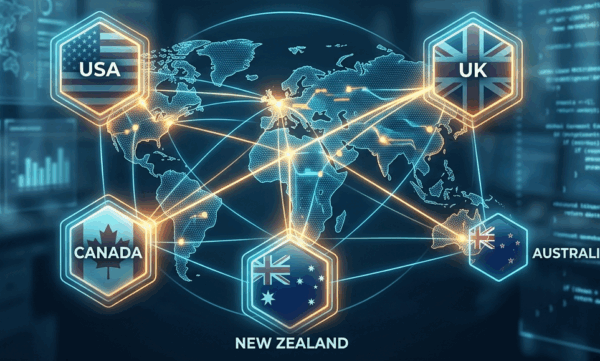
The intelligence partnership known as the Five Eyes—comprising Australia, Canada, New Zealand, the United Kingdom, and the United States—is often subject to persistent misunderstandings. Far from being solely a technical collaboration, its foundation lies in human networks and mutual trust. Originating in the mid-20th century, the intelligence agencies of these five nations have pooled their efforts across various domains, from cryptanalysis to cybersecurity. While U.S. agencies are dominant, the arrangement allows each partner to collect and analyze significantly more information than it could alone, underpinned by a high degree of mutual trust. However, recent years, particularly political shifts within the United States, have introduced strains. Canada was once threatened with exclusion from the Five Eyes for refusing to comply with U.S. tariffs, and the U.K. reportedly faced potential withdrawal of U.S. support for its sovereignty over the Falkland Islands due to its lack of enthusiasm for a U.S. assault on Iran. Partner nations have grappled with this new reality, with the U.K. reportedly suspending intelligence sharing on the Caribbean due to concerns about potential U.S. military misuse. Several myths surround the Five Eyes. Myth #1: It is purely technical. While technical cooperation on signal interception and analysis is central, the human factor—how professionals interpret, adapt to, and make use of tools, systems, and resources—is paramount. Shared workplaces foster social and institutional relationships that build professional solidarity, grounded in a common mission and interests that may not always align with shifting political priorities. Myth #2: It operates under strict oversight. Intelligence agencies, while often casting themselves as guardians of the free world, have repeatedly been embroiled in controversies over mass surveillance. These episodes expose a gap where oversight bodies often struggle to meaningfully restrain these agencies, while the agencies themselves continue to operate with limited accountability. Myth #3: It is a closed circle of five nations. The partnership extends beyond its core members, encompassing a network of "third-party" intelligence agencies across Europe and beyond. Long-standing relationships, such as those between Germany's Federal Intelligence Service (BND) and the U.S. National Security Agency (NSA), demonstrate this broader interoperability, often predating the global war on terror. Myth #4: It is an anti-China bloc. While Beijing frequently portrays the Five Eyes as a bloc aimed at containing China's rise, and China is indeed described as an "existential threat," the alliance is far less homogeneous than such portrayals suggest. New Zealand has appeared to resist the "Five Eyes-ization" of its foreign policy toward China, and Canada's prime minister has explored new strategic openings in Beijing. Myth #5: It is now breaking apart. By any reasonable measure, disruptions driven by the U.S. administration are bad news for the Five Eyes. History shows that political and strategic divergence can reduce intelligence sharing. Yet, day-to-day cooperation has stayed the course, with intelligence agencies navigating tensions between their respective governments. While the unpredictability of the current geopolitical moment makes assessing the future difficult, the reality of the Five Eyes is more complex and multi-layered than often portrayed. Source: The Diplomat Indonesia
Original source
The Diplomat Indonesia