General articles are free for 24 hours after publish.
Indonesia Revives World Mangrove Center Vision for Global Conservation
Indonesia is reviving its World Mangrove Center (WMC) initiative to foster global collaboration in mangrove conservation and restoration. Leveraging its vast 3.4 million hectares of mangroves, the largest globally, the center aims to address ecological preservation, coastal community livelihoods, and climate change mitigation. However, challenges like development pressure and pollution persist.
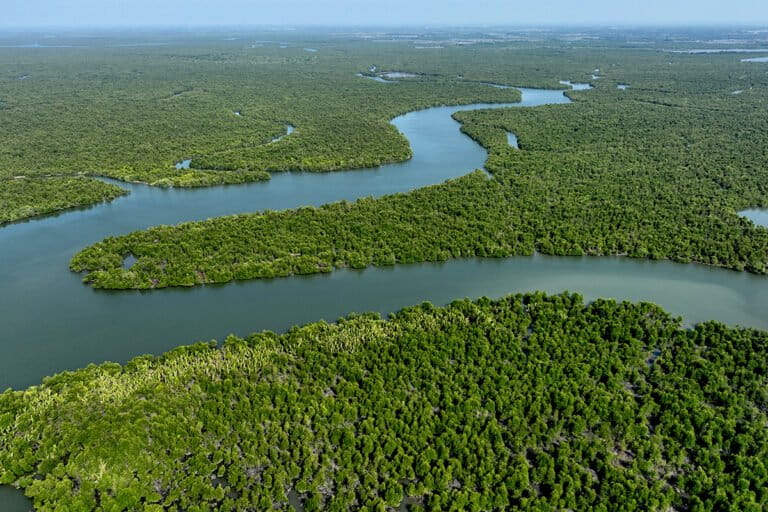
Indonesia is revitalizing a grand idea that had stalled for years: the establishment of a World Mangrove Center (WMC), a global collaboration hub for mangrove conservation and restoration. Dyan Murtiningsih, Director General of the Directorate General of Watershed Management and Forest Rehabilitation (Ditjen PDASRH) at the Ministry of Environment and Forestry, stated that the WMC concept is highly promising because Indonesia possesses an asset that is difficult for other countries to match. With approximately 3.4 million hectares of mangroves, Indonesia accounts for nearly a quarter of the world's mangrove area. Murtiningsih emphasized that mangroves are more than just a collection of trees along the coastline. They serve as natural barriers protecting shorelines, habitats for diverse flora and fauna, crucial carbon sinks, and sources of livelihood for millions of coastal communities. She explained that mangrove management has three inseparable dimensions: first, the ecological aspect, which focuses on maintaining biodiversity and the balance of coastal ecosystems; second, the socio-economic dimension, aimed at supporting community livelihoods and welfare; and third, the global dimension, contributing to climate change mitigation and adaptation. These coastal forests not only act as natural fortresses against erosion and storms but also harbor various species, absorb blue carbon, and sustain the livelihoods of millions. Murtiningsih described Indonesia's vast mangrove area as both a blessing and a significant responsibility. She cautioned that the challenges in mangrove management are increasingly complex, stemming from pressures on coastal areas, land-use changes, pollution, the impacts of climate change, and uneven institutional capacity across different regions. "Therefore, no single country, ministry, or organization can solve these issues alone. Strong scientific knowledge, appropriate policies, inclusive governance, sustainable funding, and genuine partnerships are needed," she stated during a Webinar Series. The revival of the WMC concept signifies Indonesia's ambition to play a leading role in global mangrove conservation efforts and strengthen international cooperation. However, its success will depend on overcoming domestic institutional challenges and regional disparities.
Original source
Mongabay Indonesia