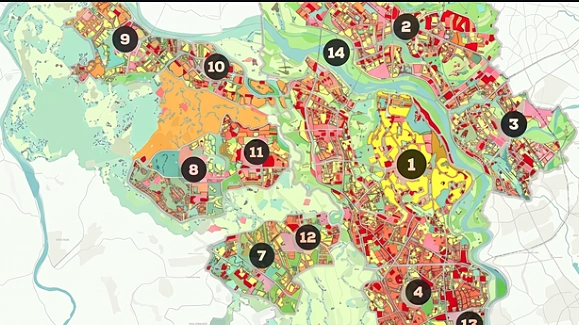
Hanoi Unveils 14 Future Urban Areas by 2045
Technology
2026年7月2日
5
VnExpress

Hanoi Unveils 14 Future Urban Areas by 2045

AI サマリー

Hanoi plans to develop 14 new urban areas, primarily in the west and south, by 2045, encompassing over half of the capital's total area. The vision focuses on science-technology, education, sports, and sustainable development.

Hanoi has unveiled an ambitious plan to develop 14 new urban areas by 2045, primarily focusing on the western and southern parts of the capital. This expansion will cover 176,708 hectares, accounting for over half of Hanoi's total natural area by 2045, and is projected to reach nearly 60% by 2065. The western region is slated to host six urban areas, including Hoa Lac, Xuan Mai, and Son Tay. Hoa Lac, in particular, is designated to become a hub for high-tech science, technology, and advanced education, with a special administrative function and a projected population of 0.8 million by 2045 on its 10,099-hectare site. In the central area, the Red River's riverside urban zone will maintain a stable area of over 45,300 hectares until 2065, expecting a population of 6.36 million by 2045. This zone will serve as the national and city's political and administrative center, aiming to preserve existing architectural values while establishing a financial center with unique mechanisms focused on public finance. The Red River corridor is envisioned as a spine for landscape, culture, history, and environment, featuring public facilities, parks, and tourism services. This area will develop 11,425 hectares by 2045, with a projected population of 1.2 million, aiming to create a modern, civilized, and ecological urban image that balances development with traditional identity. In the south, four urban areas are planned, including Olympic, Thuong Tin - Phu Xuyen, and Van Dinh - Dai Nghia. The Olympic urban area, spanning nearly 14,000 hectares, is expected to become an international-class sports complex, centered around a 135,000-seat stadium. It also aims to be a major new urban center at the southern gateway, driving socio-economic development through a Transit-Oriented Development (TOD) model, increasing high-rise buildings, reducing construction density, and expanding green spaces. Hanoi also plans to reserve approximately 3,000 hectares of land for future urban development in ten locations, including areas near major bridges and highway intersections. This strategic urban planning aligns with Vietnam's long-term development goals under its one-party system, aiming to manage rapid urbanization and economic growth.

多角的分析

経済的影響

ハノイの都市開発計画は、ベトナム経済の成長と構造変化を反映している。特に、科学技術ハブ、金融センター、そして国際的なスポーツ複合施設といった高付加価値産業への投資は、サービス業の拡大と雇用創出に寄与するだろう。また、TODモデルの導入は、インフラ投資の効率化と持続可能な都市交通システムの構築を目指すものであり、これは長期的な経済成長の基盤となる。しかし、大規模な開発には巨額の資金が必要であり、その調達方法と、開発に伴う不動産価格の高騰が、経済格差の拡大やインフレ圧力となる可能性も否定できない。過去の都市開発プロジェクトでは、資金調達の遅延や、計画と実行の乖離が課題となるケースも見られたため、本計画の着実な推進が経済成長に不可欠である。

投資家心理

このハノイの都市開発計画は、国内外の投資家にとって大きな機会をもたらす可能性がある。特に、インフラ、不動産、テクノロジー、教育、スポーツ関連分野への投資が期待される。ベトナム政府は、外国直接投資(FDI)を積極的に誘致しており、特別経済区やインセンティブ措置を通じて、投資環境の整備を進めている。しかし、ベトナムの法制度や規制の不確実性、土地利用権に関する複雑さ、そして予期せぬ政策変更のリスクは、投資家が慎重に検討すべき点である。過去には、一部の大型プロジェクトで、土地収用や許認可プロセスに遅延が生じ、投資家の期待に影響を与えた事例もあるため、綿密なデューデリジェンスが求められる。

社会的影響

ハノイの都市拡大計画は、市民生活に多岐にわたる影響を与える。新しい都市エリアの建設は、雇用機会の創出や生活水準の向上をもたらす可能性がある一方で、既存の居住者の移転や、開発地域周辺の環境変化といった課題も生じさせる。特に、開発が進む西部や南部では、農村部から都市部への人口流入が増加し、住宅、教育、医療などの公共サービスの需要が急増することが予想される。また、紅河沿岸の伝統的な景観の保全と、近代的な都市開発との調和は、地域住民のアイデンティティや生活様式に影響を与えるため、住民参加型の計画プロセスが重要となる。過去の都市開発では、開発による恩恵が一部の層に偏り、地域間の格差が拡大するケースも見られたため、包摂的な開発が求められている。

市民の声

ハノイの14の未来都市構想は、市民の生活に直接的な影響を与える。特に、開発対象地域に住む住民にとっては、土地の収用や移転、生活基盤の変化が懸念される。新しい都市エリアでは、現代的なインフラや公共サービスが提供されることが期待されるが、その恩恵が公平に分配されるかどうかが問われる。また、都市部への人口集中は、交通渋滞の悪化、住宅価格の高騰、そして公共サービスへのアクセス困難といった問題を引き起こす可能性がある。ハノイ市が掲げる「現代的で文明的、そして生態学的な都市」というビジョンが、すべての市民にとって実現可能なものとなるためには、住民の声を聞き、彼らの生活の質を向上させるための具体的な施策が不可欠である。例えば、開発地域に隣接する既存のコミュニティへの影響や、新しい都市部へのアクセス手段の確保などが、市民の不安を解消する上で重要になるだろう。

背景・歴史的文脈

ハノイの都市開発計画は、ベトナムが経済改革(ドイモイ)以降、急速な都市化と経済成長を遂げてきた歴史的文脈の中に位置づけられる。1986年のドイモイ政策導入以降、ベトナムは市場経済化を進め、特にハノイやホーチミンなどの大都市圏を中心に人口が集中し、インフラ整備の遅れが課題となっていた。2010年代以降、ハノイ市は持続可能な都市開発を目指し、マスタープランの策定を重ねてきた。今回の14都市構想は、2050年までの都市開発ビジョンを具体化するものであり、特に西部・南部の開発は、人口増加と経済活動の拡大に対応するための戦略的な取り組みである。これは、ベトナム共産党による長期的な国家開発戦略の一環であり、経済成長と社会安定の両立を目指す政府の意向を反映している。

原文ソース

VnExpress

原文を読む