General articles are free for 24 hours after publish.
Ho Chi Minh City Pushes for 'Mindset Shift' in Vocational Education Quality Improvement
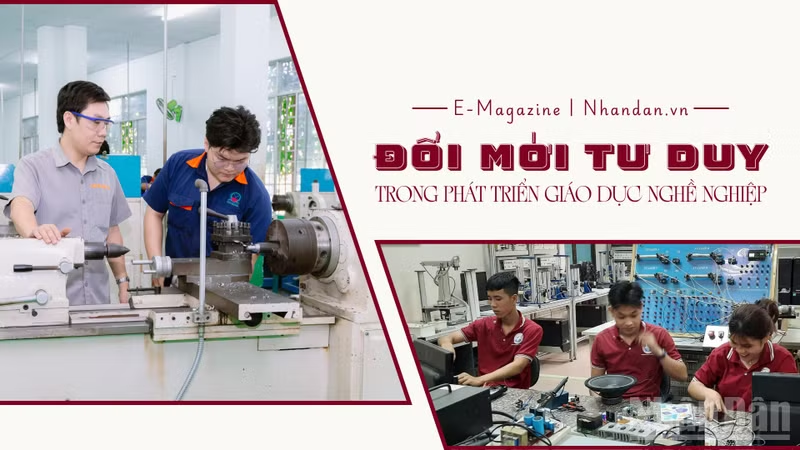
Ho Chi Minh City is promoting a 'mindset shift' to improve the quality of vocational education, in response to the Industry 4.0 era. The city is focusing on diversifying student pathways and strengthening vocational education in secondary and high schools, aiming to transform the educational system.
Ho Chi Minh City, the economic heart of Vietnam, is strongly promoting a 'mindset shift' in vocational education to cultivate high-quality human resources essential for the Industry 4.0 era. This initiative aims to enhance the supply of specialized personnel, which is crucial for sustainable economic development. The city is actively pushing for diversified student pathways and strengthening vocational education, particularly for students in junior secondary (THCS) and high school (THPT) levels. This approach seeks to provide diverse educational opportunities, enabling students to acquire specialized skills from an early stage, thereby improving post-graduation employment rates and accurately meeting industry demands. Expanding the network of educational institutions and improving the quality of education are also key pillars of this reform. Specific measures include introducing curricula aligned with the latest industrial trends, enhancing teacher skills, and investing in practical educational facilities. This will enable educational institutions to provide students with more advanced specialized knowledge and technical skills. In this context, Military Region 9 (Quân khu 9) is emphasizing the comprehensive improvement of national defense and security education. This highlights the importance of nurturing the ability of future generations to contribute to national security, given Vietnam's complex geopolitical situation. Ho Chi Minh City's vocational education reform is part of strengthening the foundation to support Vietnam's economic growth and technological innovation. It exemplifies investment in human capital within the nation's development strategy under its one-party system. Particularly as economic and geopolitical relations with China become more complex, enhancing domestic industrial competitiveness and self-reliance is an urgent task. The advancement of vocational education is positioned as a key means to address this challenge. Source: Nhan Dan
Original source
Nhan Dan