General articles are free for 24 hours after publish.
Last Artisan: 86-Year-Old Woman Preserves Indonesian Traditional Bark Cloth
In Indonesia's Central Sulawesi, 86-year-old Tobani Tiku is the sole preserver of the traditional bark cloth 'kumu nunu' of the Kulawi indigenous community, once used for daily wear and bedding. Her skilled craftsmanship in selecting materials and the intricate production process sustains a disappearing cultural heritage.
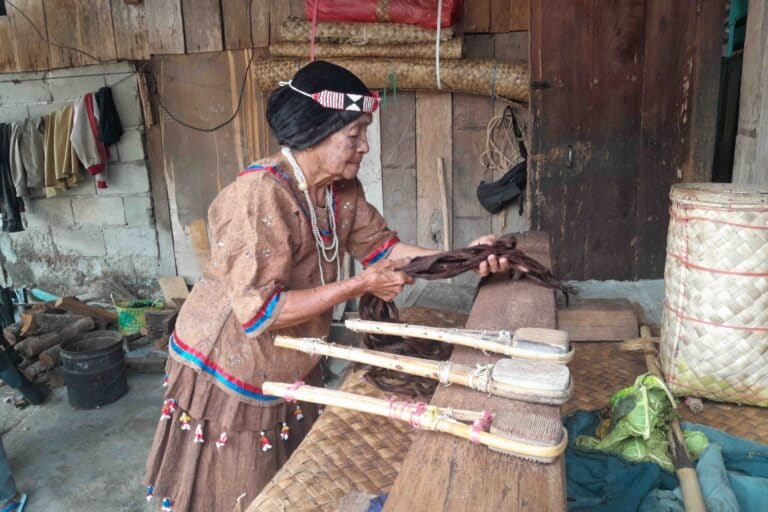
In Desa Mataue, Kecamatan Kulawi, Kabupaten Sigi, Central Sulawesi, Indonesia, 86-year-old Tobani Tiku spends her days from morning till evening pounding the bark of banyan trees behind her home. She is crafting 'kumu nunu,' a traditional bark cloth unique to the Kulawi indigenous community. Historically, kumu nunu served as daily attire, from work clothes in the fields to blankets. Today, the cloth is increasingly rare, worn only during traditional ceremonies. Tobani is the only woman in Kulawi who masters the entire production process. She learned the skill in her youth from her mother and grandmother. The primary material comes from the bark of red banyan trees, known as 'nunu lero,' or white banyan trees, called 'nunu bula.' Tobani, however, more frequently uses the red banyan. The harvesting of branches is not arbitrary. Branches are cut during the full moon and must grow pointing towards the sky or horizontally. Branches pointing downwards yield thinner bark with less favorable fibers. "If it's not the full moon, it's not potent," says Syafrudin, Tobani's son, who is responsible for collecting the branches. The branches are cut to lengths of 1.0 to 1.5 meters, then peeled, cleaned, and soaked for three days. Afterward, the bark is gently pounded until it widens and thins into cloth. Tobani also uses plant-based concoctions, such as 'linuro' and 'ulakau,' as natural dyes and preservatives. The cloth is made using four distinct pounding tools in sequence: 'pola,' 'ike tinahi,' 'ike tiva,' and 'ike pogea.' The latter three tools are made from special stones sourced from Desa Towulu. The tools Tobani uses are heirlooms from her grandmother and remain sturdy to this day. A set of clothing, consisting of a top and bottom, requires at least a week to produce and costs around Rp1.5 million (approximately $100 USD). The continuation of this traditional bark cloth making technique is vital for preserving the cultural diversity of the community, especially as modernization threatens many indigenous traditions.
Original source
Mongabay Indonesia