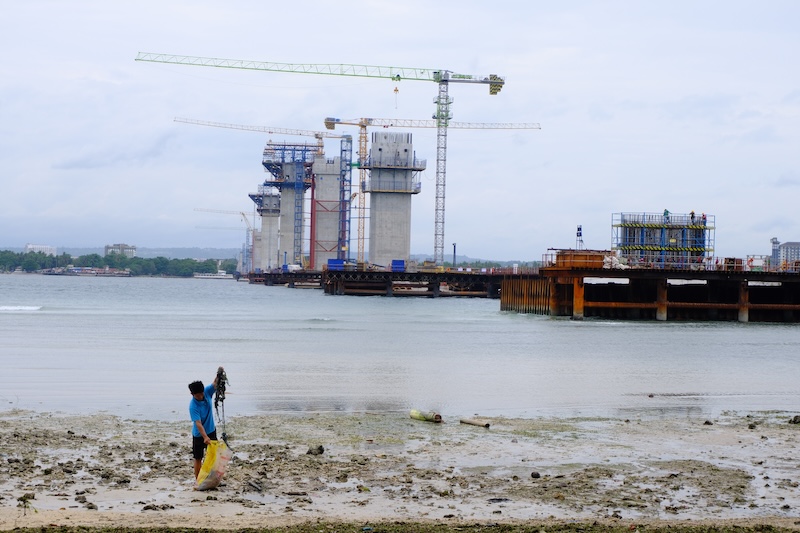
Samal Island-Davao Bridge Nears Completion, Environmental Accountability Still Under Construction
Infrastructure
2026年7月25日
5
MindaNews Philippines (GN)

General articles are free for 24 hours after publish.

Samal Island-Davao Bridge Nears Completion, Environmental Accountability Still Under Construction

Share
AI Summary

As the Samal Island-Davao City Connector project progresses, concerns are mounting over noise pollution and impacts on marine ecosystems. Establishing environmental accountability is becoming increasingly urgent.

ISLAND GARDEN CITY OF SAMAL (MindaNews / 24 July 2026) — For Samalenyos residing near the construction site, the Samal Island-Davao City Connector (SIDC) project is measured less by its towering pillars, but by the sounds that accompany them. The steady rumble of the 24/7 construction echoes along the shorelines every day, turning what was once an open coastline into a constant reminder of change. As neighboring communities witness the bridge take shape, another critical foundation is still being built: environmental accountability. Designed to be a reliable 24/7 link across the Pakiputan Strait, the bridge aims to enhance the region’s economy, agriculture, and tourism. With improved connectivity, it is expected to provide faster mobility — from a 20-minute ferry ride to a five-minute ride across the bridge — and greater access to opportunity across the two localities. Led by the Department of Public Works and Highways (DPWH), the bridge is contracted by China Road and Bridge Corporation (CRBC) in joint coordination with local government units from Davao City and the Island Garden City of Samal (IGaCos). Since construction officially began in 2022, the project has expanded discussions beyond infrastructure to include environmental stewardship and accountability. This raises broader questions on how ecological safeguards are implemented, and who will be responsible for ensuring that these mandates are consistently upheld and communicated to the public. “The Department of Environment and Natural Resources (DENR) quarterly monitors the compliance of environmental factors with the Environmental Compliance Certificate (ECC),” says Engr. Kim Joshua Garciano, Senior Environmental Management Specialist of the City Environment and Natural Resources Office (CENRO). He shared that although the environmental conditions such as soil, air, and water are compliant with the ECC’s parameters, nighttime noise levels recorded at three monitoring stations exceeded the standards prescribed by the National Pollution Control Commission (NPCC) for the January–June 2026 reporting period. The NPCC was merged with the National Environmental Protection Council in 1987 into what is now the Environmental Management Bureau (EMB) but the NPCC Memorandum Circular 002, series of 1980, remains the primary legal standard for allowable decibel limits in the Philippines. Daily reality At the affected areas, the allowable nighttime noise limits ranged from 45 to 65 A-weighted decibel (dBA), while the recorded levels ranged from 48 to 66 dBA—or 1 to 3 dBA higher than the applicable standards. The loudest noise was recorded near the Blue Jazz Resort Jetty, measuring 48 dBA, or 3 dBA above the permitted limit. Two other monitoring areas also recorded slightly louder noise levels than allowed: the area near the CRBC warehouse measured 66 dBA, or 1 dBA above its 65-dBA limit, while a residential compound recorded 61 dBA, or 1 dBA above its 60-dBA limit. According to the monitoring report, these higher readings were limited to specific locations and occurred only during nighttime. The noise levels were related to nearby activities such as the use of heavy equipment and industrial operations, with one location’s readings influenced by natural nighttime sounds, such as chirping insects. In response, it is the recommendation of the Multi-partite Monitoring Team to continue implementing the Noise Management Plan– while maintaining a Community Grievance Mechanism (CGM) or complaint system so nearby areas can quickly report disturbances and have their concerns further investigated and addressed. For those living and working near the bridge, these recommendations reflect their daily reality. Liam, a staff member from the nearby resort said the sound of the construction persists all throughout the day, with no clear indication of when construction activities are scheduled. He also spoke of instances where human feces washed into the beach waters, which he alleged were associated with the ongoing construction. While Garciano notes that the working area is equipped with portable toilets, no formal complaints on the matter have been received to date. He encourages everyone to report their concerns through the barangay or the appropriate local government office to allow authorities to investigate and respond accordingly. Beneath the bridge However, beyond the challenges raised by nearby communities, the project warrants a larger reflection on environmental accountability beneath the bridge. The bridge’s impact on coral reefs remains one of the most contested environmental disputes. Because construction takes place above and near Paradise Reef and the Hizon Marine Protected Area, concerns over the vulnerability of these coral reef ecosystems have remained central to public discourse surrounding the project. A July 2025 report by MindaNews quoted marine biologist John Michael Lacson as saying that roughly one-fifth of the 7,500 square meter Paradise Reef had died, attributing the damage to sedimentation, a process associated with bridge construction. The reported coral damage also renewed discussions on alternative bridge alignments, where Lacson cited a Japan International Cooperation Agency (JICA) study identifying multiple routes that would cost an estimated ₱16 billion – around ₱7 billion less than the current project cost and would cause less impact on the marine ecosystem. These points later became parts of the arguments raised in the Petition for the Issuance of a Writ of Kalikasan filed before the Supreme Court. Writ of Kalikasan In April last year, the Sustainable Davao Movement filed a petition for Writ of Kalikasan before the Supreme Court. The Writ is a special legal remedy under Philippine law created to protect people’s constitutional right to a healthy environment. The Supreme Court on July 1, 2025 issued a Writ of Kalikasan against the Department of Public Works and Highways, Department of Environment and Natural Resources, the Samal Island Protected Landscape and Seascape Protected Area Management Board, and the contractor, CRBC, China Road and Bridge Corporation and gave them 10 days to file a verified return on the petition and referred the prayer for a Temporary Environmental Protection Order (TEPO) to the Court of Appeals (CA) in Cagayan de Oro for action. The CA, however, denied the petitioners’ prayer for a TEPO 11 days later as it “would cause undue disruption to a government infrastructure project already in progress and may potentially harm the greater public interest.” “The TEPO would have immediately halted construction activities that, according to marine scientists and field documentation, have already caused irreversible damage to coral reef ecosystems in Paradise Reef (Samal) and the Hizon Marine Protected Area (Davao City),” the petitioners from the Sustainable Davao Movement said in a statement on the day the TEPO was denied. The case is ongoing at

0

Original source

MindaNews Philippines (GN)

原文を読む