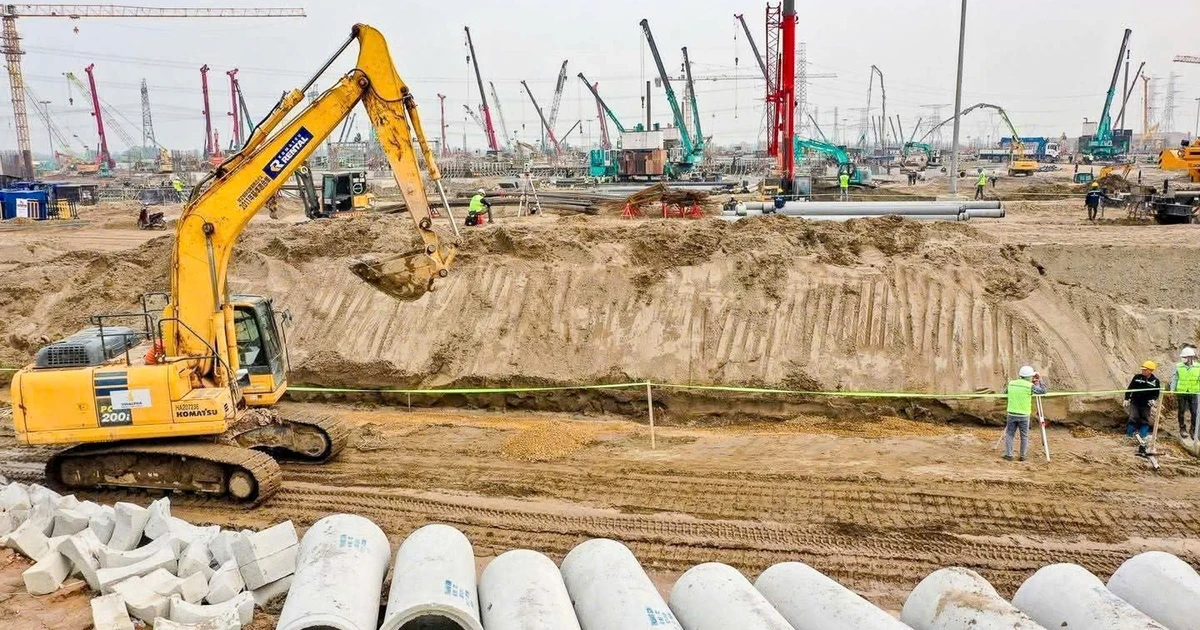
Vietnam Accelerates Public Investment to Drive Economic Growth Amid Challenges
Economy
2026年7月24日
6
Nhan Dan

General articles are free for 24 hours after publish.

Vietnam Accelerates Public Investment to Drive Economic Growth Amid Challenges

Share
AI Summary

Vietnam is accelerating public investment disbursement as a key driver for economic growth. However, challenges such as land acquisition and plan revisions persist, making improved investment efficiency a pressing need.

Vietnam is prioritizing the acceleration of public investment disbursement as a key task to drive economic growth and enhance the efficiency of social capital utilization. Investment is considered a crucial engine for Vietnam to enter a phase of rapid and sustainable growth. Public investment, in particular, is expected to play a catalytic role, attracting private investment and creating ripple effects across various sectors. The Ministry of Finance reported that in the first six months of the year, the country disbursed over 356 trillion VND in public investment, reaching 35.5% of the Prime Minister's allocated plan. This represents an increase of 38.4 trillion VND compared to the same period last year, attributed to the highest-ever public investment plan of 1,010 trillion VND for the current year. Hanoi stands out among localities leading in public investment disbursement. The capital city has disbursed over 62 trillion VND, equivalent to 51.8% of its allocated plan, ranking third nationwide in disbursement rate and first in absolute value. Mr. Nguyen Ngoc Tu, Director of the Hanoi Department of Finance, stated that the city considers public investment disbursement a key political task and a vital driver for growth in 2026 and beyond. Hanoi has implemented directives and plans, setting KPIs for departments and investors, and closely monitoring project progress. Recognizing land acquisition as the biggest hurdle, Hanoi requires detailed weekly plans for affected projects and links performance to personnel evaluations and accountability of heads. Funds may be reallocated from projects experiencing consecutive two-month delays. In An Giang province, over 8.6 trillion VND, or 32% of the province's 2026 public investment plan (totaling over 28.6 trillion VND), was disbursed in the first six months. Projects supporting the 2027 APEC High-Level Week have seen a disbursement rate of over 38%, higher than the provincial average. However, Mr. Pham Minh Tam, Director of the An Giang Department of Finance, noted that a significant portion of the province's public investment is tied to APEC projects, many of which require adjustments to total investment and funding structures, hindering disbursement despite progress. Nationwide, while the first-half disbursement rate is not yet high, a clear trend of recovery and acceleration is evident, reflecting the significant efforts of ministries, agencies, and localities. Many national key infrastructure projects are entering their peak construction phases, leading to substantial progress payments expected in the latter half of the year. Furthermore, stabilizing geopolitical factors, raw material prices, and transportation costs are expected to facilitate faster implementation and disbursement. Mr. Le Thanh Quan, Director of the Infrastructure Development Department at the Ministry of Finance, emphasized that rapid disbursement is a necessary but not sufficient condition; the ultimate goal is to improve investment efficiency. Prolonged project timelines, frequent revisions, or delayed operationalization increase costs, reduce capital efficiency, and negatively impact the ICOR (Incremental Capital Output Ratio). Vietnam's average ICOR has been declining, from 6.77 in 2016-2020 to a projected 6.43 in 2021-2025, with further reduction targets of 4.5-4.8 set for 2026-2030. Achieving these targets requires enhanced legal frameworks, improved planning and preparation quality, strategic project selection, and a more focused approach to public investment. Strengthening the accountability of project leaders, simplifying administrative procedures, and addressing bottlenecks in material supply, pricing, land acquisition, and project management are crucial. A shift towards prioritizing investment efficiency, with early operationalization to maximize economic and social benefits, is also vital. Additionally, reallocating funds from slow-moving projects to those with better progress and leveraging public investment to mobilize social resources through strategic, interconnected, and high-impact infrastructure projects, along with promoting digital transformation in public investment management, are key priorities. Information Source: Nhan Dan

0

Original source

Nhan Dan

原文を読む