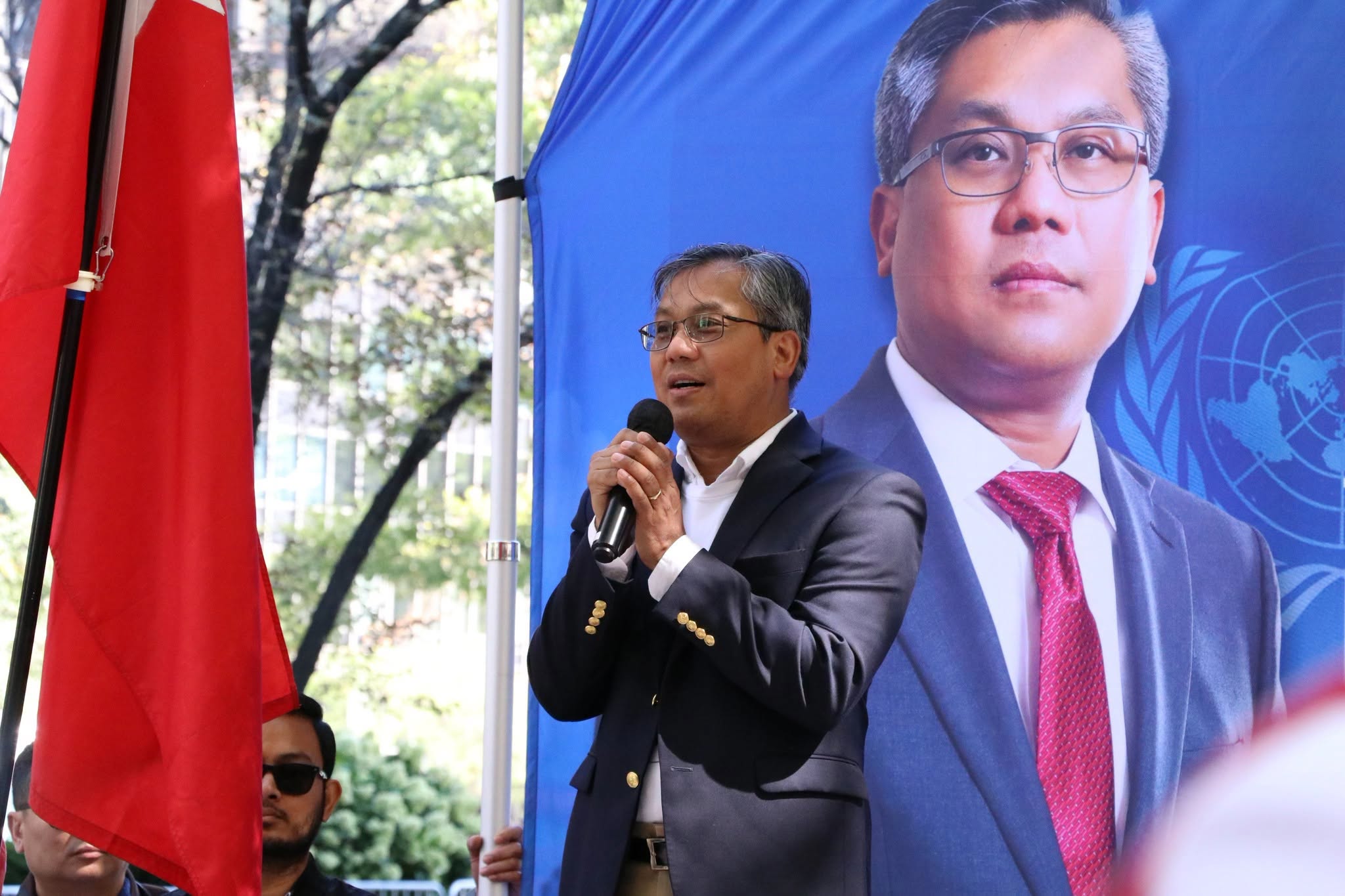
Myanmar diaspora plans US rallies to back UN Ambassador Kyaw Moe Tun amid regime pressure
Diplomacy
2026年7月13日
3
DVB
Relations
🇲🇲Myanmar🇺🇸United States🌐United Nations / ASEAN

Myanmar diaspora plans US rallies to back UN Ambassador Kyaw Moe Tun amid regime pressure

AI サマリー

Members of the Myanmar diaspora across the United States are preparing for a series of nationwide public rallies this September. The campaign aims to ensure that Ambassador Kyaw Moe Tun—a staunch critic of the military r

Members of the Myanmar diaspora across the United States are preparing for a series of nationwide public rallies this September. The campaign aims to ensure that Ambassador Kyaw Moe Tun—a staunch critic of the military regime—retains his seat as Myanmar’s Permanent Representative to the United Nations at the upcoming 81st session of the U.N. General Assembly. Kyaw Moe Tun was appointed under Aung San Suu Kyi’s civilian National League for Democracy (NLD) administration in October 2020. Since the military seized power in February 2021, he has used his platform to vehemently denounce the regime and represent the ousted civilian government. A critical U.N. review The rallies are timed to coincide with a critical diplomatic juncture. During the 81st session of the U.N. General Assembly, scheduled for Sept. 8-22, the nine-member U.N. Credentials Committee will review member states’ representatives. The committee will issue a pivotal recommendation on whether to recognize the credentials of Kyaw Moe Tun or seat a representative appointed by the military regime in Naypyidaw. While the U.S., China, and Russia hold permanent positions on the Credentials Committee, the six rotating members for the upcoming session have yet to be announced. The ‘day of action’ Khin Thiri Nandar Soe, a prominent pro-democracy activist, confirmed that public rallies will take place throughout September across various U.S. cities. The campaign will culminate on Sept. 19, which has been designated as the main “Day of Action.” A large-scale demonstration is planned outside the U.N. headquarters in New York City to explicitly demonstrate to the Credentials Committee that the regime “doesn’t represent” the people of Myanmar. Geopolitical pushback from Beijing The diplomatic battle for the U.N. seat is facing significant geopolitical interference, particularly from China. Following a state visit to Beijing by regime leader Min Aung Hlaing—who was inaugurated as Myanmar’s president by a pro-military parliament in April—the Chinese government released a statement on June 17 explicitly supporting Myanmar’s “full” participation in both the U.N. and the Association of Southeast Asian Nations (ASEAN). Jason Tower, a senior expert at the Global Initiative Against Transnational Organized Crime, noted in a recent interview with DVB that Beijing is actively maneuvering to install a representative friendly to Min Aung Hlaing’s administration in the U.N. seat. Shifting regional dynamics The U.N. credential dispute mirrors a shifting, controversial diplomatic landscape in Southeast Asia. While ASEAN has largely excluded senior regime officials since April 2021—due to the regime’s failure to implement the “Five-Point Consensus” peace plan—signs of a thaw have emerged. On July 12, ASEAN foreign ministers hosted an informal meeting with the regime’s Foreign Minister, Tin Maung Swe, in Bangkok, Thailand. This move broke a five-year diplomatic freeze and drew immediate, sharp criticism from international and regional human rights experts who accused the bloc of rewarding the regime’s atrocities. The humanitarian stakes As the diplomatic battle unfolds in New York, the situation on the ground remains dire. At a U.N. General Assembly plenary debate on July 6, Ambassador Kyaw Moe Tun pleaded with the international community to invoke the “Responsibility to Protect” (R2P) doctrine to halt what he called a systemic campaign of mass atrocities and war crimes by the military. The violence has exacted a devastating toll. According to the Armed Conflict Location & Event Data (ACLED) project, an estimated 100,114 conflict-related fatalities have been recorded in Myanmar since the coup on Feb. 1, 2021. Meanwhile, civilian leaders remain sidelined; President Win Myint was released under amnesty in April, while Aung San Suu Kyi was reportedly transferred to house arrest in Naypyidaw with a reduced 18-year sentence. But no evidence of Aung San Suu Kyi’s relocation has been provided by the regime. The post Myanmar diaspora plans US rallies to back UN Ambassador Kyaw Moe Tun amid regime pressure appeared first on DVB.

多角的分析

経済的影響

直接の経済ニュースではありませんが、治安と司法の信頼は地域経済の土台です。職場での暴力や未成年者保護への不安が強まると、夜間営業、観光、雇用、地域サービス業のリスク認識が高まります。

投資家心理

投資家目線では、個別事件よりも法執行の予見可能性が焦点です。加害者への対応が曖昧になれば、ローカルビジネスの統治リスクや従業員保護の弱さとして評価されやすくなります。

社会的影響

メンバーの現場では、暴力を「個人間の事件」で片づけず、誰が守り、誰が説明するのかを可視化する圧力が強まります。軍の動きは、被害者側が孤立しやすい環境で、沈黙より手続きを選ぶための足場になります。

市民の声

市民にとっては、自分や家族が被害に遭った時に公正な手続きへアクセスできるのかが最大の関心です。地域団体が声を上げることで、事件の風化を防ぎ、被害者側の孤立を和らげる意味があります。

背景・歴史的文脈

このニュースは、ミャンマーの地域社会で法の支配と弱者保護がどこまで機能しているかを映す事案です。暴力事件そのものに加え、女性団体や市民社会が司法手続きを求めて声を上げている点が重要です。軍政下では警察・司法への信頼が揺らぎやすく、個別事件が地域の不安や統治への不信に直結します。

原文ソース

DVB

原文を読む