General articles are free for 24 hours after publish.
Vietnam to Host AI Contest to Accelerate Technological Innovation and Talent Development
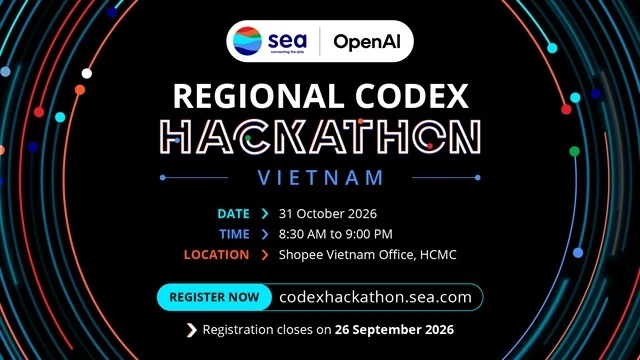
Vietnam will host an AI contest as part of the Vietnam Innovation Challenge 2026, focusing on AI-driven solutions to business problems. Numerous domestic teams are participating, aiming to foster technological innovation and talent development.
Part of the Vietnam Innovation Challenge 2026, the programme goes beyond conventional coding competitions by requiring participants to develop AI-driven solutions to business challenges in real time. Vietnamese teams account for the largest share with 174 entries, followed by India with 114 teams, the Philippines with 44 and Indonesia with 20. As a key activity within the technology component of the Gia Lai Quantum Year 2026, the event brings together nearly 100 contestants across 26 teams, including students, PhD candidates, young researchers, startups, and tech talents, alongside 50 domestic and international experts, mentors, and judges. A delegation from the Communist Party of Vietnam (CPV) Central Committee’s Commission for Policy and Strategy paid a working visit to France from September 13-16, focusing on exchanging experience in science and technology, innovation, startup ecosystems and human resources development. Experts said the Mekong Delta region does not lack data, but valuable information collected by government agencies, universities, businesses, projects and communities is scattered across different locations and formats, making it difficult to access, compare and use effectively. Under the direction of the Government and the Ministry of Public Security, the ministry’s Police Department for Administrative Management of Social Order (C06) has led efforts to review and standardise information on martyrs and their relatives, collect DNA samples from relatives, and build and manage a DNA database. It also coordinates with forensic agencies to compare DNA data and identify the remains of fallen soldiers. The rapid growth of EVs is creating new infrastructure challenges for cities, requiring charging networks to be planned according to travel demand, power supply capacity and available urban space. Although the Political Bureau’s Resolution No. 57-NQ/TW allows pilot schemes for new practical issues and accepts risks and delays in science, technology and innovation, concerns over risks and responsibility persist. “Ban Sac” is an online platform combining culture, digital communications and artificial intelligence (AI), running from September 15 to October 31 on its official website, www.bansac.vn. Digital technology may change how journalism is practiced, but the core mission of journalists at a news agency remains unchanged: serving the nation and the people while ensuring a flow of official and reliable information that helps build public trust in the Party’s leadership. Vietnam needs to step up semiconductor workforce training to meet growing market demand and enhance its capacity to participate in the global technology value chain, experts said, highlighting the importance of closely linking training with businesses, production and technological research. Education and training, science and technology, and high-quality human resources are key areas of cooperation in Vietnam-France relations, said Politburo Member, Secretary of the Communist Party of Vietnam Central Committee, and Chairman of its Commission for Organisation Nguyen Duy Ngoc while visiting the Institut Polytechnique de Paris on September 11. The University of Science and Technology of Hanoi (USTH), under the Vietnam Academy of Science and Technology (VAST), and the French Alternative Energies and Atomic Energy Commission (CEA) exchanged two cooperation agreements in Paris on September 11, in the presence of General Secretary of the Communist Party of Vietnam Central Committee and President To Lam. For Vietnam, the opportunity presented by unmanned aerial vehicles (UAVs) lies not only in expanding their applications but, more importantly, in gradually building industrial capacity, mastering technologies and engaging more deeply in global value chains. Nguyen Anh Tuan, Director of the National Centre for Pilot Semiconductor Chip Manufacturing Support under the Ministry of Science and Technology, said that amid increasingly intense global technological competition, the semiconductor industry is not only a high-value-added economic sector but also a foundation for technological self-reliance, national security and economic competitiveness. The two projects involve an intelligent autonomous transportation system developed by Phenikaa-X JSC and a technology for producing mixed rare-earth oxides with a purity of over 95% on a semi-industrial scale developed by the Mining Technology and Construction Consultancy JSC. Vietnamese Ambassador Duong Hoai Nam stressed the need to strengthen cooperation between educational and research institutions of the two countries, shifting from exchanges and individual projects towards long-term partnerships with tangible outcomes. Quantum technology is an emerging field undergoing rapid breakthroughs and requiring enormous investment resources. Learning from the experience of pioneering countries such as Russia will enable Vietnam to significantly shorten the time needed to build its workforce and develop endogenous capabilities. General Secretary of the Communist Party of Vietnam Central Committee and President To Lam’s upcoming official visit to France is expected to provide fresh momentum for Vietnam-France ties as it comes at a pivotal time for Vietnam’s economic restructuring. Leaders of the Vietnam Academy of Science and Technology (VAST) and AFK Sistema agreed to promote cooperation in three priority strategic technology areas, namely green hydrogen, small satellites, and unmanned aerial vehicle (UAV) systems. Dung acknowledged FPT’s progress in the Korean market and said he expects the company to further foster exchanges in technology and advanced research and development (R&D) models, helping connect Vietnamese technology companies in the RoK. General Secretary of the Communist Party of Vietnam Central Committee and President To Lam’s visit to France, Guy Bonassi, Senior Vice-President of Latin America and Asia at Thales Group, said the upgrade of bilateral ties to a Comprehensive Strategic Partnership reflects their shared desire to deepen and broaden cooperation, with technological autonomy, resilience and human resources development assuming increasingly important roles. Schneider Electric remains committed to its long-term cooperation with Vietnam, contributing to a more resilient, competitive and sustainable economy. Copyright, VietnamPlus, Vietnam News Agency (VNA) Editor-in-chief, Mr. Tran Tien Duan.
Original source
VietnamPlus English