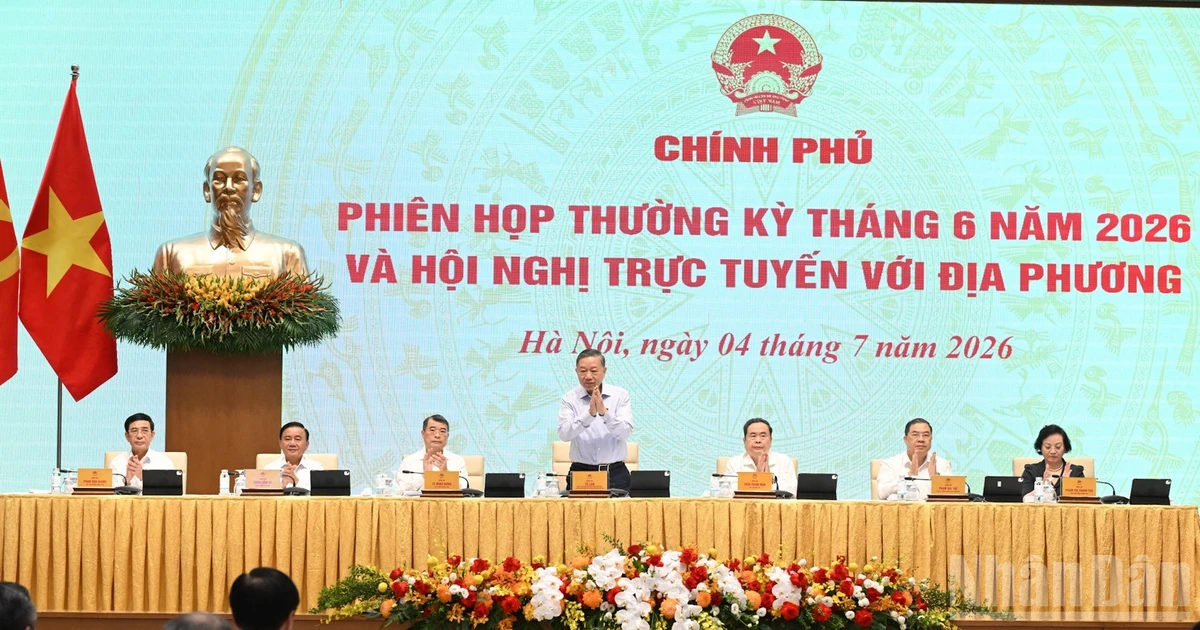
Vietnam Holds June Government Meeting, General Secretary and President Delivers Directives
General Secretary of the Communist Party of Vietnam and President To Lam attended and directed the June regular government meeting and an online conference with localities. Amidst global uncertainties, balancing domestic stability and growth was highlighted as a key challenge.
General Secretary of the Communist Party of Vietnam and President To Lam attended and directed the June regular government meeting and an online conference with localities held on July 4 at the Government Headquarters. The meeting was also attended by Prime Minister Le Minh Hung, National Assembly Chairman Tran Thanh Man, Standing Secretary of the Central Secretariat Tran Cam Tu, along with leaders from government ministries, central agencies, and local authorities. In his opening remarks, Prime Minister Le Minh Hung expressed his honor in welcoming General Secretary and President To Lam, and presented the socio-economic development situation in the first half of 2026, in the context of implementing the resolutions of the 14th Party Congress. He highlighted the rapidly evolving and unpredictable global and regional landscape, characterized by intensifying strategic competition among major powers, rising geopolitical and non-traditional security risks, and climate change. The conflict in the Middle East, in particular, has disrupted global trade and supply chains, negatively impacting global security, trade, growth prospects, and macroeconomic stability, leading to increased inflationary pressures and policy adjustments by major partners, including a rise in protectionism and the relocation of investments and supply chains. Domestically, despite favorable conditions and renewed confidence post-14th Party Congress, Vietnam faces significant challenges in maintaining macroeconomic stability, ensuring energy security, boosting growth drivers, and restructuring the economy for rapid and sustainable development. Prime Minister Hung acknowledged the concerted efforts of the government, ministries, and localities, guided by the Party leadership, the National Assembly, and the collective will of the people and businesses, in effectively addressing routine tasks, resolving long-standing issues, and responding promptly to emerging challenges. This has resulted in positive economic and social progress in June, the second quarter, and the first half of 2026, creating momentum for the year's objectives. The Prime Minister urged participants to thoroughly analyze the first half's performance, forecast future trends, and propose comprehensive solutions. He emphasized the need to assess whether current achievements have fully utilized existing potential and resources, and whether greater determination could yield even higher results. The meeting also focused on analyzing shortcomings, challenges, and the implementation of Resolution 18-KL/TW from the second Plenum of the Central Committee, with a target of achieving double-digit growth in the second half while maintaining macroeconomic stability. Discussions also covered institutional reforms to lay the foundation for rapid and sustainable development, and the mobilization of state, social, domestic, and international resources, particularly in science-technology, innovation, and digital transformation. General Secretary and President To Lam's directives at the conclusion of the meeting are expected to provide crucial guidance for future work. Participants were asked to provide concise, focused remarks on key issues, difficulties, and specific proposals for the Government and ministries, demonstrating a commitment to translating these into concrete actions. The agenda included reports and discussions on the socio-economic situation in June and the first half of 2026, the allocation and disbursement of public investment capital, the implementation of national target programs, state budget execution, the Government and Prime Minister's direction and administration in June and the first half, key tasks for the coming period, and preparations for the 2026-2027 academic year. Source: Nhan Dan
多角的分析
ベトナム経済は、世界的なサプライチェーンの再編や保護主義の高まりといった外部環境の悪化に直面している。2026年前半の堅調な成長は評価されるものの、首相が言及したように、マクロ経済の安定維持と2桁成長の両立は依然として大きな課題である。特に、エネルギー安全保障の確保と経済構造の転換は、持続的な成長のための鍵となる。科学技術、イノベーション、デジタル変革への投資促進は、新たな成長エンジンの創出に不可欠であり、政府の政策運営における最優先事項の一つと考えられる。
今回の会議は、ベトナム政府の経済運営に対する強いコミットメントを示すものだ。総書記兼国家主席が直接会議を主導し、経済社会発展の課題と目標を明確にしたことは、投資家にとって安心材料となり得る。しかし、グローバルな地政学リスクや保護主義の台頭は、ベトナムの輸出主導型経済にとって依然としてリスク要因である。投資家は、政府の経済政策の実行力、特に制度改革や資源動員策の進捗を注視する必要がある。デジタル変革やイノベーションへの投資は、将来的な成長ポテンシャルを示唆しており、注目すべき分野である。
会議では、経済成長とマクロ経済の安定維持が中心的な議題となったが、その恩恵が国民全体にどのように行き渡るかが重要である。物価安定、エネルギー供給の確実性は、一般市民の生活に直結する。また、経済構造の転換やデジタル化の推進は、新たな雇用機会を生み出す一方で、一部の労働者にとってはスキルの再習得や職種変更を迫られる可能性もある。政府の政策が、国民生活の安定と向上にどのように貢献していくかが、社会的な支持を得る上で不可欠となる。特に、地方とのオンライン会議は、中央政府と地方の連携強化を図る意図がうかがえる。
国民生活への直接的な影響としては、まず物価の安定が挙げられる。世界的なインフレ圧力が高まる中、ベトナム政府がどのようにこれを抑制し、国民の購買力を維持するかが問われる。また、エネルギー安全保障の確保は、日常生活や産業活動の安定に不可欠である。経済成長の恩恵が、ハノイやホーチミン市といった大都市だけでなく、地方の住民にも公平に分配されることが期待される。デジタル変革の推進は、若年層を中心に新たな機会をもたらす可能性があるが、高齢者やデジタルデバイドに直面する人々への配慮も必要となるだろう。
背景・歴史的文脈
ベトナムは、ドイモイ(刷新)政策以降、市場経済化を進め、目覚ましい経済成長を遂げてきた。しかし、一党体制下での経済運営は、政策決定の迅速さと安定性をもたらす一方で、政治的リスクや社会的な不平等を内包する。近年、中国との関係は経済面で緊密である一方、南シナ海問題などを巡る地政学的な緊張も抱える。今回の会議は、こうした複雑な国内外の環境下で、ベトナム共産党指導部が経済社会の安定と発展をいかに両立させようとしているかを示すものと言える。特に、2026年前半の好調な経済指標を背景に、さらなる成長を目指す意欲と、それに伴う課題への認識が示されている。
原文ソース
Nhan Dan