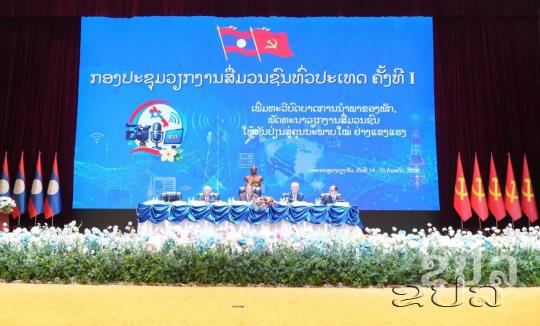
Laos Holds First National Media Conference to Chart Future Direction
Laos convened its first National Media Conference to strengthen media development and redefine its role under Party and state leadership. The conference aims to formulate strategic priorities through 2030.
The Lao People's Revolutionary Party Central Committee has successfully convened the First National Media Conference, a landmark event aimed at strengthening media development and charting the future direction of the sector. The conference was chaired by Gen. Vilay Lakhamfong, Member of the Politburo and Standing Secretary of the Party Central Committee Secretariat, and attended by senior Party officials, government representatives, and media professionals from across the country. In his opening address, Gen. Vilay highlighted the conference as a pivotal moment for Lao media, stating that it would comprehensively review recent achievements, assess the implementation of a Politburo resolution on enhancing Party leadership and state management of the media, identify existing challenges, and formulate strategic priorities for the sector's development through 2030. He reaffirmed the Party and Government's consistent view of the media as a crucial pillar for political and ideological work, public communication, and national development. The media, he emphasized, serves as a vital channel for disseminating Party policies, state laws, and national development strategies, while also fostering public consensus, strengthening political stability, and combating misinformation. Following the opening session, Khamphan Pheuyavong, Member of the Politburo and Head of the Party Central Committee's Information and Education Commission, presented a report reviewing the media sector's performance and outlining its strategic development priorities up to 2030. Khammon Chanthachit, Alternate Member of the Party Central Committee and Deputy Head of the Information and Education Commission, presented the Politburo's resolution on strengthening Party leadership and state management of the media in the new development context. The conference also featured presentations and policy discussions on key issues shaping the future of Lao journalism. These included the application of artificial intelligence and digital technologies in media operations, modernization of telecommunications infrastructure, strengthening analytical and investigative journalism, professional development of media personnel, digital transformation, promotion of tourism through local media, public-private cooperation in media innovation, protection of media interests in the digital era, and the media's role in political communication, youth education, and safeguarding national security. Participants also exchanged views on enhancing the quality, professionalism, and credibility of Lao media, reinforcing its role in supporting the Party's strategic objectives for national development and defense. The conference is expected to conclude with a policy address by President Thongloun Sisoulith, General Secretary of the Party Central Committee and President of the Lao PDR, outlining the Party and Government's vision for the future development of the Lao media sector.
多角的分析
ラオスのメディア産業の近代化とデジタル化は、経済発展、特に観光業の振興に不可欠である。AIやデジタル技術の導入は、コンテンツ制作の効率化と新たな収益機会の創出につながる可能性がある。しかし、インフラ整備や人材育成への投資が十分に進まなければ、デジタルデバイドが拡大し、経済格差を助長するリスクも存在する。
ラオス政府がメディアのデジタル変革と近代化を推進する姿勢は、テクノロジー企業やコンテンツプロバイダーにとって新たな投資機会を示唆している。特に、観光振興を目的としたメディア活用や、AIを活用したコンテンツ制作分野への関心が高まる可能性がある。ただし、投資判断においては、ラオスの法規制、市場規模、および政治的安定性を慎重に評価する必要がある。
今回の会議は、ラオス社会における情報流通のあり方と、それが国民生活に与える影響を考える上で重要である。党と政府によるメディアへの指導強化は、情報統制につながる可能性も指摘される一方、誤報対策や国家安全保障の維持という側面も持つ。国民が正確で多様な情報にアクセスできる環境が整備されるか、また、メディアの専門性や信頼性がどのように高められるかが、社会全体の情報リテラシーや民主的議論の質に影響を与えるだろう。
今回のメディア会議は、ラオス国民がどのような情報に触れ、どのように世界を理解していくかに直接関わる。党と政府がメディアを「戦略的支柱」と位置づける方針は、今後、報道内容がより一層、党の政策や国家目標に沿ったものになることを示唆している。国民は、公式発表される情報と、SNSなどを通じて入ってくる多様な情報との間で、情報の真偽を判断する能力がより一層求められるようになるだろう。また、地方メディアの振興は、地域社会の声をより反映させる機会となりうるが、その実現にはインフラや人材の格差解消が課題となる。
背景・歴史的文脈
ラオスは一党体制の社会主義国家であり、ラオス人民革命党が政治・社会のあらゆる側面を指導している。メディアも例外ではなく、党の政策やイデオロギーを国民に浸透させるための重要なツールと位置づけられている。近年のラオスは、中国やベトナムとの関係を深化させる一方で、経済開発のために外国からの投資を積極的に誘致している。特に中国からのインフラ投資は巨額に上り、ラオスの経済構造に大きな影響を与えている。このような状況下で、メディアが党の指導の下でどのように機能し、国内外の情報発信を担っていくかが、ラオス社会の将来を左右する重要な要素となる。
原文ソース
KPL Laos News