General articles are free for 24 hours after publish.
Mongolia's President Seeks Closer Ties with China, Russia at SCO Summit
Mongolian President attended the SCO Summit in Kyrgyzstan, holding bilateral talks with China and Russia to strengthen economic and energy cooperation. Focus was on energy supply and infrastructure development.
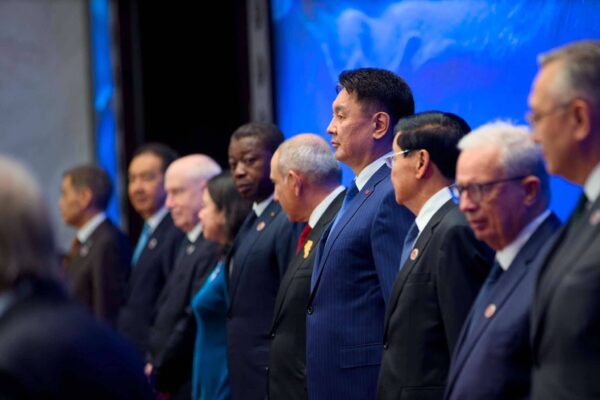
Read The Diplomat, Know The Asia-Pacific For Mongolia, the highlights were the bilateral meetings held on the sidelines with Kyrgyzstan, China, and Russia. Mongolia’s President Khurelsukh Ukhnaa stands alongside other SCO heads of state in preparation for a group photo during the 2026 Bishkek Summit, Sep. 1, 2026. Mongolian President Khurelsukh Ukhnaa is attending the Shanghai Cooperation Organization (SCO) Council of Heads of State in Bishkek, Kyrgyzstan as the organization recognizes its 25th anniversary. While the SCO spent much of its existence focused on security and regional cooperation, the Bishkek Declaration demonstrates a much larger global agenda. Mongolia, in the new partner state status, is seeking deeper ties with SCO member states in emerging sectors via robust bilateral links. For example, Khurelsukh and Kyrgyz President Sadyr Japarov, the summit’s host, held bilateral talks to accelerate political, economic, and trade relations under the Comprehensive Partnership Agreement that was signed during Khurelsukh’s state visit to Bishkek in 2025. Mongolia and Kyrgyzstan are aiming to boost regional trade turnover to $100 million. During Khurelsukh’s remarks, he noted the trade volume between the two countries had grown from $2.6 million in 2023 to $19 million as of 2025. The Mongolian side expressed interest in further Kyrgyz investments and joint projects in developing industries, minerals exploration, transport and logistics, and direct flights. Mongolia’s interim free trade agreement with the Eurasian Economic Union (EAEU) creates additional trade opportunities for the two countries. Kyrgyzstan will be chairing the EAEU in 2027. But there were more leaders in Bishkek than just Japarov. For Mongolia, the SCO Summit was a valuable opportunity for face-to-face diplomacy as the world faces major geopolitical and economic challenges. On August 31, Khurelsukh held bilateral talks with Chinese President Xi Jinping. During their meeting, Xi reiterated Beijing’s long-term support for Mongolia as close neighbors and promised to support “win-win cooperation.” Mongolia and China discussed opportunities to expand cooperation in emerging sectors such as green minerals, AI, digital economy, and supporting Mongolia’s efforts in combating desertification and climate issues. According to the Mongolian presidential office, Khurelsukh and Xi discussed several projects that are underway, including China’s support for the operation of the Erdeneburen Hydropower Plant, a long-stalled mega-project that received new life in 2022. Xi and Khurelsukh also discussed the need to make progress on constructing the Shiveekhuren-Sekhee, Bichigt-Zuunkhatavch, Khangi-Mandal railways which are crucial to the countries’ bilateral economic activities. Moreover, one of the most important discussion points was China’s willingness to continue exporting petroleum product supplies to Mongolia amid fuel shortages triggered by supply disruptions from Russia. The two sides are currently aiming for Mongolia to import 71,000 tons of petroleum product per month from China. More broadly, Xi promised to support Mongolia’s fuel industry, and cooperate in the exploration of oil and gas, a key priority for Mongolia as it seeks to address its energy dependencies. While China is a leading investor in Mongolia’s mining sector, it has yet to allocate investments into the renewable energy sector. Considering Mongolia’s push to transition to renewable energy and diversify its energy sources, Beijing’s contribution will be crucial in the coming years. Khurelsukh also met with Russian President Vladimir Putin while in Bishkek. During the meeting, Putin reiterated the historic links between Mongolia and Russia. He expressed hope that Ulaanbaatar’s interim free trade agreement with the EAEU will provide “preferential treatment for Mongolian traditional exports across the customs territory of our association.” Moreover, Putin highlighted that Mongolia – previously an observer in the SCO – now will receive “partner state” status. Last year, the SCO streamlined its various levels of participation to just two: full members and partner states. Mongolia thus became a partner state along with other states previously recognized as observer states. The debate on whether Mongolia should join the SCO as a full member has been a hot topic among scholars and policymakers in the last decade. The Khurelsukh-Putin summit was also attended by the Russian energy minister and president of Rosatom, Russia’s nuclear power corporation. Rosatom’s leader reportedly met with Mongolian partners to discuss small modular nuclear reactors as a way to diversify Mongolia’s energy mix. According to Russia’s Pivot to Asia official website, “Mongolia is reviewing a proposal from the Russian state nuclear corporation to build a small modular nuclear reactor in the country, which may be built near New Kharkhorum, a planned new capital city located about 230 kilometers west of Ulaanbaatar.” Following Khurelsukh’s high-level meetings with both Xi and Putin, separately, Xi and Putin resumed high-stakes negotiations on the construction of Power of Siberia 2, a long-discussed gas pipeline that would bring LNG from Russia’s Yamal gas fields to China via Mongolia. According to Pipeline Technology Journal, “Kremlin foreign policy aide Yury Ushakov confirmed Friday that the flagship energy project will feature prominently during talks in Bishkek.” Ushakov added that discussions will continue at the Eastern Economic Forum currently underway in Vladivostok, where Chinese Vice Premier Ding Xuexiang will meet with Russian officials. Russia is keen to export more gas to China, and Mongolia has welcomed the construction of the pipeline. However, China has been driving a hard bargain on pricing, especially as it moves away from fossil fuels toward renewable energy. There was no China-Mongolia-Russia trilateral meeting scheduled in Bishkek. However, Mongolian Prime Minister Uchral Nyam-Osor is in Vladivostok through September 4, so trilateral talks might be resumed there. The three heads of state gathered last year in Beijing shortly after the 2025 SCO summit in nearby Tianjin. At that meeting, Mongolia emphasized the importance of trilateral cooperation and reaffirmed its commitment to jointly implementing the projects and programs outlined in the Economic Corridor Construction Program. As evidenced by the Bishkek Declaration, the SCO is setting itself up as a much larger player in global political, economic, and security arenas. As SCO member states encompass approximately 42 percent of the global population, SCO-linked global governance, multipolarity, and economic and trade are set to expand in the organization’s next 25 years. While Mongolia’s participation in this year’s SCO in Bishkek has been primarily economically motivated, Ulaanbaatar is aware of the shifts in global geopolitics. Mongolia engagement in the SCO is underpinned by its bila
Original source
The Diplomat Indonesia