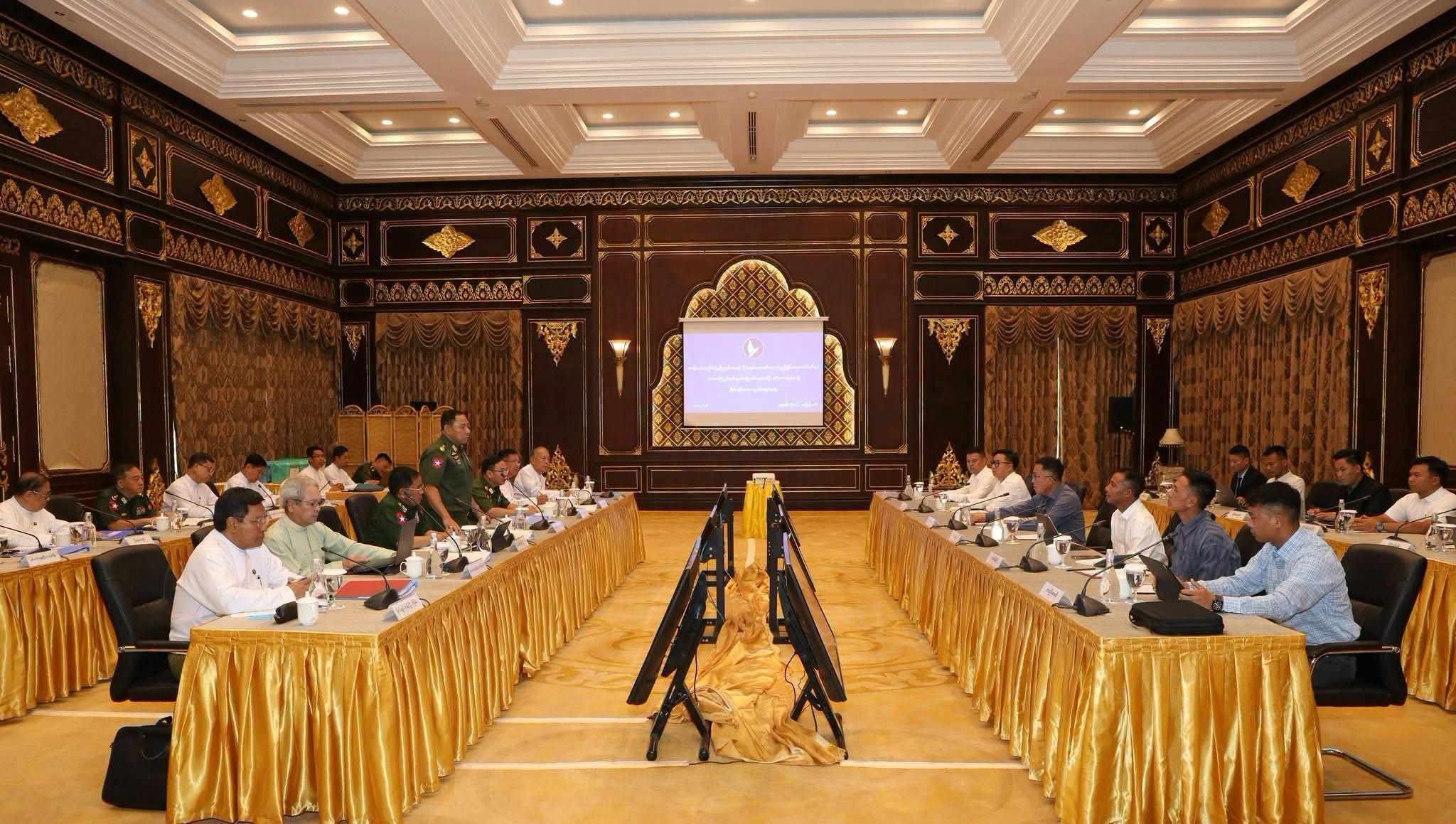
Interim government's ceasefire measures lack political substance and aim to consolidate military rule, says ISP
The ceasefire measures of the interim government under the military junta, following the coup, lack political substance and are aimed at dictatorial conflict management, division of anti-regime forces, and consolidation
This article requires PRO
This article is outside the free access window or is a special report. PRO unlocks it and the full archive.
Related articles
- Repatriation of Myanmar Nationals Abroad is Not Humanitarian Aid but Forced Conscription for Military Service, Revolutionary Groups Point Out
Nai Min Lwin / Irrawaddy Times October 6, 2023 The National Unity Government (NUG), youth residing abroad, and revolutionary force members have pointed out that the interim government's repatriation of Myanmar nationals,
- State Administration Council Chairman U Min Aung Hlaing to make official visit to Malaysia
State Administration Council Chairman U Min Aung Hlaing will make an official visit to Malaysia in the coming days at the invitation of Malaysian Prime Minister Dato' Seri Anwar Ibrahim, according to the Ministry of Fore
- If excuses for reform continue, Myanmar will be the poorest country in the next 20 years, says MP
If excuses for reform continue, Myanmar will be the poorest country in the next 20 years, said U Aye Chan, a representative for Hlaing Thar Yar (East) constituency. He made the remarks during a debate on bank consolidation held in the Pyithu Hluttaw on October 5. "Excuses that it does not yet suit Myanmar's situation have been given since 1962. What is the result of the excuses given in '62? It has become the poorest country in Southeast Asia. I propose this because I cannot bear to see Myanmar become the poorest country for another twenty years," he said. It is understood that after five representatives debated the proposal for bank consolidation, it was recorded that it should be considered when the time is right, and the current situation will be monitored. It is known that Myanmar has four state-owned banks and 27 private banks, and among these 27 private banks, there are seven large banks, two medium-sized banks, and 18 small banks, according to the Central Bank of Myanmar. U Aye Chan, who proposed the bank consolidation, is the son of former Chief of Defence Services (Navy) U Soe Thein, who served as a senior minister responsible for economic policies during the administration of President Thein Sein.
- YGN Region CM met with returnees from Malaysia
The Government of the Republic of the Union of Myanmar places great importance on supporting its citizens and assists Myanmar nationals residing abroad under any circumstances whenever they encounter difficulties. On the