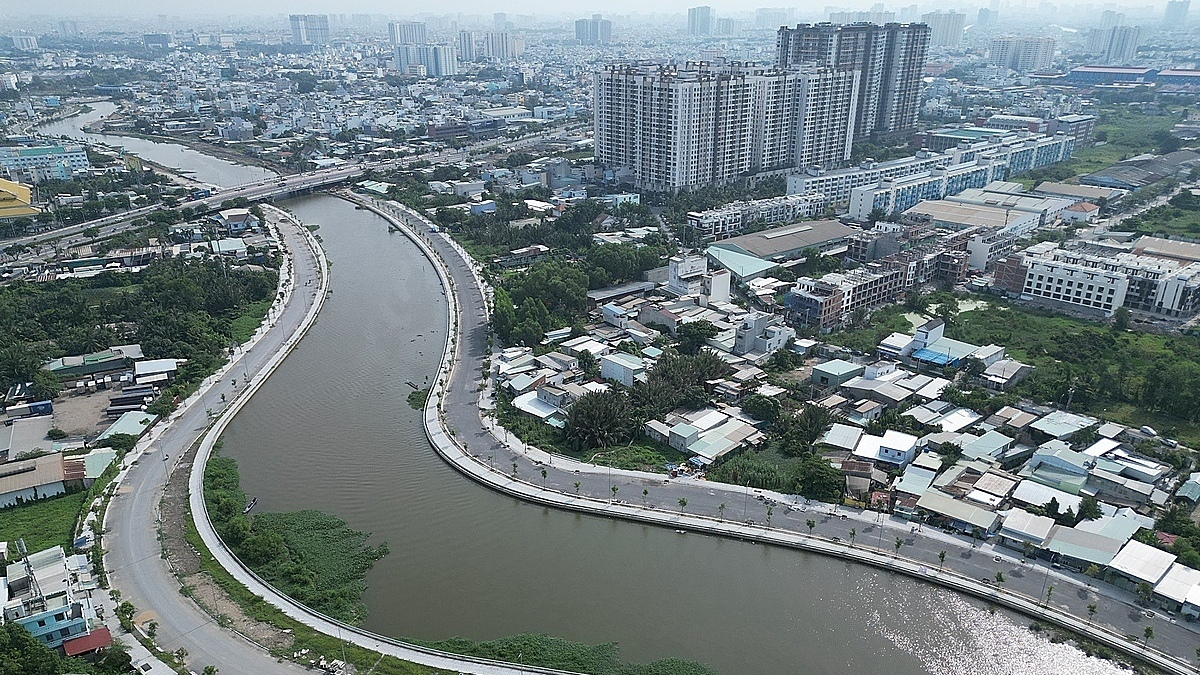
Ho Chi Minh City Canal Dredging Project Faces Delays Over Soil Disposal Site Issues
Business
2026年8月9日
5
VnExpress

General articles are free for 24 hours after publish.

Ho Chi Minh City Canal Dredging Project Faces Delays Over Soil Disposal Site Issues

Share
AI Summary

Ho Chi Minh City's Tham Luong-Ben Cat-Nhuoc Len canal renovation project, spanning nearly 32 km, faces potential delays due to the lack of a disposal site for over 3 million cubic meters of dredged soil. Initial disposal plans have failed, leading to a proposal to auction the soil as 'mineral resources'.

The Tham Luong-Ben Cat-Nhuoc Len canal renovation project in Ho Chi Minh City, spanning nearly 32 kilometers, is facing potential delays due to the inability to secure a disposal site for over three million cubic meters of dredged soil. This issue has become a significant bottleneck for the project. Currently, the soil disposal site issue is the primary bottleneck for the project. Initial plans to use the Go Vap Cultural Park and the former Zone 3 in Binh Tan district as disposal sites have failed. Resident opposition in densely populated areas and conflicts with other projects have rendered these sites unsuitable. Furthermore, some regulatory changes have also complicated the original disposal strategy. In response, the Ho Chi Minh City Urban Infrastructure Investment and Construction Management Board, the project's investor, has proposed a new solution: treating the dredged soil as 'Type IV mineral resources' under the new Law on Minerals and Geology, which takes effect in July 2025. Under this proposal, the city would auction the over three million cubic meters of soil. The winning bidder would be responsible for arranging machinery and equipment, dredging according to design specifications, and managing transportation and environmental processing. This approach is expected to resolve the disposal issue for the large volume of soil, reduce the city's processing costs, and potentially generate revenue from the auction. The Department of Construction has endorsed this direction, stating that classifying the dredged material as 'mineral resources' aligns with regulations and promotes efficient resource utilization, cost reduction, and budget savings. The department has requested the city to assign the Department of Agriculture and Rural Development to guide the investor through the relevant procedures for synchronized and compliant implementation. The project, which began in February 2023, has seen its initial investment of VND 8.2 trillion increase to over VND 9 trillion due to the addition of some components. The Tham Luong-Ben Cat-Nhuoc Len canal is one of the longest in Ho Chi Minh City, passing through seven old districts. The project includes dredging, concrete embankment construction, two parallel roads, 19 drainage culverts, 12 piers, and cross-bridges, along with lighting and green spaces. The goal is to achieve substantial completion by the end of this year, but the soil disposal problem poses a significant risk to this timeline. Experts, such as Dr. Pham Viet Thuan, Director of the Institute of Environmental and Natural Resources Economics, emphasize that while canal and river dredging is essential for urban development, it must be accompanied by adequate containment and processing facilities. This aspect is currently lacking in Ho Chi Minh City. Previous projects like Nhieu Loc-Thi Nghe and Tan Hoa-Lo Gom primarily involved on-site landfilling, green buffer zones, or private sector services which were costly and insufficient for long-term needs. Given that Ho Chi Minh City is undertaking and planning numerous canal renovation projects, including Xuyen Tam and the north bank of Kenh Doi, Mr. Thuan suggests the city needs to proactively plan and manage centralized soil reception and processing sites. This would provide a central point for controlling origin, volume, and processing, ensuring environmental compliance and facilitating the classification and reuse of dredged soil as a valuable material for infrastructure projects. Information Source: VnExpress

0

Original source

VnExpress

原文を読む