General articles are free for 24 hours after publish.
Xeo Quit: Echoes of Revolution in the Mekong Delta's Green Embrace
Xeo Quit in Vietnam's Dong Thap province, once a hub of revolutionary struggle, now thrives as a peaceful tourist destination. It preserves echoes of its past amidst rich natural beauty, reflecting Vietnam's history and present.
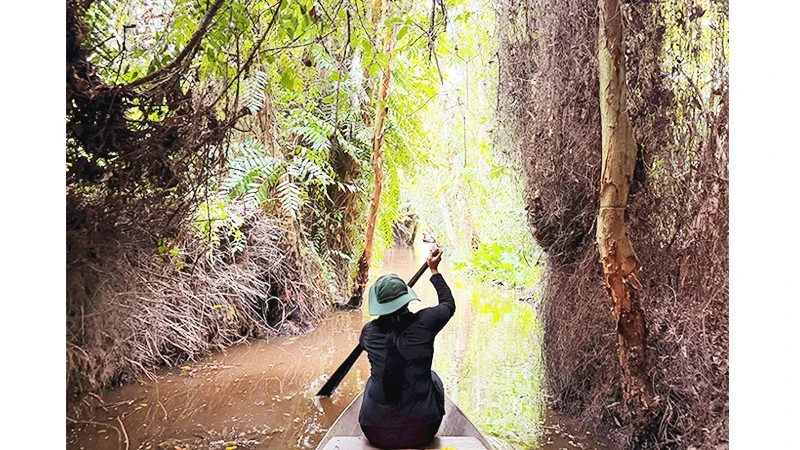
Xeo Quit, located in My Hiep commune, Sa Dec city, Dong Thap province, in Vietnam's southern Mekong Delta, is a historical revolutionary base now transformed into a serene tourist destination, preserving its significance and natural richness. Situated over a dozen kilometers from Sa Dec city center via the Sa Dec-Mieu Trang ferry route, Xeo Quit spans more than 62 hectares, a mosaic of pristine melaleuca forests and seasonal wetlands. Despite its isolated position, it lies adjacent to crucial waterways leading deep into the heart of the Mekong Delta. In local Southern Vietnamese dialect, 'xẻo' means a small canal, and Xeo Quit is situated at the end of the Xeo Quit canal, originating from the Nga Cai canal, divided by the Hoi Dong Tuong canal into two internal areas: Xeo Quit Trong and Xeo Quit Ngoai. For 15 years, from 1960 to 1975, this site served as the headquarters of the Kien Phong Provincial Party Committee (now Dong Thap Province), directly directing armed and political struggle movements in the area. Visitors to Xeo Quit today can experience navigating through the remnants of the old revolutionary base by taking a traditional 'ba lá' (three-leaf) sampan boat, winding through narrow canals amidst mangrove forests. More than half a century ago, a base was established amidst this swampy forest region, strategically encircled by 12 enemy posts. The opposing forces frequently conducted carpet bombing raids with B-52 aircraft and heavy artillery fire from neighboring sub-districts. Along the routes now traversed by tourist sampans, deep bomb craters are still visible. Yet, throughout its 15 years of historical significance, no enemy operation or soldier ever managed to penetrate the central headquarters of the Kien Phong Provincial Party Committee. To maintain the protective vegetation cover, the Provincial Party Committee mandated that each cadre, soldier, and staff member plant 3,000 native trees annually (primarily melaleuca, gao, and tram bau). To access the central base area, boats had to navigate through a dense swamp of wild grass, melaleuca, and dung trees. This vegetation cover continues to serve its purpose today, preserving a historical relic while creating a unique ecological tourist attraction. Rising above its function as a mere base, Xeo Quit is recognized in military history as a prime example of a 'people's base' (căn cứ lòng dân). Currently, the Xeo Quit tourist area only permits movement by sampan and bicycle. Free from the noise of motorized vehicles, the space between the trees offers an atmosphere of absolute tranquility. Passing by old encampments, A-frame bunkers, and bomb craters now filled with water, listening to the gentle splash of oars from a woman in a traditional 'ba ba' shirt, one can deeply appreciate the preciousness of peace. Article and photos: HỒNG VIỆT Editor-in-Chief: Lê Quốc Minh
Original source
Nhan Dan