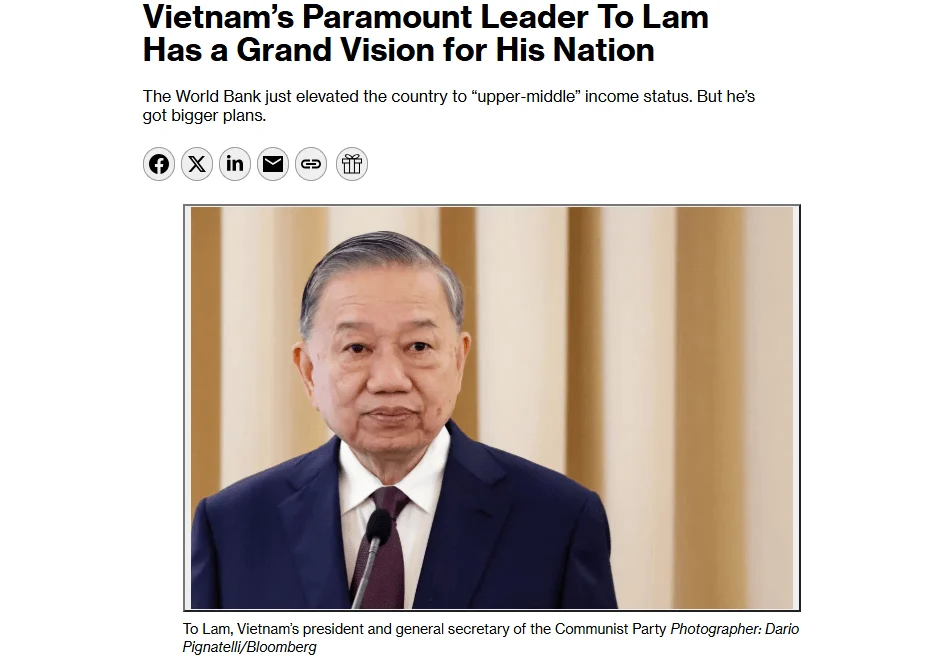
Vietnam's Grand Vision: Targeting High-Income Status by 2045 Amidst Mega Investments and Diplomatic Maneuvers
Diplomacy
2026年7月17日
5
Vietnam Insider
Relations
🇻🇳Vietnam🇨🇳China

General articles are free for 24 hours after publish.

Vietnam's Grand Vision: Targeting High-Income Status by 2045 Amidst Mega Investments and Diplomatic Maneuvers

Share
AI Summary

Vietnam aims to become a high-income country by 2045, driven by robust economic growth and enhanced international standing. The nation is leveraging significant infrastructure investments and the "China Plus One" strategy, while maintaining diplomatic balance to accelerate its development.

Vietnam is solidifying its position as one of Asia's most compelling growth narratives. The nation is pursuing an ambitious goal of becoming a high-income country by 2045, aiming for sustained economic expansion and enhanced international influence. To achieve this, Vietnam is driving massive infrastructure development and employing a sophisticated diplomatic strategy. Recent second-quarter GDP figures showed the economy expanded by 8.39 percent, significantly outperforming many forecasts. The World Bank has officially upgraded Vietnam from a lower-middle-income country to the upper-middle-income group, a vital milestone, though the leadership's ambitions extend far beyond this achievement. The government is reportedly targeting growth of nearly 12 percent for the second half of 2026, while concurrently formulating long-term development strategies for the coming decades. Specifically, Hanoi's recently announced 100-year master plan for capital development carries an estimated investment requirement of approximately 2.5 trillion USD. Vietnam's development trajectory over the past two decades has been stunning, climbing the development ladder rapidly without substantial revenue from primary commodities, largely through exports and industrial manufacturing, mirroring the path once taken by Japan and later China. However, Vietnam's current objective transcends becoming merely a manufacturing hub. The leadership aims to transform the nation into a high-income country by 2045, the centennial of its founding, by maintaining double-digit growth rates for an extended period, with public investment and large-scale development projects serving as the primary engines of progress. A significant portion of the strategy is dedicated to infrastructure and urban development. One prominent project highlights the plan to develop the Red River waterfront in Hanoi into a modern urban corridor featuring parks, cultural landmarks, and new residential districts. Similar large-scale initiatives are underway in Ho Chi Minh City as the metropolis accelerates infrastructure investment. While ministries and local authorities have been tasked with aggressive growth targets and administrative streamlining, concerns remain regarding the capacity to mobilize the necessary resources for such massive undertakings. Regarding foreign policy, Vietnam continues to pursue a strategy of balancing relations with major partners while maintaining a favorable environment for international investment. Total registered foreign direct investment (FDI) in Vietnam reached 34.65 billion USD by the end of June, a 61 percent increase compared to the same period last year. This is capitalizing on two concurrent trends: Western corporations expanding investments under "China plus one" strategies, and Chinese firms relocating portions of their operations to Vietnam to mitigate the impact of trade barriers. Vietnam is seeking to maximize these opportunities by remaining open while maintaining economic ties with as many partners as possible. Achieving these ambitious development goals will be a critical test of Vietnam's governance capacity in the coming years. Following the consolidation of domestic political standing and the enhancement of Vietnam's international profile, the challenge for the leadership lies in translating large-scale developmental commitments into tangible results. The journey toward the 2045 high-income goal will require Vietnam to resolve multiple complex challenges simultaneously: sustaining high growth while ensuring financial stability, mobilizing investment resources efficiently, and upholding a delicate balance amidst intensifying strategic competition between global powers.

0

Original source

Vietnam Insider

原文を読む