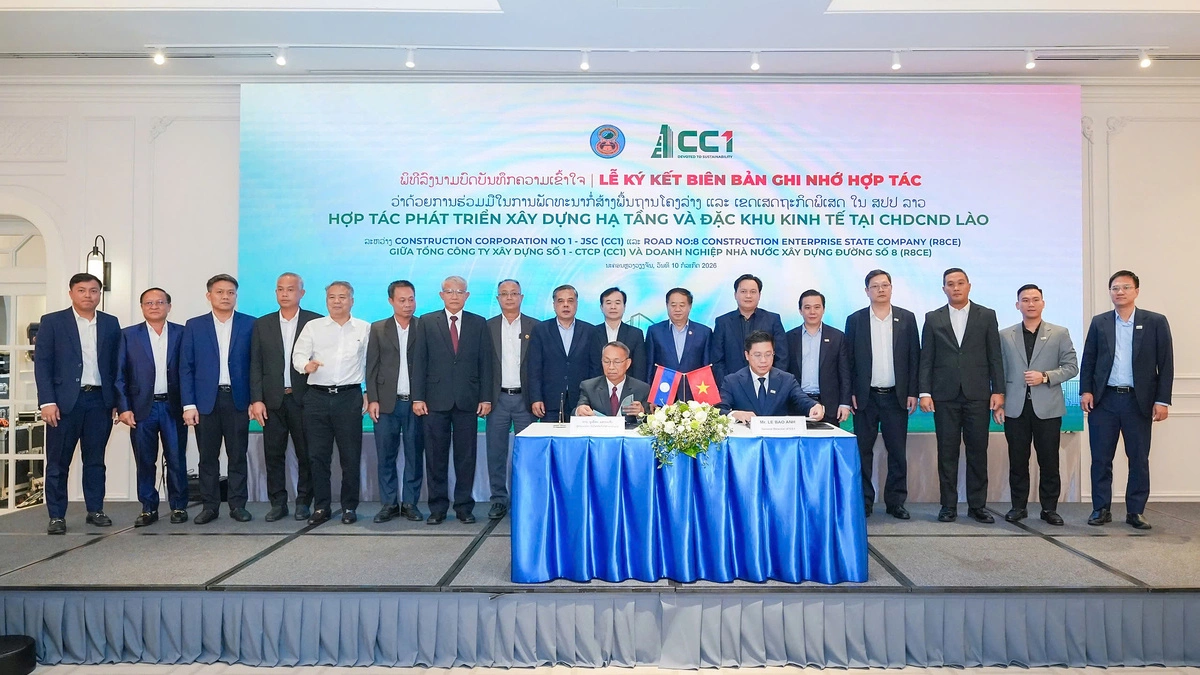
Vietnam's CC1 Expands Infrastructure and Logistics Presence in Laos
Vietnam's leading construction firm, CC1, has signed two Memoranda of Understanding (MOUs) in Laos, significantly boosting its presence in the country's infrastructure and logistics sectors. The agreements aim to develop border infrastructure, logistics hubs, and port facilities, fostering deeper economic ties between Vietnam and Laos.
Vietnam's leading construction firm, Construction Corporation No. 1 Joint Stock Company (CC1), has signed two Memoranda of Understanding (MOUs) in Laos, significantly strengthening its presence in the country's infrastructure and logistics sectors. These partnerships are poised to deepen economic cooperation between Vietnam and Laos. The first MOU, signed on July 10th, was with Road Construction No. 8 State Enterprise (R8CE), a unit under the Lao Ministry of Public Works and Transport. This agreement focuses on developing transport infrastructure across Laos, particularly enhancing key routes like National Highways No. 8 and No. 13, which connect to Vietnam. It also includes the development of logistics infrastructure at border crossings and Inland Container Depots (ICDs), along with associated warehouses, distribution centers, and cargo storage facilities. The two parties also plan to research and develop special economic zones, as assigned by the Lao government to R8CE, and potential infrastructure connectivity projects between Vietnam and Laos, such as expressways and railways. Mr. Phoupheuane Sengphachanh, CEO of R8CE, stated that the signing is the result of exchanges, contacts, and goodwill cooperation from both sides following working visits. He expressed confidence that the MOU will be implemented effectively and practically, serving as a solid foundation for broader future cooperation. The second MOU, signed on July 9th, was with CK Group, a diversified Lao conglomerate involved in investment, trade, construction, real estate, mining, building materials, and industrial equipment. This collaboration aims to jointly research, evaluate, and develop potential infrastructure projects in Laos or those with Lao government capital contribution. Key areas include the Lao-Vietnam International Port in Vung Ang, logistics systems at border gates and ICDs, warehouses, and distribution centers. If implemented effectively, these components could form a complete value chain encompassing seaports, border gates, logistics, industrial parks, trade, and investment. The operation of Berth No. 3 at the Lao-Vietnam International Port (Vung Ang) is particularly significant in improving Laos' access to the East Sea through Vietnam. Mr. Le Bao Anh, General Director of CC1, emphasized that these cooperation agreements go beyond mere business-to-business understandings. They are intended to concretize the high-level cooperation directions between Vietnam and Laos in a new era, with economic, trade, investment, and infrastructure cooperation identified as strategic pillars. In recent years, both governments have promoted transport cooperation for the 2026-2035 period, with the Vietnam-Laos Logistics Forum highlighting the need to translate commitments into concrete actions, especially in reducing logistics costs, modernizing procedures, digitizing data, and developing multimodal transport. CC1 positions itself not just as a construction contractor but as a long-term project development partner. The company intends to participate throughout the entire project lifecycle, from research and surveys, investment planning, financial structuring, to EPC contracting, construction management, and operation. Leveraging over 46 years of experience in infrastructure, industrial, energy, seaport, and PPP projects, CC1 aims to make substantial contributions to large-scale projects in Laos. However, CC1's leadership acknowledges the inherent challenges in cross-border infrastructure projects, including legal hurdles, funding, technical standards, and environmental and social requirements. Therefore, following the MOU signings, CC1 proposed the rapid establishment of a joint working group to review priority projects, conduct on-site surveys, and perform comprehensive evaluations within the first 60 days before proceeding to formal agreements. "CC1's spirit is to speak truthfully, act sincerely, and see things through to real results. Today's MOU must open a working process with a schedule, with products, with responsibility, and with the ability to transform into concrete projects," Mr. Le Bao Anh stressed. Although these agreements are in their early stages, they are considered to be crucial contributions to Vietnamese enterprises gradually expanding their presence and reinforcing Vietnam's role as a gateway in the Mekong sub-region.
多角的分析
CC1のラオスでのインフラ・物流分野への進出は、ベトナム経済の多角化と地域サプライチェーンにおける役割強化を目指す動きと捉えられる。ラオスは内陸国であり、港湾アクセスや物流網の整備が経済発展の鍵となる。CC1は、ベトナムの港湾(特にブンアン港)とラオスの内陸物流拠点を結びつけることで、両国間の貿易コスト削減と効率化に貢献する可能性がある。これは、ベトナムが地域における物流ハブとしての地位を確立しようとする戦略とも合致する。特に、特別経済区や工業団地の開発は、外資誘致や製造業の集積を促進し、ラオスの経済成長を後押しすると同時に、ベトナム企業にとって新たなビジネス機会を生み出すだろう。
CC1のラオスでの事業拡大は、同社にとって新たな成長機会をもたらす可能性がある。インフラ開発は一般的に長期的な視点と多額の資本を要するが、ラオス政府との連携やCKグループのような現地有力企業との提携は、プロジェクトのリスクを分散し、実行可能性を高める。投資家にとっては、CC1がベトナム国内のインフラ建設で培った実績と、ラオスという未開拓市場への進出という点で、将来的な収益拡大の可能性を評価するだろう。ただし、国際プロジェクト特有の法規制、資金調達、為替リスクなど、慎重なデューデリジェンスが求められる。
このインフラ開発は、ラオス国民の生活に直接的な影響を与える可能性がある。例えば、物流網の整備は、地方部への物資供給を改善し、生活必需品の価格安定に寄与するかもしれない。また、新たな道路や港湾は、人々の移動を容易にし、地域経済の活性化につながることも期待できる。一方で、大規模インフラプロジェクトは、土地収用や環境への影響、地域住民の移転といった社会的な課題を伴う可能性がある。CC1が「環境・社会的要求」に言及している点は重要であり、これらの懸念にどのように対応していくかが、プロジェクトの持続可能性を左右するだろう。特に、国境地域や開発される特別経済区周辺の住民の生活や生計への影響を注視する必要がある。
CC1のラオスでのインフラ・物流事業拡大は、ラオスの一般市民、特に地方や国境地域に住む人々にとって、生活の利便性向上や経済機会の拡大につながる可能性がある。新たな道路網は、都市部と地方間の移動を容易にし、物資の流通を改善することで、生活必需品の価格低下や入手しやすさの向上をもたらすかもしれない。また、物流センターや工業団地の開発は、新たな雇用機会を生み出し、地域経済の活性化に貢献することが期待される。しかし、プロジェクトの実施に伴う土地利用の変化や、開発による環境への影響などが、地域住民の生活にどのような変化をもたらすか、注意深く見守る必要がある。
背景・歴史的文脈
ベトナムとラオスは、長年にわたり「特別な関係」を維持しており、経済協力はその中心的な柱の一つである。特に、両国政府はインフラ開発、特に交通インフラの連携強化を重視しており、2026年から2035年までの交通協力期間も設定されている。ベトナムは、ラオスを越えて東南アジア地域へのアクセスを強化する「陸の港」としての役割をラオスに期待しており、CC1のようなベトナム企業によるインフラ投資は、この戦略を具体化するものである。過去には、中国のラオスへのインフラ投資が債務問題を引き起こした事例もあり、ベトナムは、より持続可能で互恵的な協力関係の構築を目指していると考えられる。
原文ソース
VnExpress