General articles are free for 24 hours after publish.
Vietnamese Scientists Develop 'Cyborg Cockroach' for Rescue Missions
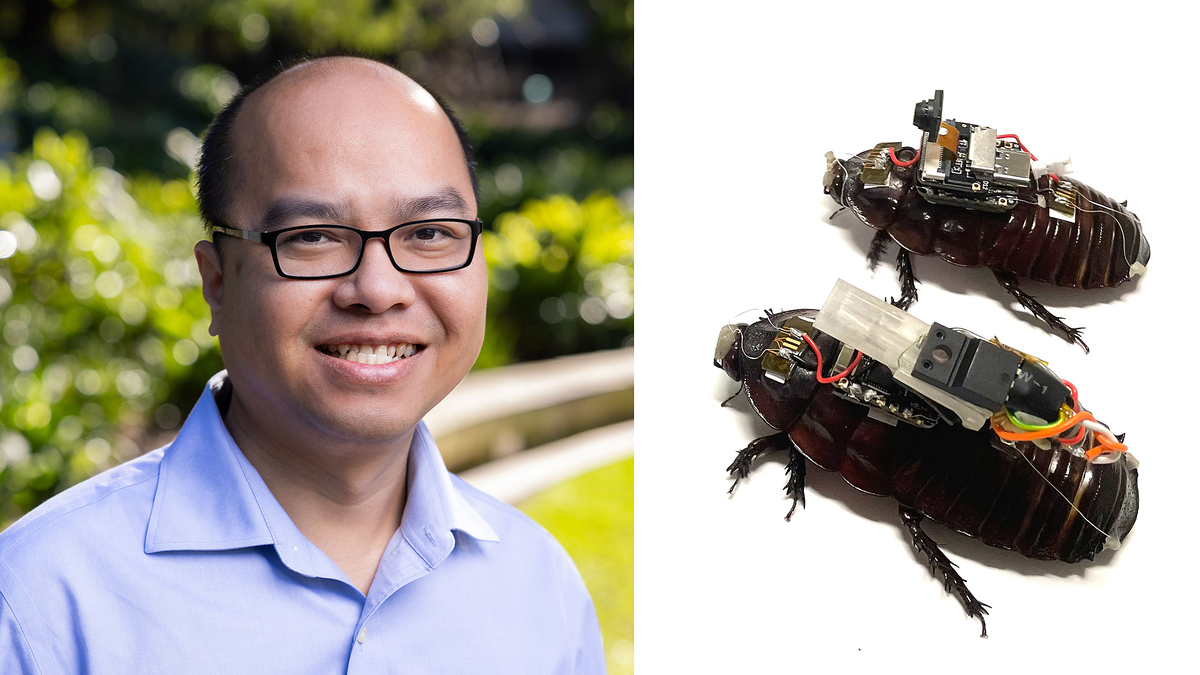
A Vietnamese research team has successfully developed 'cyborg cockroaches' specifically for rescue operations. This innovative technology is expected to contribute to saving lives in disaster areas and other inaccessible locations for humans and larger robots.
A team of Vietnamese scientists has successfully developed 'cyborg cockroaches' for rescue missions, a groundbreaking innovation that could significantly enhance search and rescue efforts in disaster-stricken areas. Led by Dr. Võ Đoàn Tất Thắng, the research integrates biological capabilities with advanced robotics and electronics. The project, based at the Biorobotics Lab, aims to combine the unique strengths of living organisms with engineering. Dr. Thắng, who has a PhD from Nanyang Technological University in Singapore and postdoctoral experience in Germany and Australia, explained that the idea stemmed from a simple question: what more can a cyborg insect do after it finds a trapped person? The developed system, named 'Paraborg,' utilizes the giant burrowing cockroach (Macropanesthia rhinoceros). This species was chosen for its large size and robustness, allowing it to carry additional electronic components, a miniature camera, or a remotely activated injection mechanism while maintaining good mobility. The researchers leverage the cockroach's natural locomotion, adding an electronic layer for directional control and communication. Paraborg is equipped with electrodes that interface with the insect's sensory organs, a miniaturized control circuit, a power source, and a remote-controlled injection system. This allows the cyborg cockroach to move as directed and perform injections at designated targets. The system has achieved a 95% success rate for close-range injections, with a 72% success rate for the complete navigation and injection process. One of the primary challenges encountered was 'habituation,' where the insect's response to stimuli diminishes over repeated exposures. The team has developed adaptive control strategies to address this, including rotational mechanisms to restore orientation capabilities and adjusting stimulation levels. Limitations of the miniature camera's resolution and field of view, challenges in precise localization in confined spaces where GPS is ineffective, and video instability due to the cockroach's movement are also being addressed. Currently, Paraborg is in the prototype phase, with no immediate commercialization roadmap. However, Dr. Thắng anticipates that insect-based robots could become a standard part of rescue teams within the next 5-10 years. He envisions them as an extension of rescuers' capabilities, enabling access to areas inaccessible to humans or larger robots. Future applications could include automated tasks such as navigation, obstacle avoidance, and stabilizing the insect before intervention. For Vietnam, this technology holds particular promise for scenarios like landslides or building collapses, where the cyborg cockroaches could navigate narrow crevices to detect signs of victims, transmit images, and measure environmental parameters. Dr. Thắng also noted the potential for future iterations to carry sensors, communication devices, or small support tools to victims, emphasizing that this technology is intended to supplement, not replace, existing rescue methods. The research has received positive feedback, with Tim Hassiotis, Commissioner of the NSW Rural Fire Service and National Resilience in Australia, commenting on its potential to expand the operational range of rescue teams.
Original source
VnExpress