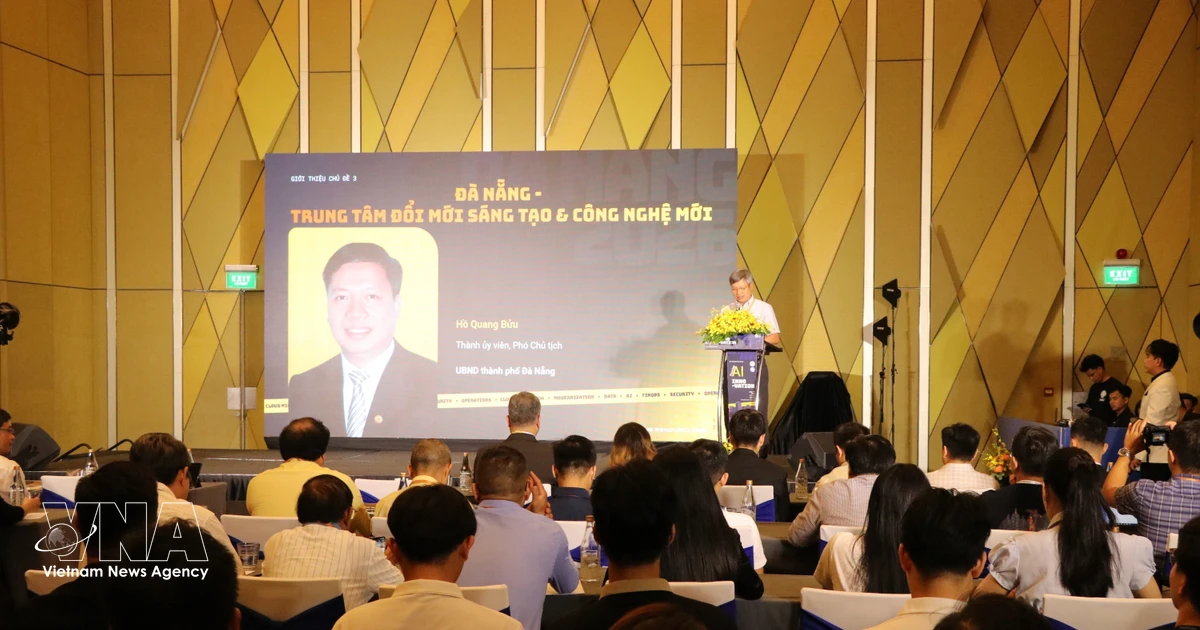
Vietnam Boosts AI Infrastructure Development Through Global Partnerships, Da Nang Eyes Hub Role
Technology
2026年7月17日
5
VietnamPlus English
Relations
🇻🇳Vietnam🇯🇵Japan🇺🇸United States

General articles are free for 24 hours after publish.

Vietnam Boosts AI Infrastructure Development Through Global Partnerships, Da Nang Eyes Hub Role

Share
AI Summary

Vietnam is accelerating partnerships with global technology firms to develop its AI infrastructure. Da Nang city, in particular, is focusing on innovation and fintech, aiming to become a next-generation International Financial Centre (IFC). This move symbolizes Vietnam's industrial restructuring and transition towards a digital economy.

Da Nang is pursuing a next-generation IFC focused on innovation, fintech and sustainable finance, concentrating on high-value segments rather than a traditional fully integrated financial-centre model. According to the Da Nang Statistics Office, total social investment exceeded 50.98 trillion VND (about 1.94 billion USD) in the first six months, up 31.5% from the same period last year. The strong growth reflects investors' confidence in the city's business environment, as well as the effectiveness of its investment promotion policies and efforts to accelerate project implementation. Deputy PM Ho Quoc Dung said the current priority is to change the mindset. AI should not be developed in isolation by individual agencies or organisations but through an interconnected ecosystem linking the State, universities and research institutes, and businesses. Following a rigorous five-week intensive bootcamp led by experts from Google Research, Stanford, and NVIDIA, the teams entered a grueling 48-hour AI hackathon to develop AI-native applications. Vietnam is implementing 19 cooperation projects with the IAEA in different areas, including agriculture, healthcare, nuclear safety and security, and physical and chemical sciences. The initiatives demonstrate how nuclear technologies can contribute to socio-economic development. Both sides agreed that Vietnam-RoK startup cooperation must pivot from fact-finding tours, trade shows and short-term networking towards a hard-nosed partnership model that delivers concrete market access, business partner matchmaking, product validation, technology piloting and investor connectivity. Via conferences, expert dialogues, networking and inspirational talks, VinFuture has brought many of the world's leading scientists to Vietnam not just to share knowledge, but to co-design research, advise on talent pipelines, and build practical solutions for the country’s most urgent problems. Under Directive No. 29/CT-TTg, the Prime Minister instructed ministers, heads of ministerial-level agencies and provincial and municipal leaders to treat science, technology, innovation and digital transformation as a top political priority, stressing that faster disbursement must go hand in hand with efficiency, transparency and the prevention of waste and corruption. End-to-end electronic processing rates have climbed to 91.7% for outgoing documents and 93.8% for incoming ones, the highest nationwide. The rate of administrative procedures handled entirely online has surged to roughly 97–99% at present from 89.65% as of July 1, 2025 Experts are introducing six-dimensional (6D) cerebral vascular imaging for treatment planning, AI-assisted stroke imaging, and robotic intervention and rehabilitation. They are also presenting next-generation neurointerventional devices and personalised treatment strategies to shorten treatment times, improve survival rates, and reduce long-term disability. HSBC (Hongkong and Shanghai Banking Corporation Limited) identifies Vietnam as the economy that has recorded the fastest improvement in its position within the AI supply chain. The country’s share of global trade in AI-related equipment surged from 1.2% in 2015 to 12.4% in 2025, the strongest increase worldwide during the period. Japan is aware that no country can single-handedly manage the entire semiconductor supply chain, so cooperation with partners like the US, Europe, and Asian countries including Vietnam forms a crucial part of Japan's strategy, said Assoc. Prof. Dr Le Duc Anh of the University of Tokyo. Dr Ta Anh Phuong, CEO of Seinetime, a French technology start-up specialising in data personalisation and artificial intelligence (AI) solutions, said Vietnam's strategic technology goods should pass a global relevance test and strive to achieve strategic indispensability, making them products that international corporations actively seek to incorporate into their operations. Deputy Prime Minister Ho Quoc Dung expressed his hope that Professor Tran Thanh Van, the Rencontres du Vietnam Association and ICISE would continue serving as bridges between Vietnam and the international scientific community, attracting leading researchers and making practical contributions to the country's scientific and technological progress. During the event, participants receive both fundamental and advanced training in particle physics and neutrino science through lectures covering neutrino physics, the Standard Model, particle and radiation detectors, reactor neutrino experiments, high-energy neutrino astronomy, supernova neutrinos, and major international projects such as Super-Kamiokande, T2K and Hyper-Kamiokande. Experts said an efficient data market will ensure that data flows to sectors where it generates the greatest economic value, thereby improving the economy's overall efficiency. As Vietnam implements the Politburo's Resolution No. 57-NQ/TW on breakthroughs in science, technology, innovation and national digital transformation, the development of a domestic semiconductor industry has become an important strategic priority. Academic queries account for 17% of all prompts submitted by Vietnamese users, well above the regional average of 11%, cementing Vietnam’s position as the region’s top adopter of AI for education. Under the newly issued resolution, citizens have the right to control the use of their personal data, access digital services and receive legal protection in the digital environment. Vietnam's growth model, long fueled by low-cost labour, resource extraction, contract manufacturing, expanded investment, and capital accumulation, has run out of road. The country now needs a sweeping reform agenda to shift from extensive growth to a model driven by productivity, knowledge, science and technology, innovation, and digital transformation. A year after adopting the two-tier local administration model, Bu Gia Map, a remote border commune in the southern city of Dong Nai with a significant ethnic minority community, has experienced notable improvements in public administration, making digital public services more accessible to residents and boosting governance efficiency. In the first quarter of 2026, more than 6.9 million accounts were exposed, double the figure recorded in the same period last years. Stolen personal data has frequently been exploited in sophisticated online scams, particularly impersonation schemes targeting victims through fake relatives or acquaintances. Through a series of display areas, visitors can explore notable scientific and technological achievements of the People's Public Security Force in safeguarding national security in cyberspace. The exhibition also provides information on common forms of online fraud and cyber scams, along with practical guidance on how to identify and prevent them. Copyright, VietnamPlus, Vietnam News Agency (VNA) Editor-in-chief, Mr. Tran Tien Duan.

0

Original source

VietnamPlus English

原文を読む