General articles are free for 24 hours after publish.
Vietnam's Missile Focus Addresses Maritime-Continental Dilemma
Vietnam is shifting its military modernization from naval platforms to long-range surface-to-surface and ground-based anti-ship missiles to address its dual challenge of defending South China Sea claims and continental borders. This strategy aims to enhance multi-domain deterrence and defense capabilities with limited resources.
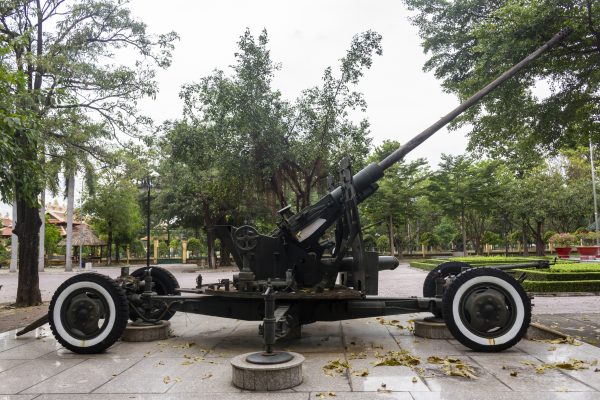
Read The Diplomat, Know The Asia-Pacific Long-range surface-to-surface and ground-based anti-ship missiles will help defend the country on both land and sea. An air defense gun on display at a military museum in Binh Duong, Vietnam, Nov. 16, 2021. Vietnam’s military modernization is setting off in a new direction. Instead of procuring naval platforms such as submarines or frigates to defend its South China Sea claims, as it did in the 2010s, the country is looking to upgrade and acquire long-range surface-to-surface and ground-based anti-ship missiles (ASMs) to guard against both continental and maritime threats. A number of recent developments show that this is the case. First, Vietnam established the Artillery-Missile Command based on the Artillery Corps in August of last year. The Command was intended to be leaner, given expanded duties, and equipped with more advanced weaponry. Second, it introduced the domestically produced shore-based ASM system Truong Son and showed off the Scud-B tactical ballistic missiles procured from the Soviet Union in the 1980s, on the 80th anniversary of Vietnam’s founding. Hanoi also revealed that it succeeded in upgrading the range of the Scud-B from 300 to 500 kilometers. In May, Vietnam signed a $629 million BrahMos missile deal with India. Third, it is moving the 380th Missile Brigade from Thai Nguyen province in northern Vietnam to Dak Lak province in the Central Highlands, whose mountainous terrain and position at the center of the Indochinese peninsula can help Vietnam project power further southwest in response to security uncertainty from Cambodia. The 380th Missile Brigade is one of Vietnam’s two ballistic missile brigades, along with the 490th Missile Brigade based in Hai Phong in the northeast. Vietnam’s rationale for this focus on missile forces is rooted in the maritime-continental dilemma. As I argued a few years ago, Vietnam is torn between allocating its resources to the continental west and the maritime east. Land-based platforms such as tanks, artillery, or armored personnel carriers cannot be deployed to defend the country’s outposts in the South China Sea. Frigates, submarines, or patrol boats likewise cannot guard Vietnam’s borders with Laos and Cambodia. Due to resource constraints, Vietnam cannot procure both platforms, and this makes little sense anyway considering that China could easily win an arms race in such a scenario. Vietnam’s air force can defend the two domains, but its Su-22, Su-27, and Su-30 fighters are aging fast. Vietnam has looked to replace its fleet with F-16 and Su-35 fighters, but those deals have not materialized. Vietnam also lacks modern long-range bombers. Missiles thus become the most suitable option for multi-domain deterrence and defense. Vietnam’s military doctrine is to defend the country early and from afar, and missiles’ long range and quick reaction time fit this doctrine. Importantly, missiles can help resolve Vietnam’s maritime-continental dilemma thanks to their adaptability to multiple geographical domains. ASMs allow Vietnam to prevent an enemy navy from operating in its territorial waters by harassing its naval strike groups. Long-range surface-to-surface missiles can threaten targets in western Indochina or maritime outposts. The fact that these missiles are land-based means they have better survivability compared to frigates or patrol boats, which are exposed on the open ocean. Vietnam’s mountainous and jungle terrain coupled with silos provides the ideal cover for a missile system, while logistics and maintenance lines are more robust on land than at sea. Vietnam’s military has tremendous experience with moving, concealing, and operating missile systems in this terrain from the Second Indochina War. It has also operated Scud-Bs for more than 40 years. In terms of cost, land-based missiles are cheaper to acquire than single-domain platforms. Vietnam is thus prioritizing the development of ASMs and surface-to-surface missiles. Instead of having to invest in frigates or patrol boats to deny the enemy access to its waters or escort its naval vessels, Vietnam can use land-based missiles for that end. Indeed, it has long counted on the 4K44M Redut-M and K-300P Bastion-P coastal defense missile systems. The development of its own Truong Son coastal defense missile system shows that Vietnam wants to lessen dependence on foreign suppliers and considers land-based platforms an essential part of maritime defense. Missiles also posed an asymmetrical threat to the enemy’s surface warships and aircraft carriers given that each missile is cheap to produce and hard to defend against. Vietnam’s long coastline guarantees coastal missile defense systems can cover most of the South China Sea. Ukraine successfully sank several Russian vessels in the Black Sea using ASMs. Vietnam’s missiles can be pointed westward too. It is the only Southeast Asian country armed with Scud-Bs. With an upgraded range of 500 kilometers, they allow Hanoi to hit targets throughout most of Indochina from bases in Hai Phong and Dak Lak without having to send troops outside of Vietnam’s territory. Vietnam has test-fired other Scud variants in the 550-700 kilometer range without any issues. BrahMos missiles’ ability to attack both land and sea targets within 300 kilometers only strengthens Hanoi’s strategy of denying enemy access to western Indochina and the South China Sea. Doctrines and weapons will not be effective without a unified command. And this is why Hanoi decided to establish the Artillery-Missile Command last year. The role of the Command is to streamline the decision-making process and accelerate the kill chain among different military units, including both the ASMs and the surface-to-surface missile units. Due to many provinces having both land and sea borders after the consolidation of 63 cities and provinces into 34 in July 2025, Vietnam seeks to equip each theater of operations with one surface-to-surface missile brigade, one long-range ground-based ASM brigade, and one mixed artillery brigade to give them the versatility to fight enemies from all directions, including from the air. For strategic theaters, Vietnam will allocate even more missile forces. A unified command will ease the process of research and development as well as the adoption of new missile systems throughout all military units. It will also provide the framework for the establishment of future missile brigades. It is worth noting that while missiles alleviate Vietnam’s maritime-continental dilemma by denying the enemy access, they cannot occupy or reclaim territories. Vietnam will still have to procure single-domain platforms for western Indochina and the South China Sea if it wants to hold physical territories. However, the fact that Vietnam assigns expanded duties to the artillery-missile forces signals that it will not tolerate any gap in defense while it is undertaking long-term weapon domestication for the army and
Original source
The Diplomat Indonesia