‘Blocked Aid, Unbroken People’ puts spotlight on aid crisis in central Myanmar
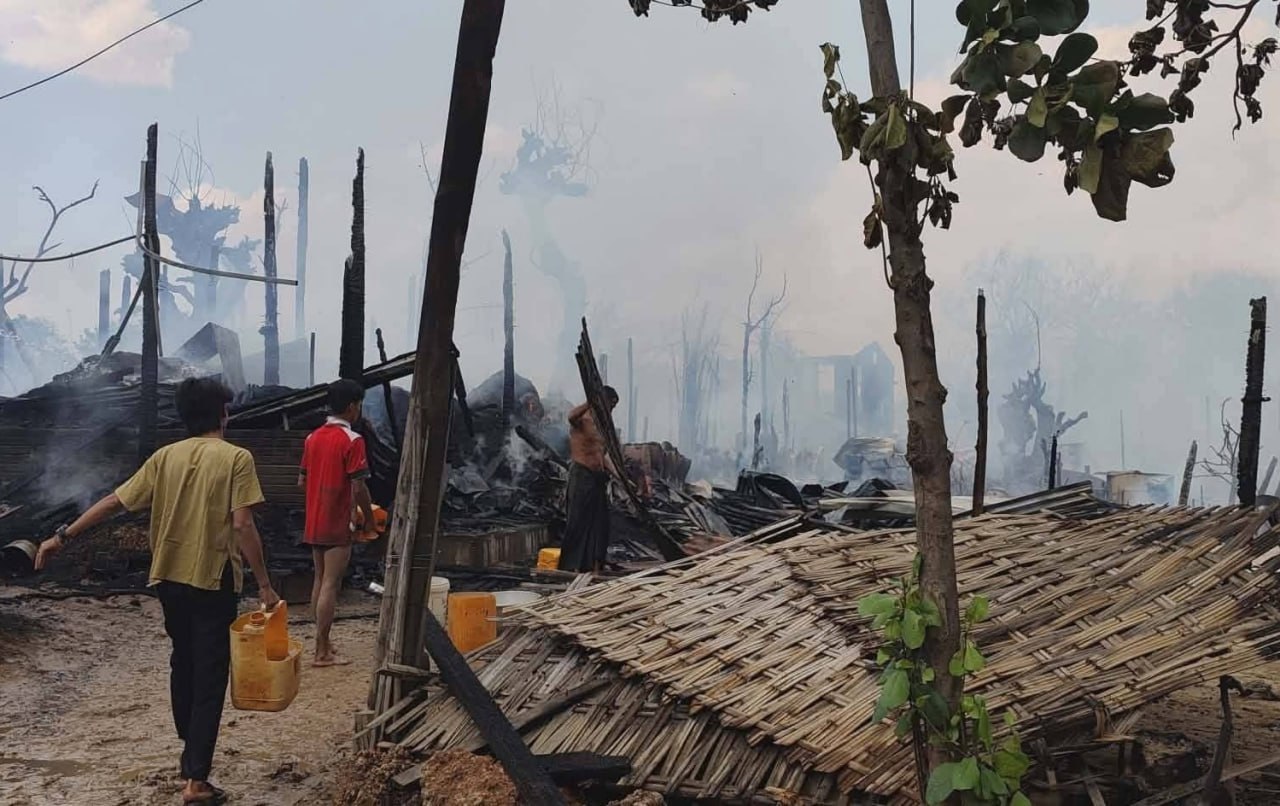
Myanmar’s humanitarian crisis is rapidly deepening across the central “Dry Zone” as the military intensifies its campaign of violence and systematically weaponizes humanitarian aid against civilians, according to a newly released joint briefing paper by nine civil society organizations. The report, titled “Blocked Aid, Unbroken People,” details how the military has expanded its brutal “Four Cuts” strategy into the Sagaing, Magwe, and Mandalay regions, relying heavily on three defining tactics of terror: airstrikes, arson, and landmines. A campaign of airstrikes, artillery, and arson Since the Feb. 1, 2021 military coup, the regime in Naypyidaw has increasingly deployed “mass-barrage airstrikes,” utilizing Myanmar Air Force fighter jets, as well as drones, gyrocopters and paramotors to deliberately target civilian infrastructure. On the ground, arson attacks have decimated communities as a form of collective punishment. Since 2021, the military and its militias have destroyed over 121,000 civilian homes, with the Sagaing Region suffering the greatest losses, accounting for more than 63 per cent of all homes razed nationwide. Furthermore, the military is heavily contaminating civilian areas, farmland, and abandoned villages with internationally banned anti-personnel landmines. Myanmar now records the highest number of landmine casualties globally. “There is a great deal of fear. None of us feel safe. We are afraid of air attacks,” said a resident from Sagaing’s Taze Township, who fled his home due to military attacks. “When drones come, we have to run and hide, and when aircraft come, we have to take cover wherever we can… We can no longer stay in our own village”. Humanitarian catastrophe and the weaponization of aid The relentless violence has led to widespread and prolonged displacement. The United Nations estimates that over 3.7 million people are displaced from their homes in Myanmar—referred to as internally displaced persons (IDPs) by the U.N.–with more than 1.3 million sheltering from attacks in the Sagaing Region alone. The crisis is compounded by the regime’s deliberate obstruction of life-saving assistance. The World Food Programme (WFP) recently warned that more than 12 million people in Myanmar will face acute hunger in 2026. “When [regime forces] burn, they do not burn just the houses; they burn everything together, including machinery and livestock,” said a human rights defender living in the Magway Region. Community-led resistance and survival Despite the severe restrictions, deliberate violence, and massive shortfalls in international funding, local communities remain unbroken. With international aid largely blocked, civil society and local organizations have stepped in as the primary lifeline for conflict-affected communities in Myanmar. These frontline humanitarian responders are navigating active conflict zones to deliver emergency food, cash, and medical supplies. To fill the void left by destroyed public infrastructure, communities are establishing their own essential services, including community-led education centers, mobile libraries, and mobile healthcare clinics. A call for direct international action The coalition of civil society organizations is issuing an urgent plea to the Association of Southeast Asian Nations (ASEAN) and the broader international community: stop attempting to deliver aid through the regime in Naypyidaw. “ASEAN Special Envoy Ma. Theresa P. Lazaro recently announced plans to lead a humanitarian mission to conflict-stricken Myanmar by the end of 2026,” said Khin Ohmar, the chairperson of Progressive Voice. “Why is there such a delay in saving lives? ASEAN has waited far too long. The Philippines, as the current ASEAN Chair, must immediately implement this decision and ensure aid goes through locally led border mechanisms.” The post ‘Blocked Aid, Unbroken People’ puts spotlight on aid crisis in central Myanmar appeared first on DVB.
This article requires PRO
This article is outside the free access window or is a special report. PRO unlocks it and the full archive.
Related articles
- Mae Tao Clinic highlights Thai-Myanmar border crisis after winning Okinawa Peace Prize
In an exclusive interview with DVB following the announcement of the 13th Okinawa Peace Prize, Dr. Cynthia Maung, founder and director of the Mae Tao Clinic, reflected on the clinic’s recognition as the first non-Japanes
- MAA calls for a one-day work stoppage to protest the visit of the interim president Min Aung Hlaing to Malaysia
Ayeyarwaddy Times October 5 Myanmar Affairs Alliance (MAA) has urged Myanmar nationals residing in Malaysia to participate in a "work stoppage strike" by refraining from going to work entirely on the upcoming October 7th
- Skeletons of 12 Civilians Discovered in Mass Graves in Myanmar’s Myaing Township
The human remains of 12 civilians abducted by Myanmar military forces in June 2023 have been discovered in two mass graves near Wetpoke Village in Magway Region’s Myaing Township, according to local resistance fighters a
- Myanmar workers in Malaysia call for strike ahead of Min Aung Hlaing visit to Kuala Lumpur
The Myanmar Affairs Alliance, an advocacy coalition representing Myanmar migrant workers across Malaysia, issued an urgent appeal on Monday, calling for a nationwide “Work Stoppage Strike” on Wednesday. The strike is org