General articles are free for 24 hours after publish.
Digital Transformation Fuels Sustainable Development in Mekong Delta
Digital transformation is emerging as a key driver for sustainable development in Vietnam's Mekong Delta. Universities and research institutions are focusing on technological development and dissemination in agriculture to enhance farmers' risk resilience and increase the value of agricultural products. International cooperation in advanced technology fields, such as semiconductor workforce training and industrial application of drone technology, is also progressing.
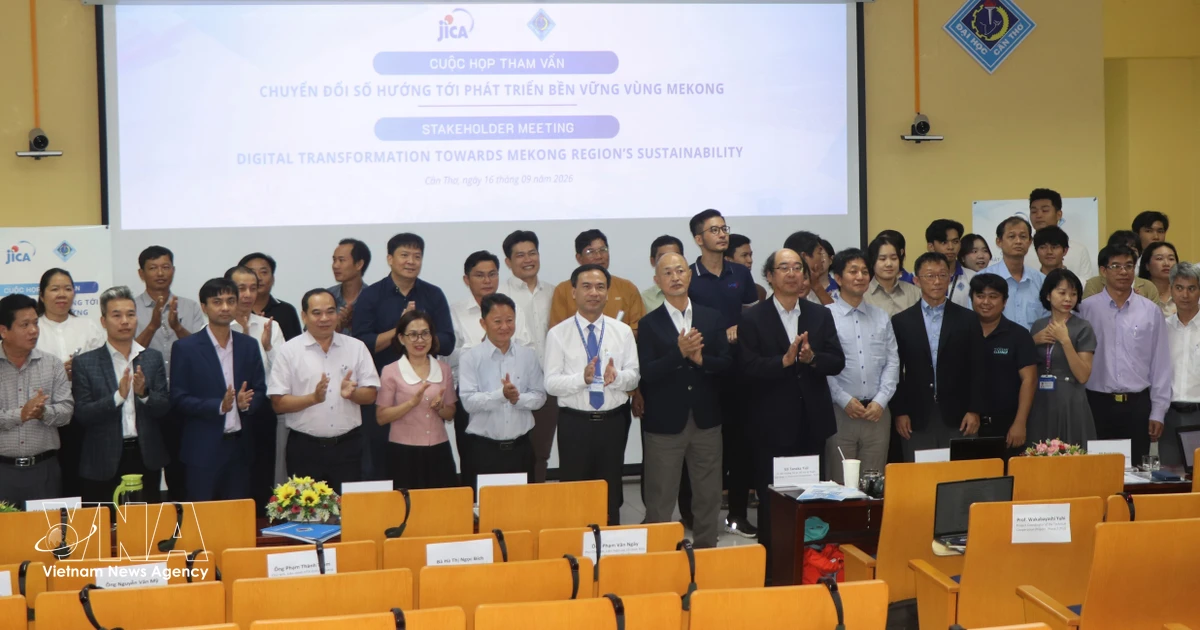
Digital transformation is being promoted as a key to sustainable development in Vietnam's Mekong Delta region, an area known for its rich agriculture. Dr. Nguyen Van Quang, Rector of Nam Can Tho University, stated that the university is developing a value chain encompassing training, research, technology development, testing, technology transfer, and commercialization. This model aims to strengthen the link between research and practical needs, ensuring that technologies generate products and products create value for society. An urgent shift from a "passive response" mindset to one of "proactive adaptation" is crucial for ensuring the sustainable development of the Mekong Delta and advancing the greening of Vietnam's largest rice-producing region. This model helps farmers proactively respond to weather risks while opening up new directions for increasing the value of agricultural products through ecological and organic production processes. Vietnam needs to step up semiconductor workforce training to meet growing market demand and enhance its capacity to participate in the global technology value chain, experts said, highlighting the importance of closely linking training with businesses, production, and technological research. Nguyen Anh Tuan, Director of the National Centre for Pilot Semiconductor Chip Manufacturing Support under the Ministry of Science and Technology, noted that amid increasingly intense global technological competition, the semiconductor industry is not only a high-value-added economic sector but also a foundation for technological self-reliance, national security, and economic competitiveness. Furthermore, Vietnam sees opportunities in unmanned aerial vehicle (UAV) technology, not only in expanding their applications but, more importantly, in gradually building industrial capacity, mastering technologies, and engaging more deeply in global value chains. Innovative projects are also progressing, including an intelligent autonomous transportation system developed by Phenikaa-X JSC and technology for producing mixed rare-earth oxides with a purity of over 95% on a semi-industrial scale by Mining Technology and Construction Consultancy JSC. In terms of international cooperation, Nguyen Duy Ngoc, Member of the Politburo, Secretary of the Communist Party of Vietnam Central Committee, and Chairman of its Commission for Organisation, stated during his visit to the Institut Polytechnique de Paris that education and training, science and technology, and high-quality human resources are key areas of cooperation in Vietnam-France relations. The University of Science and Technology of Hanoi (USTH) and the French Alternative Energies and Atomic Energy Commission (CEA) exchanged two cooperation agreements in Paris in the presence of General Secretary of the Communist Party of Vietnam Central Committee and President To Lam. Vietnamese Ambassador Duong Hoai Nam stressed the need to strengthen cooperation between educational and research institutions of the two countries, shifting towards long-term partnerships with tangible outcomes. Moreover, Vietnam believes that by learning from the experiences of pioneering countries like Russia, it can significantly shorten the time needed to build its workforce and develop endogenous capabilities. General Secretary of the Communist Party of Vietnam Central Committee and President To Lam’s upcoming official visit to France is expected to provide fresh momentum for Vietnam-France ties, coming at a pivotal time for Vietnam’s economic restructuring. Source: VietnamPlus English
Original source
VietnamPlus English