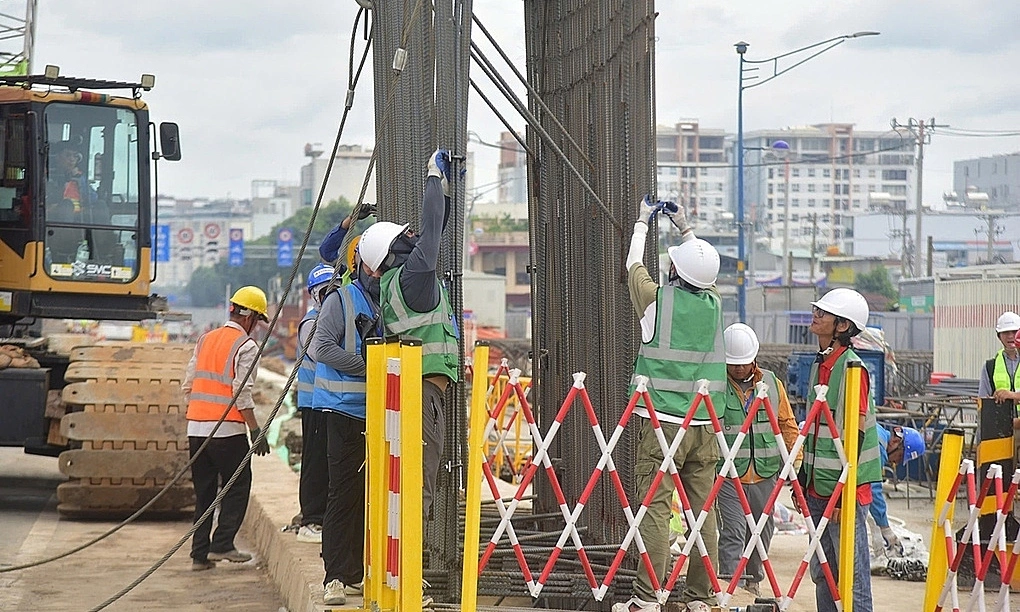
HCMC Begins Construction on 41m-Deep Station for Metro Line 2
Ho Chi Minh City has commenced full-scale construction on its Metro Line 2 (Ben Thanh-Tham Luong), with the excavation and diaphragm wall construction for the 41-meter-deep Pham Van Bach Station underway. This marks a significant step in the VND55 trillion (US$2.1 billion) project aimed at expanding the city's urban rail network by 2030.
Workers have begun lowering initial steel reinforcement cages into an excavation pit near the Cong Hoa–Truong Chinh intersection to construct the 1.2-meter-thick diaphragm wall for Pham Van Bach Station, marking the official transition of Ho Chi Minh City's Metro Line 2 (Ben Thanh-Tham Luong) from its preparation stage to full-scale construction. According to the HCMC Management Authority for Urban Railways (MAUR), the diaphragm wall at Pham Van Bach Station will extend approximately 534 meters. The construction of this 41-meter-deep wall is expected to take six months. During the building phase, the wall will serve to retain soil and groundwater, ensuring the stability of the excavation pit. Once the station is completed, it will function as a permanent load-bearing component of the overall structure. MAUR emphasized that this phase demands a high level of technical precision, strict material quality control, and rigorous safety measures. Pham Van Bach Station is strategically located at the gateway to Tan Son Nhat International Airport. It will serve as the final underground stop before Metro Line 2 transitions to an elevated section at Tan Binh Station. The station's design includes two underground levels intended to house ticketing areas, operational facilities, and passenger platforms. Phan Cong Bang, head of MAUR, stated that Pham Van Bach Station and Le Thi Rieng Station (located on Cach Mang Thang Tam Street) will act as the primary launch sites for the tunnel boring machines (TBMs) that will excavate the underground routes. Both stations have been prioritized for early construction, with completion scheduled for the third quarter of 2027, to facilitate TBM installation and operation. MAUR acknowledged that the simultaneous construction along the route will inevitably impact local traffic. To mitigate congestion and minimize disruption to residents, the agency has established barriers, traffic diversions, and designated construction staging areas. The construction of the Ben Thanh–Tham Luong Metro Line officially commenced in mid-January, backed by a total investment exceeding VND55 trillion (US$2.1 billion). The route stretches nearly 11.3 kilometers in total length, with over 9 kilometers of underground track. The line features one elevated station in addition to the 10 underground stations, and a single depot. The project is set to be completed in 2030, linking downtown HCMC with the city's northwestern area. HCMC currently operates one metro line, the 20-km Ben Thanh-Suoi Tien route, which connects downtown HCMC to Thu Duc City. Officially opened in late 2024, this line spans nearly 20 kilometers and is the city's first operational urban rail project.
多角的分析
地下鉄2号線の建設は、ホーチミン市の都市インフラへの大規模な投資であり、経済成長の推進力となる。総工費2.1兆円という巨額の資金は、建設業、資材供給、関連サービス産業に直接的な雇用と需要を生み出す。さらに、完成後の鉄道網の拡充は、物流コストの削減、通勤時間の短縮、ビジネス活動の活性化に繋がり、長期的な経済効率の向上に寄与すると考えられる。これは、ベトナムが国際的なサプライチェーンにおけるハブとしての地位を強化し、外国直接投資(FDI)をさらに呼び込むための重要な基盤整備と言える。
このプロジェクトは、インフラ開発への長期的な投資機会を提供する。特に、建設資材、エンジニアリングサービス、不動産開発といった関連分野への投資が期待される。また、完成後の都市交通網の改善は、沿線不動産の価値向上や商業施設の活性化に繋がり、間接的な投資リターンも期待できる。ただし、大規模インフラプロジェクトは、建設期間中の交通渋滞や環境への影響、予期せぬコスト増のリスクも伴うため、投資家はこれらのリスクを慎重に評価する必要がある。
地下鉄2号線の建設は、ホーチミン市民の日常生活に直接的な影響を与える。工事期間中の交通渋滞や騒音、振動は、沿線住民の生活の質を一時的に低下させる可能性がある。しかし、長期的には、公共交通機関の利便性向上により、通勤時間の短縮、移動コストの削減、大気汚染の軽減が期待される。特に、タンソンニャット国際空港へのアクセス向上は、旅行者やビジネス関係者にとって大きな恩恵となる。これは、都市の持続可能な発展と市民生活の質の向上に向けた重要な一歩である。
ホーチミン市では、交通渋滞が日常生活の大きな負担となっている。地下鉄2号線の建設は、将来的な交通状況の改善への期待を高める一方で、工事期間中の交通規制や騒音、粉塵といった問題が、特に駅建設予定地周辺の住民や通勤・通学で道路を利用する人々の生活に直接的な不便をもたらす。市民は、工事の進捗と並行して、交通緩和策が効果的に実施されるか、また、環境への配慮が十分に行われるかに注目している。
背景・歴史的文脈
ベトナム、特にホーチミン市は、急速な経済成長と人口増加に伴い、深刻な交通インフラの不足に直面している。1986年のドイモイ政策以降、市場経済化が進み、都市部への人口集中が加速した。2010年代初頭から都市鉄道網の整備計画が本格化し、2014年には最初の地下鉄路線(ベンタイン~スオイティエン線)の建設が開始された。今回の地下鉄2号線(ベンタイン~タムルオン線)は、その第二段階の主要プロジェクトであり、都市中心部と北西部を結ぶことで、交通渋滞の緩和と経済活動の活性化を目指している。これは、ベトナム政府が掲げる「持続可能な都市開発」と「近代的なインフラ整備」という国家戦略の一環として位置づけられている。
原文ソース
VnExpress International