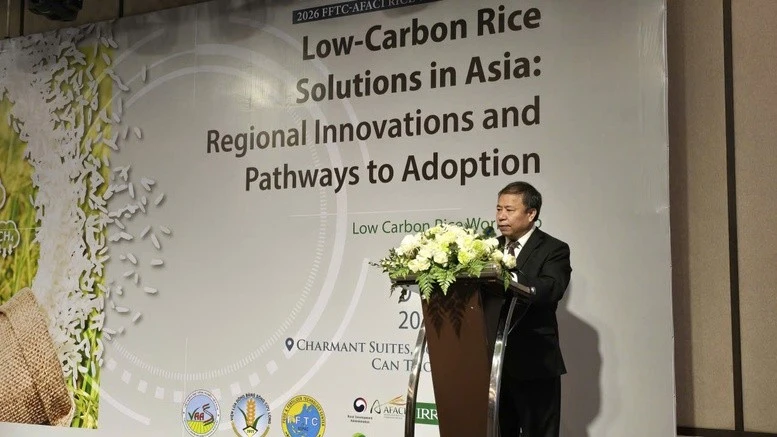
Vietnam Accelerates Science-Tech Integration for Sustainable Rice Production
Economy
2026年7月23日
6
VietnamPlus English

General articles are free for 24 hours after publish.

Vietnam Accelerates Science-Tech Integration for Sustainable Rice Production

Share
AI Summary

Vietnam is accelerating its transition to sustainable rice production by integrating nutrient management, biotechnology, mechanization, and digital technologies to enhance productivity and reduce greenhouse gas emissions. Efforts are underway with an eye on international markets.

Experts have agreed that integrating nutrient management, biotechnology, mechanization, and digital technologies is key to enhancing productivity, reducing greenhouse gas emissions, and accelerating the transition towards greener, more sustainable rice production in Vietnam. Certified rice produced through these methods has not only been exported to Japan but has also reached markets in Europe and Oceania. In 2024, the World Bank committed a US$350 million loan to the Vietnamese Government for the implementation of a project associated with green growth in the Mekong Delta, aiming to cover one million hectares. Prime Minister Pham Minh Chinh has called on the business community, business associations, and the Vietnam Chamber of Commerce and Industry (VCCI) to strengthen self-reliance, innovation, and competitiveness by improving governance, adopting advanced technologies, enhancing product quality, and utilizing capital more efficiently. A recent event, themed “Tech Empowered, Future Equipped,” underscored the group's strategy to accelerate green development, digital transformation, and international cooperation, while highlighting opportunities for deeper industrial collaboration with Vietnam. Economically, remittances transferred through credit institutions and economic organizations totaled US$2.03 billion in the second quarter, a 1.4% increase from the first quarter but a 27.9% decrease from the same period last year, according to the State Bank of Vietnam (SBV)’s Region 2 Branch. The daily reference exchange rate set by the SBV was 25,260 VND/USD on July 22, unchanged from the previous day, with the trading band for commercial banks at +/- 5%. In the aviation sector, Vietnam recorded the fastest growth among the region’s top 10 aviation markets over the past decade, with a remarkable increase of 121%, as noted by Paul Geaney, President and Chief Commercial Officer of Avolon. Infrastructure developments include the premium Hoa Phuong Do (Flamboyant Flower) train operating between Hanoi and Hai Phong city, which has completed nearly 3,000 trips and carried around 1.33 million passengers since its service commencement in May 2025. Lien Khuong Airport is expected to handle an average of 36–40 flights and around 6,800 passengers per day after its temporary closure for repair and upgrade since March. A Czech diplomat described the arrival of the first container as the successful outcome of a long and complex market-opening process involving years of negotiations, regulatory approvals, and close cooperation between Czech and Vietnamese authorities. According to Vu Binh Minh, CFA, Associate Director, FX Trading, Markets and Securities Services at HSBC Vietnam, Vietnam’s economy has built a relatively favourable position in the first six months of the year, with GDP expanding 8.18% – the highest first-half growth rate in recent years – as key growth drivers have operated in tandem. In the semiconductor industry, QTSC (Quang Trung Software City) and the Singapore Semiconductor Industry Association (SSIA) signed a memorandum of understanding (MoU) to connect Vietnam's semiconductor ecosystem with Singapore's semiconductor business network and the wider region. The CPTPP has evolved beyond tariff reductions into a broad framework covering goods, services, investment, and digital trade. Since taking effect, the agreement has significantly expanded Vietnam's access to major markets across North America, the EU, and the Asia-Pacific, contributing to strong export growth in key sectors such as textiles and garments, footwear, and agricultural, forestry, and fishery products. It has also encouraged greater investment into Vietnam by promoting regional production networks and clearer rules of origin. Source: VietnamPlus English

0

Original source

VietnamPlus English

原文を読む