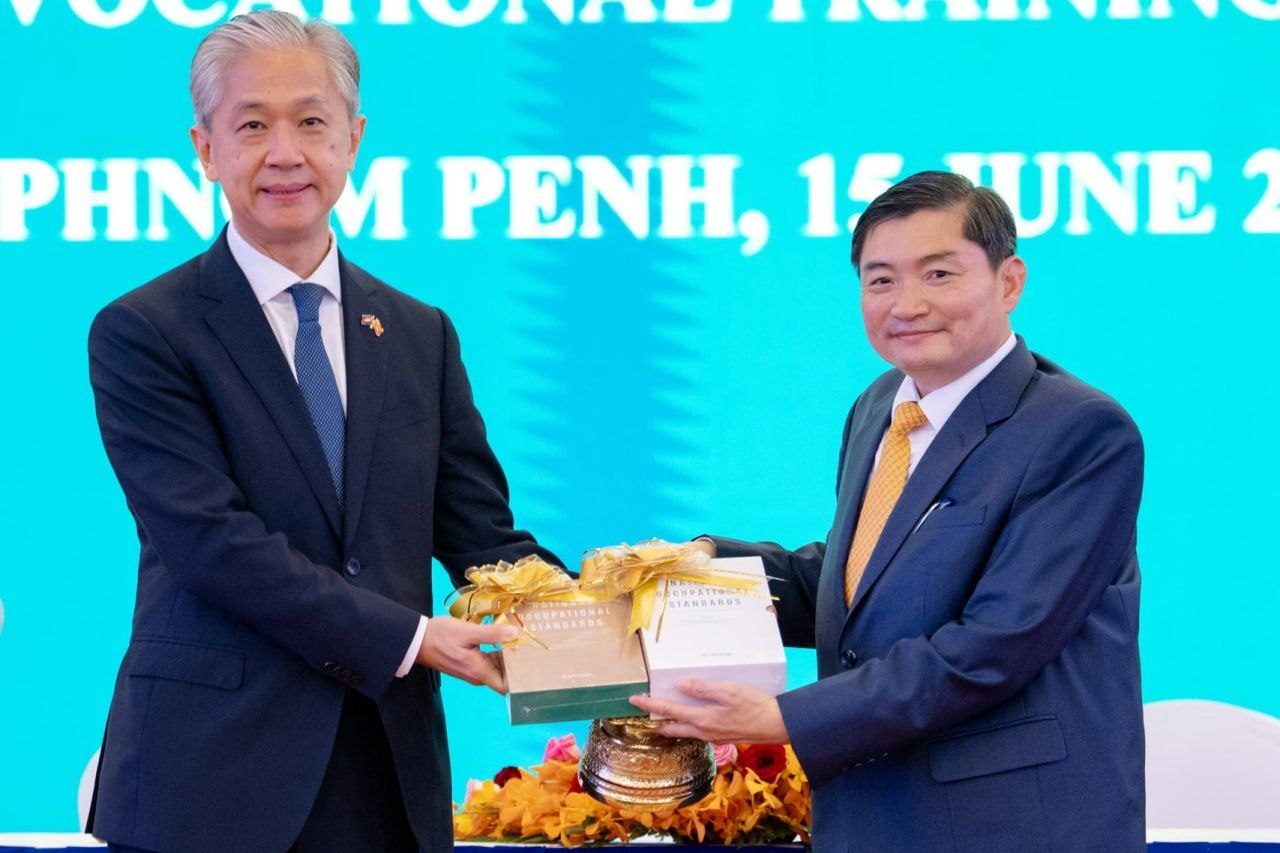
China Provides National Occupational Standard Book to Support Cambodia's TVET Enhancement
China has provided Cambodia with a "National Occupational Standard Package of China" book to support the enhancement of vocational education and training (TVET) quality and its alignment with market demands. This initiative underscores the close friendship between Cambodia and China and is expected to contribute to workforce development, particularly in the new energy vehicle sector.
The Chinese government, through the Ministry of Human Resources and Social Security of China, has provided Cambodia with the "National Occupational Standard Package of China" book to support the enhancement of professional skills standards and the development of a high-quality Technical and Vocational Education and Training (TVET) system that aligns with labor market demands. The book handover ceremony took place recently at the Diamond Island Convention and Exhibition Center, presided over by H.E. Heng Sour, Minister of Labour and Vocational Training, and H.E. Wang Wenbin, Ambassador of the People's Republic of China to Cambodia, symbolizing the close friendship between Cambodia and China. The book meticulously records numerous professions and their evaluation methods, categorized by type and skill level. It is considered highly significant in strengthening national standards for the Cambodian labor market and serves as a new roadmap for deep reforms in TVET education and training. The 16 included professional skills are: Bricklaying, Steel Bar Processing and Installation for Construction, Road Construction, Bridge and Tunnel Construction, Machining Parts by Milling Machine, Machining Parts by Lathe Machine, Internet System Installation, Telecommunication Cable Network Installation and Maintenance, Elevator and Escalator Installation and Maintenance, Refrigeration and Air Conditioning System Installation and Maintenance, Household Electronic Appliance Maintenance, Electrical and Electronic System Installation and Maintenance, Motorcycle Maintenance and Repair, Automobile Maintenance, Solar Energy Harvesting System Installation and Maintenance, and Household Services (Housekeeping). Receiving the "National Occupational Standard Package of China" not only strengthens the standards for professional skills training in Cambodia but also forms a crucial basis for developing curricula and training programs that meet the needs of the New Energy Vehicle (NEV) industry. This is aimed at responding to industrial development and competition in the era of modern technology. Concurrently, as the electric vehicle market in Cambodia is growing, these standards will help prepare a workforce with sufficient, high-quality skills and capabilities to maintain, repair, and service electric vehicles. This will support the development of the EV market in Cambodia and enhance the competitiveness of the industrial sector in the long run. The "National Occupational Standard Package of China" was published by the Ministry of Human Resources and Social Security of China, with contributions from over 50 Chinese government labor experts. It focuses in detail on the organization of professions and the evaluation of numerous jobs, clearly categorized by order and different skill levels. Source: AKP Khmer
多角的分析
中国からの技術標準書の提供は、カンボジアのTVET分野における国際基準への接近を促進し、労働力の質向上を通じて産業競争力を高める潜在力を持つ。特に、新エネルギー自動車(NEV)分野への言及は、カンボジアが将来の成長産業に備え、サプライチェーンの一部として組み込まれる可能性を示唆している。これは、中国がカンボジアの産業発展を支援する一環として、技術移転と標準化を通じて経済的影響力を拡大しようとする動きとも解釈できる。中国が提供する標準がカンボジア国内の産業ニーズとどれだけ適合するか、また、それらが国内の既存の職業訓練システムにどのように統合されるかが、経済的効果を左右する鍵となるだろう。
このニュースは、カンボジアのTVET分野における標準化と質向上への取り組みを示すものであり、長期的な視点で見れば投資環境にとってポジティブな要素となり得る。特に、新エネルギー自動車(NEV)分野における標準化は、関連産業への投資を検討する投資家にとって、人材プールの質と育成計画の明確さという点で安心材料となる可能性がある。中国の技術標準が導入されることで、技術的な不確実性が低減し、より予測可能な労働力供給が期待できる。ただし、これらの標準が実際の産業界のニーズをどれだけ満たすか、また、中国以外の国からの技術や標準との互換性なども、投資判断においては考慮すべき点となるだろう。
カンボジア市民、特に若年層にとって、この標準書の提供は、より質の高い職業訓練を受け、労働市場で競争力のあるスキルを習得する機会の拡大を意味する。16分野にわたる具体的な職業スキルリストは、求職者が自身のキャリアパスを具体的にイメージしやすくなるだろう。特に、新エネルギー自動車分野への言及は、将来性のある分野での雇用機会の創出につながることが期待される。しかし、これらの新しい標準が、地方の訓練機関や経済的に脆弱な層にも均等にアクセス可能となるか、また、訓練を受けた人材が必ずしも期待通りの雇用に結びつくか、といった点は、社会的な課題として注視する必要がある。職業訓練の機会均等と、訓練成果の社会への還元が重要となる。
今回の中国からの技術標準書の提供は、カンボジア国民、特に職業訓練を受けている若者たちにとって、将来の雇用機会を広げるための重要な一歩となる可能性があります。具体的な16の職業分野が示されたことで、どのようなスキルが市場で求められているのかがより明確になり、自身の学習目標を設定しやすくなるでしょう。特に、電気自動車(EV)のような新しい分野での専門知識は、将来性のあるキャリアを築く上で有利に働くことが期待されます。ただし、これらの新しい標準に基づいた訓練が、全国どこでも、そして経済状況に関わらず、全ての国民が平等に受けられるようになるかどうかが、社会的な恩恵を最大化するための鍵となります。訓練を受けた後に、期待通りの仕事に就けるかどうかも、国民の関心事となるでしょう。
背景・歴史的文脈
カンボジアは、経済発展の加速と産業構造の高度化を目指し、特に若年層の雇用創求とスキルアップが重要な課題となっています。長年にわたり、中国はカンボジアに対し、インフラ開発を中心に多大な経済支援を行ってきました。近年、中国は「一帯一路」構想の下、経済支援を製造業や技術分野にも拡大しており、カンボジアの職業訓練システムへの関与もその一環と考えられます。今回の技術標準書の提供は、カンボジアのTVETシステムを中国の基準に近づけることで、中国企業がカンボジアで事業展開する際の円滑化や、カンボジアの労働力の中国市場への適応を促進する狙いがあると見られます。これは、カンボジアが中国の経済圏との結びつきを一層強める動きとも言えます。
原文ソース
AKP Khmer