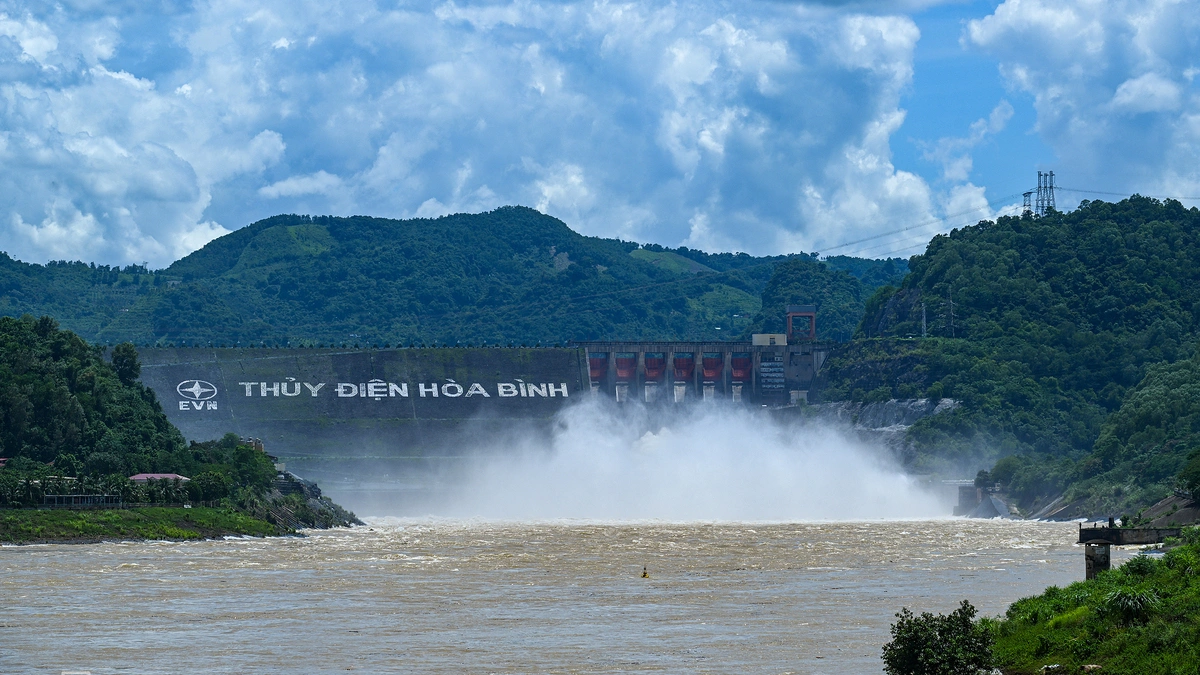
Hoa Binh Hydropower Plant Opens Spillway for Flood Control
Amidst record rainfall in northern Vietnam, the Hoa Binh Hydropower Plant has opened a spillway for flood control, the first time in 2026. Authorities have issued warnings to downstream residents to ensure safety.
Amidst persistent heavy rainfall in northern Vietnam, the Hoa Binh Hydropower Plant has initiated water discharge through a spillway for flood control purposes, marking the first such operation in 2026. This decision, mandated by a directive from the Minister of Agriculture and Rural Development on the afternoon of July 10, commenced at 11 AM on July 11, with one spillway gate opened to regulate water levels, ensure the safety of the dam, and proactively manage incoming floodwaters. As of 1 PM today, the water level in the reservoir stood at 104 meters upstream and 12.1 meters downstream. The inflow into the reservoir was recorded at 4,377 cubic meters per second, while the total discharge downstream was 2,840 cubic meters per second. The decision to open the spillway comes in the context of prolonged heavy rains across the Da River and Red River basins, influenced by a trough of low pressure. From the evening of July 8 to the evening of July 9, meteorological agencies reported widespread rainfall of 70-100 mm in the northern mountainous regions, with many areas exceeding 200 mm, including My Bang (Tuyen Quang) at 211 mm, Thac Ba Hydropower (Lao Cai) at 208 mm, and Phuc Luong (Thai Nguyen) at 208 mm. Cumulatively, from the evening of July 6 to the morning of July 10, rainfall in many northern mountainous areas surpassed 300-400 mm, with Quang Lam (Quang Ninh) recording the highest at 420 mm. The National Center for Hydro-Meteorological Forecasting predicts that northern Vietnam and Thanh Hoa province will continue to experience rainfall of 20-40 mm on the night of July 10, with localized areas possibly exceeding 100 mm. The Hoa Binh Hydropower Plant has a capacity of 1,920 MW with eight turbines. The largest flood discharge event occurred in October 2017, when the plant had to open 8 out of 12 spillway gates. While this did not impact critical sections of the dike system, it resulted in the death of 170 tons of fish from floating cages, causing losses exceeding 30 billion VND. The Ministry of Agriculture and Rural Development has urged the People's Committees of downstream provinces and cities to promptly inform residents, businesses, aquaculture facilities, watercraft, ferry terminals, riverside structures, and sand and gravel extraction units to take proactive safety measures. During water discharge, water levels and flow velocities on the Da River and the lower Red River are expected to rise rapidly, posing potential safety risks to people and vessels operating on the rivers. Recent floods and landslides have caused four houses to collapse, damaged 141 houses, necessitated the emergency evacuation of 45 houses due to landslide risks, and affected 36 houses through inundation or landslides. Over 243 hectares of rice and other crops have been submerged or damaged, and 24 livestock and 350 poultry have died or been washed away, according to the Directorate of Dyke Management and Natural Disaster Prevention. Furthermore, floods and landslides have blocked 17 locations on National Highways 6, 4H, 12, and 32, and 75 locations on provincial roads, disrupting traffic in many mountainous areas. Additionally, 137 meters of irrigation canals have been damaged.
多角的分析
ホアビン水力発電所からの放流は、下流域の農業、特に稲作や水産養殖に直接的な影響を与える。過去の事例(2017年10月)では、170トンの養殖魚が死亡し、300億ドン以上の損害が発生した。今回も同様の被害が懸念され、特に低地の農家や漁業従事者の生計に打撃を与える可能性がある。また、インフラへの被害、特に道路網の寸断は、物流コストの上昇や経済活動の停滞を招く。長期的には、気候変動による極端な気象現象の増加が、水力発電所の運用戦略やインフラ投資のあり方に影響を与える可能性がある。
水力発電所からの放流は、短期的な投資リスクを高める要因となる。特に、河川沿いの不動産開発や、農業・水産関連企業への投資は、洪水リスクの増大により慎重な評価が必要となる。過去の災害による損害事例は、保険コストの上昇や、事業継続計画の見直しを投資家に促すだろう。一方で、インフラ復旧や防災関連技術への投資機会も生まれる可能性がある。ベトナム経済の成長性と、気候変動への適応策への投資は、中長期的な視点での検討が求められる。
今回の放流は、ダ川および紅河下流沿岸の住民の生活に直接的な影響を与える。家屋の浸水、土砂災害のリスク、交通網の寸断は、住民の安全と生活基盤を脅かす。特に、過去の災害で被害を受けた地域では、不安が増大する。政府による迅速な情報提供と避難指示、そして被災者への支援策が重要となる。また、インフラの脆弱性は、地方部における医療や教育へのアクセスにも影響を及ぼす可能性があり、社会的な格差の拡大も懸念される。
今回のホアビン水力発電所からの放流は、下流域の住民、特に農家や漁業を営む人々にとって、直接的な生計への影響を意味します。2017年の洪水放流では、多くの養殖魚が犠牲になり、経済的な損失を被りました。今回も同様の被害が懸念されるため、住民は不安を抱えています。また、道路の寸断は、日々の移動や物資の輸送を困難にし、生活に支障をきたします。政府からの迅速かつ正確な情報提供と、万が一の際の支援体制が、住民の安心につながるでしょう。
背景・歴史的文脈
ベトナム北部では、夏季にモンスーンの影響で豪雨が発生しやすく、特に紅河デルタ地域は洪水のリスクが高い。ホアビン水力発電所は、ダ川に建設されたベトナム最大級の水力発電所であり、発電だけでなく、洪水調節や灌漑、治水などの多目的利用が期待されている。しかし、近年、気候変動による異常気象が増加し、過去の基準に基づいたダム運用や防災計画では対応が困難なケースが増えている。2017年の大規模放流では、甚大な漁業被害が発生しており、ダム運用と地域住民の生活との調和が課題となっている。今回の放流は、こうした背景を踏まえ、より慎重な判断が求められる状況下で行われた。
原文ソース
VnExpress