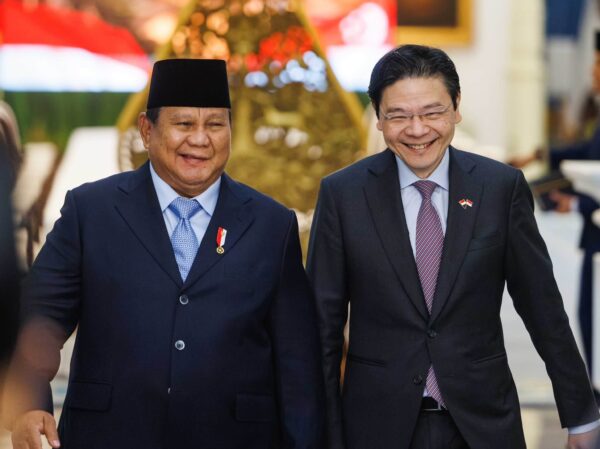
Indonesia and Singapore Reaffirm Open Malacca Strait, Dismiss Levy Idea
Indonesian President Prabowo Subianto and Singaporean Prime Minister Lawrence Wong reaffirmed their commitment to keeping the Strait of Malacca open and secure for all vessels. This effectively dismisses a prior proposal for a levy on ships transiting the vital waterway. The leaders also agreed to strengthen economic ties.
Indonesia and Singapore have reaffirmed their commitment to keeping the Strait of Malacca open and secure for all vessels, with leaders from both nations stating that the vital waterway will remain accessible to all. The affirmations came during the second Singapore-Indonesia Leaders’ Retreat in Jakarta. Speaking at a joint press conference, Indonesian President Prabowo Subianto emphasized the shared interest between the two neighboring countries in maintaining the Strait of Malacca as a passage free for all parties. "Indonesia and Singapore are countries that directly border one another in the Strait of Malacca. We have a shared interest in maintaining the Strait of Malacca as a passage that is free for all parties," he said, as per the Straits Times. "We must preserve security and peace in the strait, and also, of course, protect it from pollution, accidents, and from robbery or piracy." President Prabowo also stated that Indonesia would continue to coordinate with Malaysia and Thailand to ensure the Strait "always remain open to all, safe, and accessible to anyone who requires access," in accordance with the U.N. Convention on the Law of the Sea (UNCLOS). Singapore’s Prime Minister Lawrence Wong echoed Prabowo’s sentiments, highlighting that recent events in the Middle East, which disrupted shipping through the Strait of Hormuz, underscored the importance of keeping Malacca free and secure. He affirmed that Singapore and Indonesia are "strategically aligned" in upholding navigational rights and freedoms and keeping sea lines of communication open, including the unimpeded rights of transit passage of vessels, in accordance with UNCLOS, which is also customary law. Prabowo’s remarks appear to put to rest any speculation following Indonesian Foreign Minister Purbaya Yudhi Sadewa’s suggestion in April to impose a levy on ships transiting the Strait of Malacca. Citing Iran’s plan to charge a "toll" in the Strait of Hormuz, Sadewa had proposed that a similar toll in Malacca, if implemented cooperatively among the three states bordering the Strait – Indonesia, Malaysia, and Singapore – could generate substantial economic value. "If we split it three ways – Indonesia, Malaysia, and Singapore – it could be quite substantial," he said, noting that Indonesia’s stretch of the Strait was "the largest and the longest." While it was unclear how serious his suggestion was, it immediately prompted expressions of concern from around the region, including from Singapore’s Foreign Minister Vivian Balakrishnan. President Prabowo’s statement appears to snuff out any small chance that Jakarta might attempt to monetize the Strait or push its neighbors to do so – something that will no doubt reassure Singaporean leaders. Beyond security, the leaders also announced several agreements aimed at strengthening bilateral economic relations. They presided over the signing of 26 "tangible and concrete achievements in various fields," comprising 18 government-to-government cooperation agreements and eight business-to-business agreements. A significant development was the signing of a Memorandum of Understanding (MoU) between Indonesia’s new sovereign wealth fund, Danantara, and Singaporean entities Keppel Electric, Sembcorp Industries, and Singapore Energy Interconnections. This MoU focuses on expanding cross-border electricity trade, exploring potential collaboration on the offtake of imported low-carbon electricity, and resolving commercial and technical issues related to cross-border interconnector development. In a joint statement, Danantara and Singapore’s Ministry of Trade and Industry said that the MoU would "explore potential collaboration on offtake of imported low-carbon electricity" and help resolve "commercial and technical issues relating to cross-border interconnector development." Indonesia’s Energy Minister Bahlil Lahadalia indicated that price negotiations for the electricity deal are underway, with expectations of a "breakthrough soon," aiming for a "win-win solution for both" parties.
多角的分析
マラッカ海峡への徴収金導入案が事実上見送られたことは、国際海運におけるコスト増加リスクを回避し、サプライチェーンの安定化に寄与する。同海峡は世界の海上貿易量の約3分の1が通過する要衝であり、徴収金は海運コストの上昇を通じて、インドネシア国内の物価にも間接的な影響を与えうる。一方で、両国間の越境電力取引MOUは、インドネシアの再生可能エネルギー開発や電力インフラ整備への投資を促進し、経済成長の新たな源泉となる可能性がある。特に、低炭素電力のオフテイクは、シンガポールからの技術・資金支援を呼び込み、インドネシアのエネルギー転換を加速させるだろう。
マラッカ海峡への徴収金導入案の沈静化は、海運関連企業や、同海峡を経由する貨物に依存する製造業にとって、不確実性の低下とコスト予測の安定化を意味する。これにより、これらのセクターへの投資リスクが低減される。また、インドネシアとシンガポール間の電力取引MOUは、エネルギーインフラ分野への投資機会を創出する。特に、シンガポールのエネルギー関連企業がインドネシアの送電網や再生可能エネルギープロジェクトに投資する可能性があり、長期的な収益が見込める分野として注目されるだろう。
マラッカ海峡の航行の自由が再確認されたことは、インドネシア国民の日常生活に直接的な影響を与えるものではないが、国際貿易の安定は、輸入物資の価格安定や、輸出産業の雇用維持に間接的に貢献する。一方、両国間の越境電力取引の進展は、将来的にはインドネシア国内の電力供給の安定化や、よりクリーンなエネルギー源への移行を促進する可能性があり、国民の生活環境の向上につながるかもしれない。しかし、その恩恵が国民全体に公平に行き渡るか、あるいは一部地域や層に限定されるかは、今後の政策次第である。
マラッカ海峡の安全と開放性が再確認されたことは、ジャカルタ市民の通勤や物価に直接的な変化をもたらすものではない。しかし、インドネシア経済全体が安定し、貿易が円滑に進むことは、日々の生活必需品の安定供給や価格の安定につながる。また、両国間の電力取引に関する協力は、将来的に国内の電力料金の安定化や、よりクリーンなエネルギーへの移行といった形で、間接的な恩恵をもたらす可能性を秘めている。ただし、これらの恩恵が具体的にどのような形で市民生活に反映されるかは、今後のインフラ整備や政策実行にかかっている。
背景・歴史的文脈
マラッカ海峡は、インド洋と太平洋を結ぶ世界で最も重要な海上チョークポイントの一つであり、世界の海上貿易量の約3分の1が通過する。その戦略的重要性から、古くから多くの国が関心を寄せてきた。特に、インドネシア、マレーシア、シンガポールという沿岸国3カ国の安全保障協力は、海賊行為やテロ対策、環境保護において不可欠である。2024年4月、インドネシア外相が同海峡への徴収金導入案を提起したことは、ホルムズ海峡の事例に倣ったもので、インドネシアの財政収入増加への期待と、国際海運への影響という懸念が同時に生じた。今回の首脳会合での両国首脳による航行の自由の再確認は、この懸念を払拭し、地域経済の安定を優先する姿勢を示したものである。
原文ソース
The Diplomat Indonesia