General articles are free for 24 hours after publish.
Australia and Indonesia Elevate Security and Economic Cooperation at 2+2 Meeting
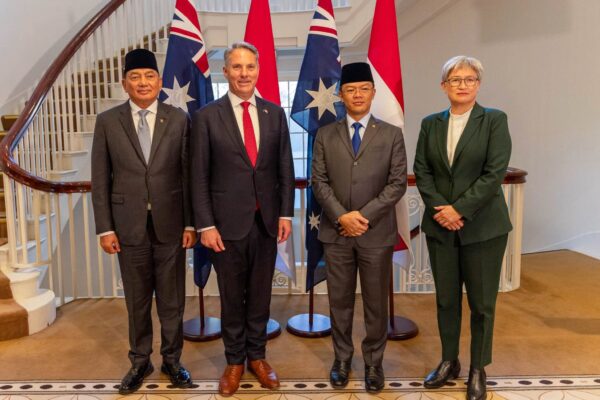
Australia and Indonesia held their tenth 2+2 meeting in Melbourne, confirming their relationship is at a "high point." They agreed to strengthen cooperation across security, economy, and climate action, with a focus on maritime security, cybersecurity, and enhancing economic resilience.
Read The Diplomat, Know The Asia-Pacific The significance of the 2+2 is the growing web of cooperation between Canberra and Jakarta. Last week, Australia and Indonesia held their tenth 2+2 defense and foreign ministers meeting in Melbourne. The two countries signed the landmark Jakarta Treaty on Common Security in 2024, and although the Indonesian parliament has yet to ratify the treaty, the 2+2 meeting proceeded with the assumption that this is simply the pace of Indonesia’s legislative processes, and that discussions can turn to how best to operationalize their cooperation. The headline claim is that the relationship between the two countries is now “at a high point.” The Albanese government has made the relationship with Indonesia one of the central pillars of Australia’s foreign policy, understanding how vital friendly, cooperative, relations with its giant near neighbor is to the country’s security. Indonesia, for its part, has recognized it has a capable partner in Canberra that can help advance its own security interests, while maintaining its strategic autonomy. Although the two countries are seeking to broaden their relationship, at present, defense and security cooperation remain the core elements and these areas were naturally a major focus of the discussions last week. Given the nature of their geographies, this has developed into a focus on maritime security. At the 2+2 meeting it was announced that Australia will provide aerial drones and training to Indonesia’s Coast Guard. Given that illegal fishing is a central concern throughout Indonesia’s vast waters, and that Chinese often use maritime militia disguised as fishing vessels, greater maritime domain awareness is considered essential for Jakarta. Alongside this, Australia and Indonesia agreed to increase cooperation on cybercrime, critical infrastructure, and artificial intelligence, building on their existing memorandum of understanding on enhanced cybersecurity and critical technology cooperation. This includes incorporating a defensive cybersecurity component into their bilateral defense exercise, Keris Woomera. Here, cybersecurity is not treated as a separate technical issue, but as a central pillar of military preparedness and national defense. There is a similar thinking around economic security as inseparable from traditional security. The ministers announced a number of initiatives designed to make their economies more resilient to external shocks and any disruption to supply chains. This included new cooperation to jointly analyze critical supply chain issues and new scholarship courses that will be focused on economic security and resilience – hoping to develop a new cohort of analysts and bureaucrats focused on these issues. The two countries have already demonstrated how economic interdependence can provide security benefits, with Indonesia working with Australian industry to facilitate a 250,000-tonne agricultural-grade supply of urea due to disruptions from the war in Iran. Alongside this, Australian liquefied petroleum gas (LPG) exports to Indonesia have increased threefold over the past year, again in response to supply chain disruptions in the Middle East. These practical forms of food and energy security are becoming increasingly intertwined with geopolitics. The two countries therefore have an interest in using the resources of one another to address their vulnerabilities. Given both their proximity to each other, and their current distance from global hotspots, there is an opportunity to build resilience together that can withstand any global shocks. These shocks include the environment. The 2+2 meeting announced the second phase of KINETIK – the Australia-Indonesia Climate and Sustainable Infrastructure Partnership, which will provide US$430 million over ten years to support sustainable infrastructure and climate investment in Indonesia. Its aim is to mobilize public and private capital into clean energy, water, waste management, and sustainable transport, helping Indonesia build climate-resilient infrastructure and accelerate its energy transition. With the hope of the two countries also developing their green technology capabilities. The 2+2 meeting also demonstrated considered strategic alignment over the regional order – something that hasn’t always been the case. The two countries reaffirmed their commitment to international law, sovereignty and ASEAN centrality, with both expressing concern about rising tensions in the South China Sea and insisting that the Code of Conduct being developed by ASEAN and China must comply with international law. The significance of the 2+2 is the growing web of cooperation between Canberra and Jakarta. From defense exercises to maritime surveillance to cybersecurity and economic resilience, there has been a noticeable step up in the relationship. This does not amount to a formal alliance, but more a convergence of interests and a recognition that as neighbors there is a natural interconnectedness. The previous distance in outlook and coordination is starting to be overcome. Subscribe today and join thousands of diplomats, analysts, policy professionals and business readers who rely on The Diplomat for expert Asia-Pacific coverage. Get unlimited access to in-depth analysis you won't find anywhere else, from South China Sea tensions to ASEAN diplomacy to India-Pakistan relations. More than 5,000 articles a year. Already have an account? Log in. Grant Wyeth is a Melbourne-based political analyst specializing in Australia and the Pacific, India and Canada. Get briefed on the story of the week, and developing stories to watch across the Asia-Pacific.
Original source
The Diplomat Indonesia