General articles are free for 24 hours after publish.
Vietnam Proposes International Network for 'Space for Development and Resilience'
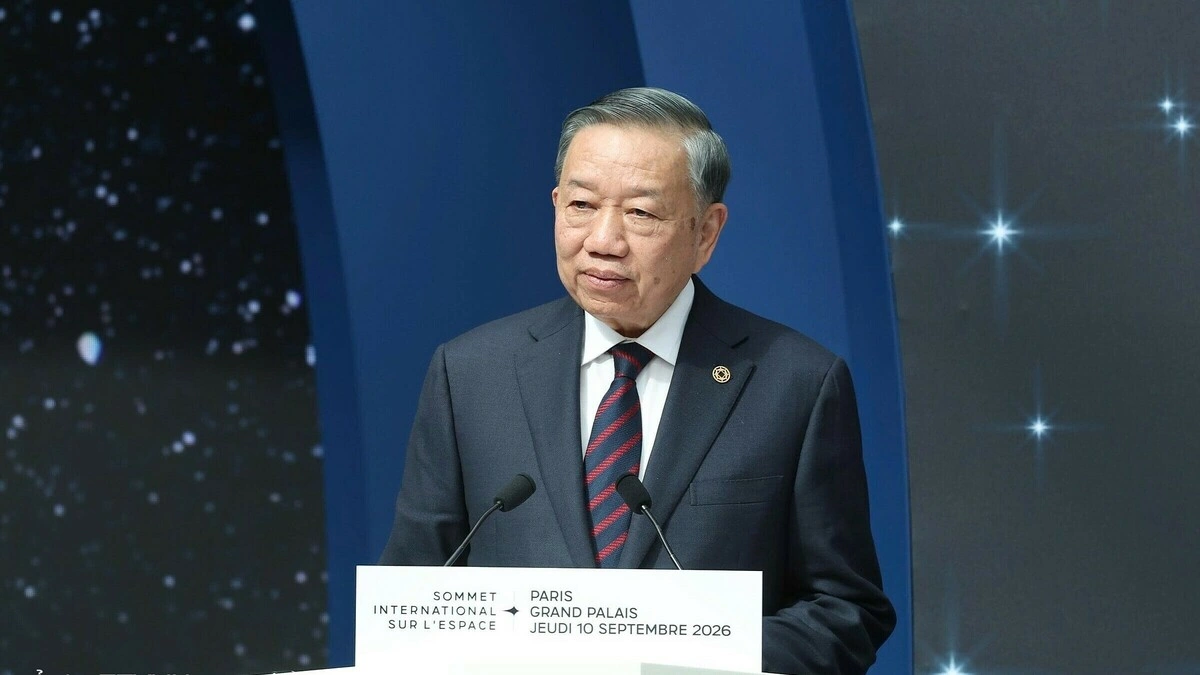
Vietnamese President To Lam proposed the establishment of a 'Space for Development and Resilience' network at the International Space Summit in Paris. The initiative aims to facilitate space data sharing, ensure safe and sustainable space environments, and foster the growth of the space economy, with a focus on Southeast Asia where Vietnam is ready to serve as a connection point.
Vietnamese President To Lam, who also serves as General Secretary of the Communist Party, proposed the establishment of an international network named 'Space for Development and Resilience' at the International Space Summit held in Paris, France. This initiative aims to promote the peaceful and sustainable use of outer space. The proposal was presented during a high-level thematic discussion session focused on 'Building a New Space for a Rapidly Changing World.' The network's core objectives include sharing and utilizing space data to support development, enhancing capabilities for ensuring a safe and sustainable space environment, and strengthening connections among research, education, businesses, and investments to foster the growth of the space economy. Vietnam expressed its readiness to serve as a connection point, particularly for the initial phase of network development in Southeast Asia. President To Lam emphasized that while outer space offers vast horizons, the ultimate measure of progress lies in the value it brings to humanity and Earth. He affirmed Vietnam's willingness to collaborate with the international community in translating the summit's outcomes into concrete actions for the present and future generations. He further stated that aerospace technology is a strategic priority for Vietnam's development, with three key directions: enhancing self-reliance in space technology and data, developing a space economy ecosystem and encouraging financial models for public benefit applications, and improving governance and institutional capacity for space activities in line with international law. President To Lam acknowledged that outer space is increasingly becoming an essential part of modern life and the economy. Satellites, remote sensing, positioning systems, and space data are utilized in various fields, including telecommunications, transportation, resource management, disaster prevention, and climate change response. However, the rapid advancement of space activities also presents challenges such as space debris, collisions, orbital congestion, frequency interference, militarization, territorial claims, technological disparities, and the growing role of the private sector. In response, President To Lam called for a multilateral governance framework to ensure outer space remains peaceful, safe, sustainable, and a common domain for all. He also stressed the need to promote innovation, the space economy, and the transformation of data into knowledge, services, and better decision-making for Earth. Vietnam highlighted five principles for multilateral space governance: first, preserving outer space for peaceful purposes, promoting dialogue, building trust, preventing conflict and arms races, and refraining from the threat or use of force. Second, prioritizing human and terrestrial development, with a focus on early warning, climate monitoring, resource management, and Sustainable Development Goals (SDGs). Third, upholding international law and the UN Charter, centering the UN and the UN Committee on the Peaceful Uses of Outer Space (COPUOS) in multilateral space governance, and strengthening the role of the International Telecommunication Union (ITU). Fourth, ensuring equality among nations in participation and benefit from research and technological advancements. Finally, advocating for responsible, transparent, and sustainable space utilization, reducing space debris and collision risks. The summit, initiated by France, convened delegates from approximately 130 countries, along with leaders from space agencies, international organizations, businesses, and the aerospace research community. It featured direct connections with the International Space Station (ISS). The conference included policy exchanges and showcased opportunities for international cooperation in aerospace technology, services, research, and training, focusing on promoting the space economy, ensuring space security through dialogue and partnerships, and advancing scientific and technological exploration of space for the future of humanity.
Original source
VnExpress