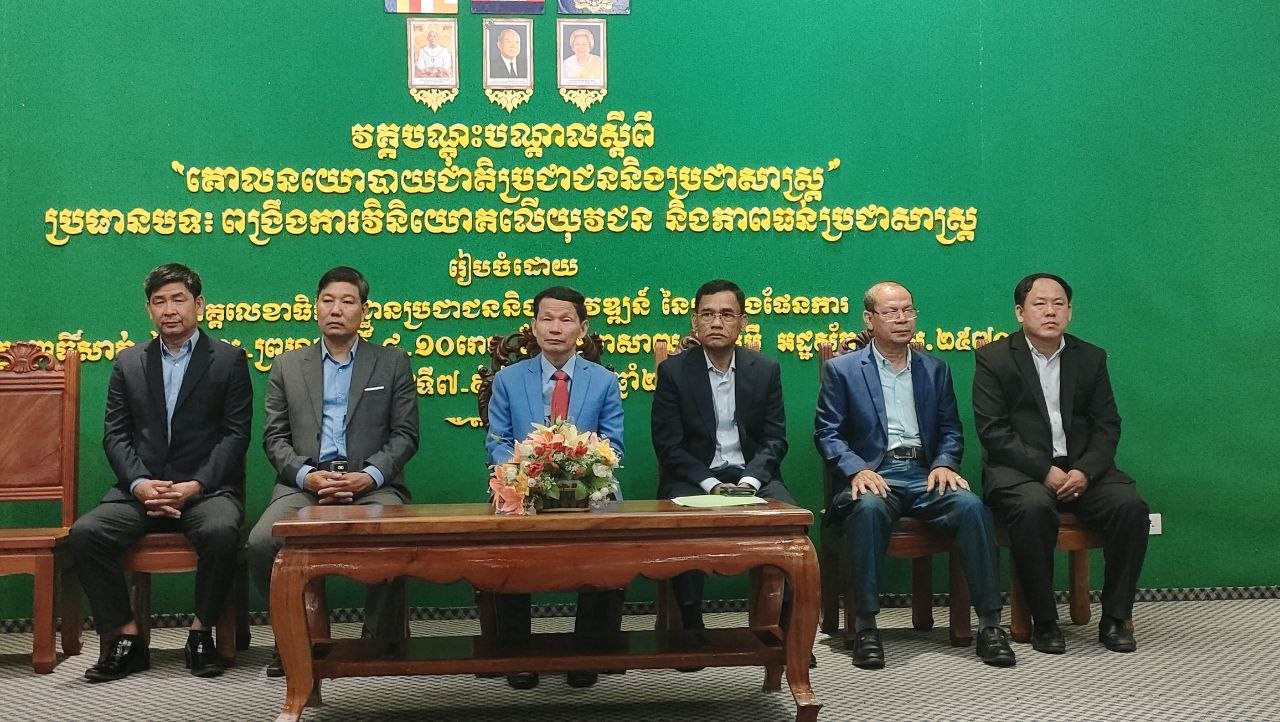
Cambodia Launches Training on Youth Investment and Demographic Resilience
Politics
2026年7月7日
5
CPP Cambodia

Cambodia Launches Training on Youth Investment and Demographic Resilience

AI サマリー

Cambodia's Ministry of Planning has launched a national training program for planning officials from nine provinces and cities, focusing on 'Investing in Youth and Demographic Resilience.' The initiative aims to foster sustainable socio-economic development in the digital era.

The Ministry of Planning has launched a national training program on "National Population and Demographic Policy," under the crucial theme of "Investing in Youth and Demographic Resilience." This initiative aims to enhance the capacity of planning officials from nine provinces and cities, driving sustainable socio-economic development in the digital era. The three-day training, held from July 7, 2026, at the Chanthy Monichan Hotel in Pursat City, was presided over by H.E. Leng Pally, Secretary of State, representing H.E. Bin Trachhey, Minister of Planning. The event saw the participation of provincial leadership, ministry delegates, and 50 planning officials from Battambang, Takeo, Kampot, Koh Kong, Banteay Meanchey, Pailin, Kampong Chhnang, Phnom Penh, and Pursat provinces. In his welcoming remarks, H.E. Pov Pisith, Acting Governor of Pursat Province, extended a warm welcome to the ministry delegation and participants from various provinces. He stated, "The organization of this training in Pursat Province is a valuable opportunity for our specialized officials. Population and demographic policies are the backbone of development strategies. For Pursat Province itself, a clearer understanding of demographic resilience and investment in youth will become a significant driving force in organizing local development plans more precisely and responding to the actual needs of the people in this new era." During the opening ceremony, H.E. Leng Pally emphasized that current national population policies have evolved from mere population management to development strategies based on human rights and resilience. To implement these policies effectively, specialized officials need to understand three key dimensions: 1. Quantitative Dimension: Balancing the management of birth rates, death rates, and migration flows. 2. Structural Dimension: Analyzing age structures to allocate resources between generations and invest in the "demographic dividend." 3. Qualitative Dimension: Developing human capital, focusing on the health, knowledge, skills, and capabilities of each citizen. The Secretary of State stressed, "Cambodia is currently in a demographic window of opportunity, a golden chance to boost economic growth. If we do not invest precisely in education and Technical and Vocational Education and Training (TVET), we will miss out on economic benefits and may face the burden of an aging population in the future." The Ministry of Planning highlighted that sub-national officials are the most crucial actors in "localizing policies." Therefore, in the digital age, trainees must utilize precise data to formulate development plans that respond to the actual situations in their respective localities. This training is expected to provide new knowledge and experiences, serving as a compass for planning officials to effectively lead, formulate, and implement sub-national plans with greater efficiency, transparency, and inclusivity. Source: CPP Cambodia

多角的分析

経済的影響

カンボジアは現在、人口ボーナス期という経済成長の機会を迎えている。この研修は、人的資本への投資、特に若者の教育・職業訓練(TVET)の重要性を強調しており、将来の経済成長を確実にするための戦略的投資の必要性を示唆している。人口構成の分析とそれに伴う資源配分は、持続可能な開発のための経済政策立案の根幹となる。

投資家心理

この研修は、カンボジア政府が将来の労働力となる若者への投資と、人口動態の変化に対応できる強靭な社会基盤の構築に重点を置いていることを示している。これは、長期的な視点を持つ投資家にとって、教育、ヘルスケア、技術訓練分野への投資機会が増加する可能性を示唆している。人口ボーナス期を最大限に活用するための政策は、経済の安定と成長への信頼を高める要因となりうる。

社会的影響

本研修は、カンボジアの将来を担う若者への投資を強化し、人口動態の変化に対応できる社会の強靭性を高めることを目指している。これは、教育機会の拡大、健康増進、スキル開発といった具体的な施策を通じて、国民一人ひとりの生活の質向上に繋がる可能性がある。また、地域レベルでの計画策定能力の向上は、住民のニーズに即した開発を促進し、地域格差の是正に貢献することが期待される。

市民の声

この研修は、将来のカンボジアを担う若者たちが、より良い教育や職業訓練を受けられる機会が増えることを意味する。これにより、彼らの雇用機会が広がり、生活水準の向上が期待できる。また、地域開発計画が住民の実際のニーズに即したものになることは、生活環境の改善にも繋がるだろう。しかし、高齢化が進んだ場合の社会保障や医療費の負担増といった課題への対応も、同時に重要となる。

背景・歴史的文脈

カンボジアは、第二次世界大戦後のベビーブーム期に生まれた人口構成が、現在、若年層の比率が高い「人口ボーナス期」を迎えている。この時期は、生産年齢人口が相対的に多く、経済成長の大きな機会となる。計画省は、この機会を最大限に活かすため、人的資本開発、特に若者の教育・訓練への投資を強化する政策を推進している。過去には、人口管理が中心であった政策が、近年、人権と持続可能な開発の観点から再構築されている。

原文ソース

CPP Cambodia

原文を読む