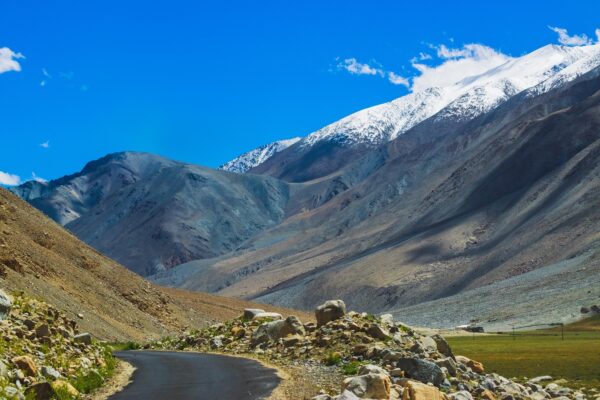
Kashmir's Worsening Climate Crisis Overshadowed by Security Concerns
Environment
2026年7月22日
5
The Diplomat Indonesia

General articles are free for 24 hours after publish.

Kashmir's Worsening Climate Crisis Overshadowed by Security Concerns

Share
AI Summary

Kashmir is experiencing significant warming, with high mountain towns seeing nearly a 1°C rise in the last two decades due to elevation-dependent warming. However, geopolitical tensions and security concerns overshadow this pressing climate crisis, hindering attention and aid.

Read The Diplomat, Know The Asia-Pacific Kashmir’s mountains are going to keep getting hotter whether anyone notices or not. Popular perceptions of Kashmir center on soldiers, checkpoints, and decades-old fights over land. Sometimes tourism edges into the discourse. Far less attention is paid to the fact that Kashmir’s mountains are heating up rapidly. A new study published in Nature’s Scientific Reports pulled together and analyzed 45 years of weather records from 1980 to 2024 and collected surface temperature records from ten India Meteorological Department stations. It found that the high mountain towns of Pahalgam and Gulmarg, which are also famous tourist sites, have warmed by nearly a full degree Celsius in just the last 20 years. One town, Bhaderwah, is heating up even faster at roughly 0.3 degrees per decade. And the nights are warming fastest of all. Meanwhile, down in the flat lowland city of Jammu, temperatures have barely moved. Some seasons there have even gotten a little cooler. Scientists have a name for this pattern: elevation-dependent warming. Simply put, the higher up a mountain you go, the faster it warms. This happens for a simple reason. Snow is white and bounces sunlight back into space. When snow melts away, it uncovers dark rock and dirt underneath, and dark surfaces soak up heat instead of bouncing it away. Less snow means more heat, which means even less snow. It is the same thing scientists have already found happening on the Tibetan Plateau, the giant high plain north of the Himalayas. Kashmir is as much a part of that story – but it rarely gets talked about. This is partly because of logistics. It is hard to maintain, much less to expand weather stations in Kashmir, thanks to its checkpoints, restricted roads, and internet shutdowns. But it’s also a dynamic of Kashmir’s contested status – and not for the obvious reasons. Money and attention follow whatever the world already agrees to worry about. In international discourse, Kashmir is often treated primarily as a tale of “conflict” or “repression,” rather than a “climate” or “environment” issue. As a result, Kashmir is under-represented in global discussions of the warming Himalayan region, even though some researchers, journalists, and local advocates have long highlighted the region’s environmental and climate impacts. And because Kashmir’s climate gets less attention, it also doesn’t get the funding, the research teams, or the adaptation help that “hotspot” regions get. A person in Kashmir uses a tiny fraction of the energy an average person in the United States or Europe uses. They didn’t build the factories or drive the cars that heated up the planet. But they are the ones watching the snow disappear earlier every year. A farmer plants his crops based on when the water usually arrives, and now it arrives late, or all at once in a dangerous flood, or barely at all. But this isn’t only Kashmir’s problem. The mountains of the wider Himalayan region hold the third-largest amount of frozen freshwater anywhere outside the North and South Poles. Up to 2 billion people depend on rivers originating in the Hindu Kush Himalaya region, and these rivers are sustained by annual ice melt. When the ice and snow don’t come back in the winter, that means reduced water flows into the rivers powering and feeding much of South Asia. There are three steps to take, right now, to begin addressing Kashmir’s climate crisis. First, scientists need real support to study Kashmir’s mountains the same way they already study Nepal and the rest of the Himalayas, or the rest of India. Whatever they learn should be shared openly (like the Scientific Reports paper) in open access, followed by funds allocation for mitigation and adaptation. Second, stop treating demilitarization and climate adaptation as separate conversations in the Kashmir region. They are the same conversation, because who gets to gather information and who gets to act on it are both, in the end, questions of power. Third, when countries meet at big climate conferences and talk about who should pay to help places already hurt by climate change, Kashmir needs to be part of that conversation – both from the climate justice side as well as colonialism side. Someone has to ask directly: who pays to fix the water systems and rebuild after floods in a place still caught in conflict? Kashmir’s unresolved future cannot be an excuse for ignoring what is happening to its mountains right now. Kashmir’s mountains are going to keep getting hotter whether anyone notices or not. The glaciers are not waiting for a diplomatic settlement, and neither should the people whose water and lands depend on them. Subscribe today and join thousands of diplomats, analysts, policy professionals and business readers who rely on The Diplomat for expert Asia-Pacific coverage. Get unlimited access to in-depth analysis you won't find anywhere else, from South China Sea tensions to ASEAN diplomacy to India-Pakistan relations. More than 5,000 articles a year. Already have an account? Log in. David Sathuluri is a founder and co-director of the Laboratory of AI, Climate & Society, Columbia University’s Lamont-Doherty Earth Observatory, where he coordinates interdisciplinary research on AI and climate justice. He writes extensively on climate justice, caste, and AI governance for outlets including The Los Angeles Times, The Hindu, The Quint, and The Diplomat. Get briefed on the story of the week, and developing stories to watch across the Asia-Pacific.

0

Original source

The Diplomat Indonesia

原文を読む