Philippines Inflation Slows, But Woes Likely to Persist Through 2026
Economy
2026年8月7日
6
Rappler Business

General articles are free for 24 hours after publish.

Philippines Inflation Slows, But Woes Likely to Persist Through 2026

Share
AI Summary

Philippine inflation eased to 6.2% in July, yet remains well above government targets. Food, housing/utilities, and transport costs significantly burden households, driven by global price hikes and a weaker peso. Structural solutions are urgently needed.

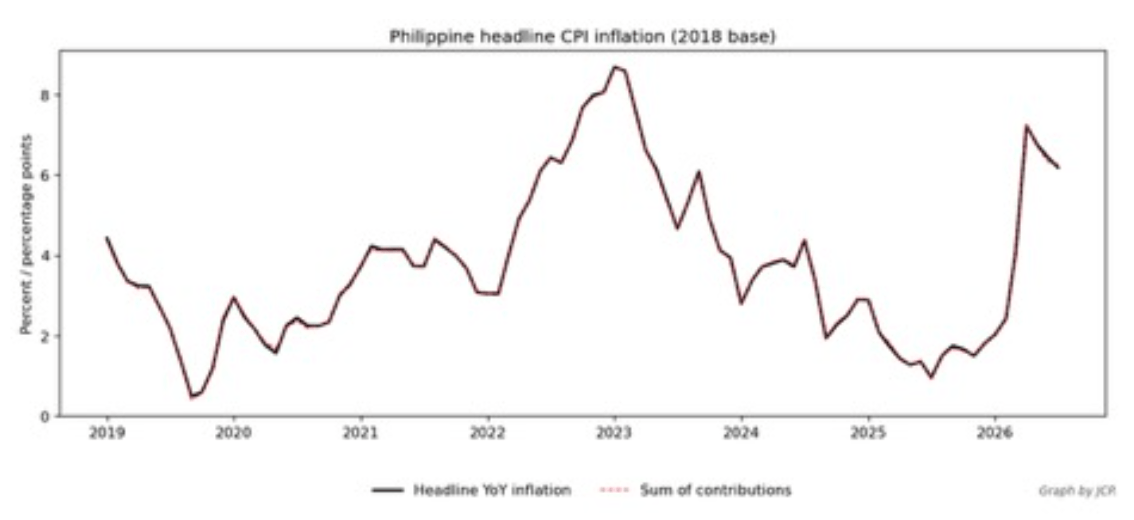
Earlier this week, on August 5, the Philippine Statistics Authority (PSA) reported that inflation eased to 6.2% in July, down from 6.4% in June. That marks the third straight month of slower inflation since the peak of 7.2% in April. At first glance this looks like good news, and in a narrow sense it is. But a closer look at the data suggests that inflationary pressures are far from gone, and we remain heavily exposed to global shocks beyond our control. Let’s start with the headline figure of 6.2%, which is still well above the government’s target range of 2% to 4%. Inflation has averaged 5.0% since January, so even if prices behave for the rest of the year, 2026 will almost surely end above target. Core inflation (which excludes volatile food and energy items) also slowed, from 4.4% to 4.2%. That tells us the easing was not confined to the most volatile items. But core remains above 4%, and this can be taken as a sign that price pressures have already seeped into the broader economy. At least, prices rose by just 0.1% from June to July. Month-on-month movements tend to be noisy, but this suggests the momentum of price increases could at least be slowing. The picture is bleaker for the poor. Inflation for the bottom 30% of income households (the poorest segment) stood at 8.2% in July. That is a full 2-percentage points higher than what the average household faced, mainly because food takes up a much larger share of poor families’ budgets. Rice and electricity again Just three commodity groups (food, housing and utilities, and transport) accounted for 76.3% of July inflation. The biggest worry is rice. Rice inflation quickened to 17.1% in July from 15.0% in June, and by itself accounted for 3.28 percentage points of food inflation, or about 62% of it. Corn (21.9%) and vegetables (8.4%) were also rising fast. Meat prices, by contrast, fell 5.4%, which helped keep overall food inflation unchanged at 5.3%. Electricity is another cause for concern. Inflation in housing and utilities edged up to 8.2%, and electricity was the single largest contributor within that group, followed by house rents and gas. The one bright spot is transport, where inflation slowed from 12.8% to 11.9% as fuel costs continued to normalize. Still, at nearly 12%, transport inflation remains punishing for commuters and drivers alike. An imported problem Why did inflation flare up in the first place? Recall that world oil prices spiked earlier this year as tensions in the Middle East escalated. The peso weakened past P61 to a dollar, making everything we import more expensive. The Bangko Sentral ng Pilipinas (BSP) was therefore compelled to raise its policy rate to 4.5%; it’s the key interest rate that influences all other interest rates in the economy. The uncomfortable truth is that much of our inflation is imported. We import nearly all our oil, we are among the world’s biggest rice importers, and much of our electricity is generated from imported coal and gas. BSP itself warned as early as February that costlier rice and oil could heat up prices. Higher interest rates can tame demand at home, but they cannot calm the Middle East or grow more palay. The structural fixes are familiar: diversifying our energy sources, securing rice supplies ahead of shocks, and expanding targeted cash transfers to the poorest households (beyond the emergency measures already rolled out by the Marcos administration). The binding constraint, as always, is whether government attention outlasts the crisis that prompted it. To its credit, just last month, the Department of Social Welfare and Development (DSWD) rolled out UPLIFT (Unified Package for Livelihood, Industry, Food and Transport), which extends P2,000 in cash aid to some 7.5 million poor, near-poor, and low-income households (one-time for some beneficiaries, monthly through December for others). The catch, though, is that, based on my own observations, DSWD field staff are already hard-put implementing AICS (Assistance to Individuals in Crisis Situations) and other big aid programs. It seems doubtful they can layer yet another ayuda or financial aid program on top without something falling through the cracks. The bigger worry is fiscal. The tax cuts President Marcos proposed in his recent State of the Nation Address threaten to widen the budget deficit at the very moment ayuda programs are ramping up. Collecting less while spending more is not a combination that can last. For the coming months, we still cannot tell how much of rice’s acceleration reflects actual supply conditions rather than comparisons with year-earlier prices, when rice was unusually cheap. So-called “base effects” (distortions that arise because inflation is measured against prices a year ago) could worsen the numbers in the coming months. What’s sure is that a projected “super El Niño” threatens to stoke inflation yet again later this year. Until then, cheering the current inflation slowdown seems premature. One more global shock, whether another oil spike or a particularly bad El Niño could easily undo three months of progress. Our inflation problem has not ended, it has merely paused. – Rappler.com Jan Carlo “JC” Punongbayan, PhD is an associate professor at the University of the Philippines School of Economics (UPSE). His professional experience includes the Securities and Exchange Commission, the World Bank Office in Manila, the Far Eastern University Public Policy Center, and the National Economic and Development Authority. JC writes a weekly economics column for Rappler.com. He is also co-founder of UsapangEcon.com and co-host of Usapang Econ Podcast. His first book, False Nostalgia: The Marcos “Golden Age” Myths and How to Debunk Them, was published by Ateneo de Manila University Press in February 2023. His second book, Twin Plagues: How Duterte and Covid-19 Wrecked the Philippine Economy, was published by Penguin Random House SEA in June 2026. Follow him on Instagram (@jcpunongbayan). Below are In This Economy pieces you may have missed: Click here for other In This Economy articles.

0

Original source

Rappler Business

原文を読む