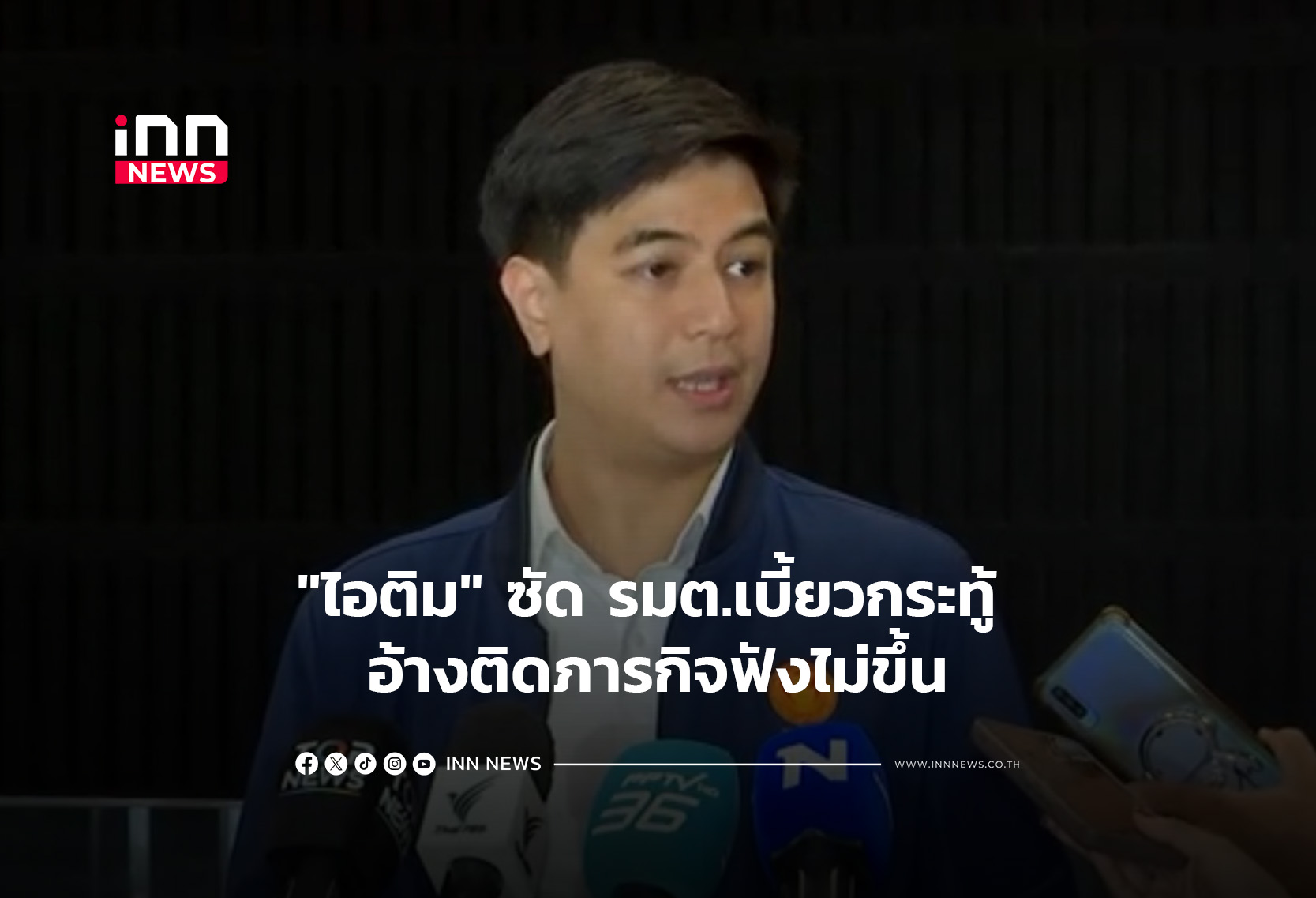
Thai Opposition Criticizes Minister's Absence, Eyes Constitutional Court Ruling on Finance Decree
Politics
2026年7月7日
7
INN News

Thai Opposition Criticizes Minister's Absence, Eyes Constitutional Court Ruling on Finance Decree

AI サマリー

Thailand's opposition party has criticized ministers for missing parliamentary questioning, citing "official duties." Attention is focused on the Constitutional Court's upcoming ruling on a 400 billion baht finance decree, with the opposition signaling its intent to hold the government politically accountable.

The opposition party in Thailand has criticized ministers for their absence from parliamentary questioning, citing "official duties" as an unacceptable reason. The party is closely watching the Constitutional Court's upcoming ruling on a 400 billion baht finance decree, asserting that the government must bear political responsibility if it is deemed unconstitutional. Mr. Parit Wacharasindhu, a party-list Member of Parliament, Deputy Leader of the People's Party, and Chairman of the Opposition Whip in the House of Representatives, announced that the opposition will pose three urgent questions in the upcoming parliamentary session. He noted that last week, the Ministry of Justice failed to send a minister to answer an urgent question raised by the opposition regarding alleged collusion in Senate bidding. Mr. Parit emphasized that all ministers have a constitutional duty to be accountable to Parliament, making the excuse of being busy with other duties difficult to accept, especially since parliamentary sessions and question times are scheduled in advance. He further observed that the reason many ministers do not prioritize answering urgent questions might stem from the Prime Minister himself never attending such sessions. Therefore, the Prime Minister should set an example by appearing in Parliament to fulfill his responsibilities. The details of the three urgent questions from the opposition are expected to be revealed on Thursday morning, pending updates on the parliamentary agenda and political developments. However, Mr. Parit confirmed that these issues are of significant public interest. Mr. Parit also expressed regret over the lack of a joint parliamentary session to consider the proposed amendment to Article 256/1 of the Constitution. He urged the Speaker of the Parliament to convene a meeting of the three whips to discuss other pending agenda items. He also suggested that the delay in scheduling this meeting might be related to the proposed amendment to Article 236, introduced by the People's Party, which seeks to limit the Speaker's power to reject petitions scrutinizing the performance of the National Anti-Corruption Commission (NACC). Furthermore, he called on Mr. Sophon Saram, the Speaker of the Parliament, to expedite a decision on whether to forward or reject the petition submitted by the opposition and some senators. This petition requests the Supreme Court to establish an independent committee to investigate the NACC's handling of the case involving Mr. Saksayam Chidchob's alleged stock concealment. Mr. Parit stressed the need for clarity on this matter within the current parliamentary session. Regarding the Constitutional Court's impending ruling on the decree authorizing the Ministry of Finance to borrow up to 400 billion baht, Mr. Parit stated that if the court finds it constitutional, the decree will proceed to parliamentary deliberation. The People's Party maintains its opposition, particularly to the 200 billion baht allocated for energy transition projects, arguing that such initiatives can be managed through the regular budget, subject to parliamentary oversight. However, Mr. Parit opined that if the Constitutional Court rules the decree unconstitutional, the government must assume responsibility, both in terms of managing the borrowed funds and politically, even in the absence of a direct historical precedent for such a ruling. He also noted that placing projects eligible for the regular budget within a borrowing decree undermines parliamentary oversight mechanisms, allowing the executive branch to unilaterally determine, scrutinize, and approve projects, which is contrary to the principles of checks and balances in a parliamentary system. Source: INN News

多角的分析

経済的影響

4000億バーツという巨額の財政出動は、タイ経済にとって重要な意味を持つ。特にエネルギー転換プロジェクトへの2000億バーツの配分は、長期的な経済構造改革の方向性を示すものだが、その財源調達方法(借入か通常予算か)は、財政規律と議会による監督のバランスを巡る議論を呼ぶ。もし憲法裁判所が政令を違憲と判断した場合、政府は代替策を講じる必要に迫られ、経済政策の遅延や不確実性が生じる可能性がある。これは、インフレ圧力や国際的な信用格付けへの影響も考慮すべき点である。

投資家心理

投資家にとって、憲法裁判所の判断は重要なリスク要因となる。4000億バーツの財政法案が違憲となれば、政府の財政運営能力に対する懸念が生じ、タイ国債の利回りに影響を与える可能性がある。また、エネルギー転換プロジェクトの遅延は、再生可能エネルギー分野への投資機会に影響を与える。野党が首相の国会欠席を批判し、政府の責任を問う姿勢は、政治的安定性への懸念を増幅させ、外国からの直接投資にも慎重な見方を促す可能性がある。

社会的影響

閣僚の国会欠席は、国民の政治への信頼を揺るがす。プラリット議員が指摘するように、首相自身が国会での説明責任を果たさない姿勢は、国民の不信感を増幅させる。4000億バーツという巨額の公的資金の使途は、国民生活に直接的・間接的に影響を与えるため、議会による透明性の高い監督が不可欠である。エネルギー転換プロジェクトの進捗遅延や、財政法案を巡る政治的混乱は、社会的な不満を高める要因となりうる。

市民の声

市民の視点からは、政治家が国民のために働く姿勢が問われている。閣僚が国会で国民の代表者からの質問に真摯に答えることは、民主主義の根幹である。4000億バーツという巨額の借入金がどのように使われ、国民生活にどのような恩恵をもたらすのか、あるいは負担となるのか、その説明責任は明確に果たされるべきである。プラリット議員が提起した問題は、多くのタイ国民が抱える政治への不信感や、税金がどのように使われているかという疑問を代弁していると言える。

背景・歴史的文脈

タイでは、議会での質疑応答は、政府の政策決定プロセスにおける透明性と説明責任を確保するための重要な手段である。閣僚が国会を欠席することは、過去にも度々問題視されてきた。特に、大規模な財政出動を伴う政令(P.P.K.)は、憲法裁判所の審査対象となりやすく、その判断が政府の政策遂行に大きな影響を与える。2023年10月には、タイ国民党が提案した憲法改正案第236条が、P.P.C.の職務遂行に関する告訴を却下する議長の権限を制限するもので、議会と司法の力関係を巡る議論を呼んだ。今回の件は、これらの背景を踏まえ、政府の権限行使と議会による監督のバランスが改めて問われている状況と言える。

原文ソース

INN News

原文を読む