General articles are free for 24 hours after publish.
India-hosted BRICS Summit Delivers "Moderate" New Delhi Declaration
The BRICS summit hosted by India concluded with the New Delhi Declaration, which supported trade in national currencies without mentioning de-dollarization. The declaration emphasized concerns over the Middle East situation and strengthening multilateralism, signaling a moderate stance.
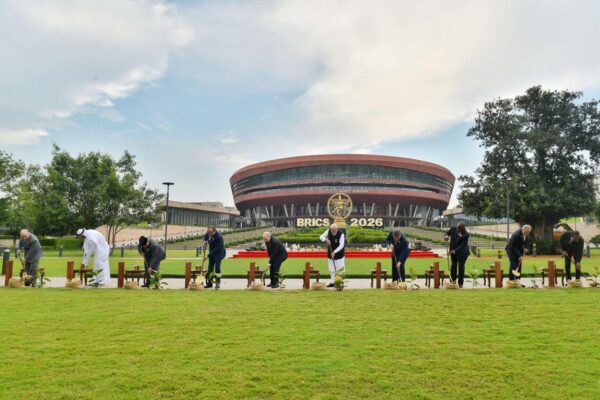
Read The Diplomat, Know The Asia-Pacific The Delhi Declaration made no mention of de-dollarization. But it did back trade in national currencies. Leaders of BRICS member nations plant banyan tree saplings to mark the 18th BRICS summit in New Delhi, India, Sept 12, 2026. The 18th BRICS summit hosted by India on September 12-13 criticized unilateral tariffs, sanctions, and protectionism in international trade, expressed support for multilateralism and multipolarity, and saw the airing of serious concern over rising tensions in West Asia. The summit was being closely watched for several reasons. The first was whether the summit would produce a consensual joint statement. The second was curiosity over whether the BRICS members would collectively reject the dollar as the main currency of international trade. And third, to see what it could say about unilateral tariffs imposed by U.S. President Donald Trump, especially since Brazil and India, two BRICS founding members, were slapped with the highest tariff rate of 50 percent last year before they were reduced. This was the first summit that India was hosting since its expansion in 2024. The presence of leaders from Iran, Saudi Arabia, and the United Arab Emirates (UAE) – countries caught in the war in West Asia – at the same table in New Delhi also raised the scrutiny levels. The summit produced a consensus outcome document, the “New Delhi Declaration.” It was not expected to do so; a BRICS foreign ministers’ meeting in May ended without consensus, especially over words to describe the U.S. war on Iran and Tehran’s subsequent strikes on Gulf countries, including BRICS members. The Delhi Declaration expressed anguish over the situation in the Middle East without naming any of the parties – neither the U.S., Israel, Iran, nor any of the Gulf countries – involved in the conflict. It expressed “deep concern” over the “continued escalation of tensions in Middle East/West Asia” and called for “exercising maximum restraint” and “avoiding actions that could further aggravate the situation.” The statement supported a two-state solution to end Israel-Palestine tensions and called for the halt of the forced displacement of Palestinians. Comments on Palestine aren’t new for BRICS but acquire salience given the current situation in Gaza. There was no mention of “de-dollarization” either, i.e., BRICS members reducing their reliance on the dollar for trade, financing, and as part of official reserves. Nor was there any reference to a BRICS common currency. But BRICS did back intra-group commerce carried out in local currencies. This is not surprising given that Russia and Iran are under multiple layers of sanctions prohibiting trade in dollars or euros. Countries like India, which have been buying oil from Russia in the wake of the West Asia crisis, have been finding it difficult to pay for oil purchases. The possibility that BRICS could sideline the dollar as an international trade currency has placed it in the crosshairs of the Trump administration. BRICS has been seen as a counterweight to Western-led institutions and a platform for building an alternative international order, especially given the presence of countries like China and Russia. India, on its part, has made it clear that it is “non-West” but not “anti-West.” Participation in BRICS, as in the Australia-Japan-U.S.-India Quad forum, reinforces India’s multi-alignment strategy in an uncertain world. At the summit’s opening, Indian Prime Minister Narendra Modi pointedly underlined that the grouping sought to move forward “not against anyone, but with an approach of taking everyone along.” In New Delhi, BRICS reiterated its “commitment to strengthening multilateralism and multipolarity and to upholding international law” in the statement. The “proliferation of trade-restrictive actions” threatened global trade and disrupted global supply chains while introducing uncertainty into international economic and trade activities, it said. “We voice serious concerns about the rise of unilateral tariff and non-tariff measures which distort trade and are inconsistent with WTO rules,” it added. In his opening remarks, Modi said BRICS needed to chart out global reforms to secure a bigger voice for developing countries in global decision-making. The “pyramid of privilege” must be changed to a “platform of partnership,” he said. “Ensuring equal participation in shaping the global rules of the future is of utmost importance. AI, cyberspace, outer space, biotechnology, and critical technologies are shaping not only the opportunities of the future, but also the rules that will govern the future,” Modi added. In the closing session on September 13, Modi raised concerns about the “weaponization of technology and critical minerals,” warning that it could hinder shared growth and development prospects. At the opening session, China’s President Xi Jinping pitched BRICS as the world’s most influential grouping for cooperation among emerging markets and developing countries. He called on BRICS to strengthen cooperation in artificial intelligence and encourage open-source development, cooperation and sharing. He invited BRICS countries to participate in the Shanghai-headquartered World Artificial Intelligence Cooperation Organization set up in July and seen as China’s attempt to shape global AI governance, rivaling the U.S.’ Pax Silica. Xi also said Beijing was willing to work with BRICS countries to play a “due role” in bringing peace to the Middle East. “We must oppose withdrawing from organizations, breaking treaties, and starting anew by setting up separate mechanisms,” Xi said, in what is seen as thinly veiled criticism of the U.S., which under Trump has walked out of pacts on climate change and many international organizations. So, apart from a wordy 140-paragraph document, what did India achieve at the 18th BRICS summit? “New Delhi’s diplomatic success lies in keeping BRICS ‘boring,’” in the middle of “rhetorical excess about radical global change,” security affairs analyst C Raja Mohan wrote in an opinion piece on September 13. “The declaration reaffirms the political diversity of the forum and dispels the notion of an ideological crusade against the West — one that some supporters of BRICS desire and many of its critics assume is already under way,” he wrote. The summit’s “principal achievement is to underline a simpler proposition: a more fragmented world requires more, not less, practical cooperation among major nations. The emphasis is on reforming the international order, not demolishing it,” he added. Happymon Jacob, founder-director of the Council for Strategic and Defense Research, opined that “a strong BRICS would put India on the adversarial side of the U.S. and its allies, at a time when India’s most important relationships are with them.” Earlier this year, India concluded a free trade agreement with the European Union. And despite all its grievances, the U.S. is
Original source
The Diplomat Indonesia