General articles are free for 24 hours after publish.
Beyond Giants: Bhutan and Singapore's Buddhist Diplomacy
As China and India vie for influence using Buddhism, Bhutan and Singapore are demonstrating how smaller states can leverage Buddhist values, networks, and heritage into diplomatic capital. Both nations are carving out unique regional roles through distinct approaches.
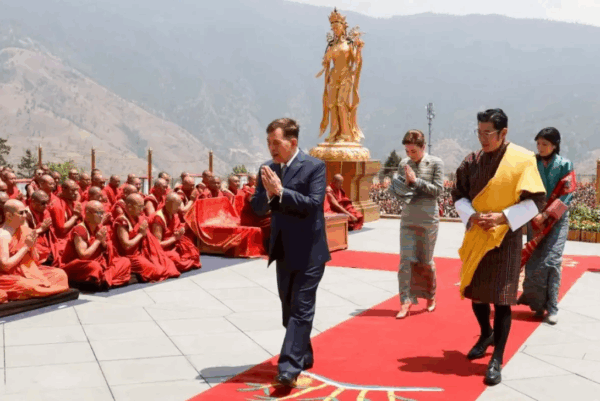
While the strategic competition between China and India over influence through Buddhism often captures attention, two smaller states, Bhutan and Singapore, are demonstrating how Buddhist diplomacy can be effectively practiced under different conditions. Their approaches reveal how limited geopolitical weight can be transformed into diplomatic capital through cultural networks and regional cooperation. Bhutan, the world's only official Vajrayana Buddhist kingdom, places Buddhist values at the core of its domestic governance and international engagement. The concept of Gross National Happiness (GNH), championed by the Fourth King, serves not merely as an alternative development measure but as a strategy to reconcile modernization with the preservation of Bhutanese Buddhist culture and national identity. This fusion of Buddhist values and development has strategically positioned Bhutan between India and China, leveraging cultural distinctiveness to safeguard sovereignty and project an international profile far exceeding its size. The current King navigates the structural constraints of Bhutan’s position by maintaining strong ties with India while cautiously managing relations with China. Cultivating close ties with Thailand, a leading Theravada Buddhist monarchy in Southeast Asia, provides Bhutan with a valuable partnership beyond its immediate geopolitical neighborhood. Recent high-level royal exchanges between Bhutan and Thailand have reinforced their bilateral relations, using Buddhism as a shared cultural and symbolic language. Furthermore, the Gelephu Mindfulness City project aims to attract global investment by branding mindfulness and sustainability, yet it also highlights a tension between Buddhist values cautioning against materialism and the strategic mobilization of these values to integrate into global capitalism. In contrast, Singapore, a secular and multireligious republic, does not ground its diplomacy in religious identity. Instead, it has cultivated a role as an intermediary, utilizing its Buddhist heritage to facilitate dialogue among governments, religious communities, scholars, and cultural institutions. This reflects Singapore's broader diplomatic strategy as a small state: rather than directly competing with larger powers, it seeks to enhance its relevance by positioning itself as a connector. People-to-people diplomacy through Buddhist networks has been particularly effective. The late Venerable Hong Choon, for instance, built extensive ties in Thailand and China, fostering relationships that facilitated cultural exchange. Former Foreign Minister George Yeo, a Catholic deeply engaged with Asian philosophies, championed Buddhism as a diplomatic resource transcending religious affiliation, enabling Singapore to act as a bridge between larger Asian powers and advance regional dialogue. Singapore's museums also play a significant role, using exhibitions of Buddhist material culture to strengthen institutional partnerships and position Singapore as a hub for the interpretation and circulation of the region's shared heritage. As China and India continue their competition for influence across Asia, Bhutan and Singapore illustrate the diverse manifestations of small-state Buddhist diplomacy. Bhutan embeds Buddhism within its monarchy, national identity, and statecraft, while Singapore leverages it as one of several cultural resources for building regional connections in its secular, multireligious context. This contrast suggests that small-state Buddhist diplomacy is not monolithic; its effectiveness lies in its capacity to adapt Buddhist actors, material culture, and networks to varied political and cultural environments.
Original source
The Diplomat Indonesia