Western Tourists' Fascination with Vietnam's 'Shameplant' Goes Viral
Culture
2026年6月30日
3
Vietnam Insider

Western Tourists' Fascination with Vietnam's 'Shameplant' Goes Viral

AI サマリー

A video of Western tourists in Vietnam's Ha Giang province marveling at a 'shameplant' (Mimosa pudica) as its leaves fold upon touch has gone viral on social media, highlighting the charm of everyday local sights for visitors.

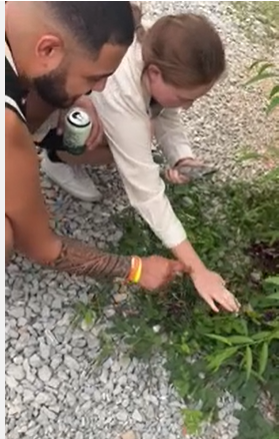
Something completely ordinary to one person can be a brand-new experience to another. For instance, Vietnamese people feel deep excitement when they see snow or red maple leaves for the first time. Similarly, foreign tourists in Vietnam often experience “wow” moments over everyday local sights. Recently, a video clip went viral on social media for this exact reason. It shows two foreign travelers sitting by the roadside in Ha Giang, playfully interacting with a simple shameplant. Two tourists mischievously playing with the shameplant. Source: @hnghgiang1 In the clip, the two tourists gently touch each branch of the shameplant with their hands. Every time the leaves fold up and droop, they burst into delighted laughter. To them, it looks like a small magic trick by nature. They do not just try it once. Instead, the travelers patiently touch one branch after another. They observe the plant closely and use their phones to record the special moment. Their excited, surprised expressions quickly made many online viewers laugh along with them. The two tourists mischievously mess with the plant and tease each other, much to the delight of the audience. Then, they even teased each other, much to the delight of viewers. Source: @hnghgiang1 To most Vietnamese people, the shameplant is an incredibly familiar sight. It grows wildly along roadsides, in grassy fields, and on empty plots of land. However, it is a completely novel experience for tourists. They are seeing a plant that actually “shrinks” when touched for the very first time. The video clip did more than just delight netizens with the tourists’ reactions. It also evoked fond childhood memories for many locals. Consequently, within a short time, the video gathered millions of views and thousands of comments. People widely reshared it across multiple social media channels. Netizens left a variety of colorful comments on the post: “Even the wild plants have to entertain tourists now!” “I saw this plant a lot during my childhood, and its flowers are beautiful. Now it is rare, and I haven’t seen one in a long time.” “When I was little, I would go out and play with it whenever I felt bored.” “Dear tourists, this plant can actually cure many diseases too!” “I messed with it all the time as a kid. At noon, after turning the straw, I would sit by the bush for half an hour playing with it from one cluster to another.” “Sometimes we just need a few carefree moments like that.” “Enjoy playing with it now! Once you go back overseas, you won’t find it anywhere.” “Did you guys seriously book plane tickets all the way here just to play with a plant?” Notably, many viewers felt curious and asked whether the plant does not grow in the tourists’ home countries. The answer is simple: it does not. The shameplant does not grow everywhere. It is only common in nations with a tropical climate. The shameplant is also known as the bashful plant, the sensitive plant, or hàm tu thảo. It bears the scientific name Mimosa pudica and belongs to the pea family. The most remarkable feature of this plant is its rapid reaction to external stimuli. With just a gentle touch or a slight shake, the compound leaves immediately fold up and droop down. This action serves as a self-defense mechanism. It protects the plant from leaf-eating animals or harsh environmental factors. After a few minutes, the stimulus fades, and the leaves slowly reopen as normal. Many Vietnamese people consider it a wild weed. However, the shameplant actually originates from South and Central America. It later spread to numerous tropical countries, including Vietnam, Thailand, Indonesia, and Malaysia. Subscribe to get the latest posts sent to your email. Type your email… Subscribe

多角的分析

経済的影響

このニュース自体に直接的な経済的影響は小さいが、ベトナムの観光業における「ユニークな体験」の提供という側面で捉えられる。地方の自然や日常風景が、新たな観光資源となり得る可能性を示唆している。特に、ハザン省のような地方部は、インフラ整備が進むにつれて、このような体験型観光の需要が増加すると考えられる。

投資家心理

直接的な投資機会を示すものではないが、ベトナムの多様な自然や文化が、観光関連産業(宿泊施設、ツアーオペレーター、体験型アクティビティ提供者など)への投資魅力を高める一因となり得る。特に、地方部での小規模かつ地域密着型のビジネスモデルに注目が集まる可能性がある。

社会的影響

ベトナムの日常風景が、外国人観光客にとって驚きと感動を与えるという事実は、文化的な価値観の相対性を示す。また、SNSでの拡散は、デジタル化が進むベトナム社会における情報伝達の速さと広がりを反映している。地元住民にとっては、子供時代の思い出を共有する機会となり、世代間のコミュニケーションを促進する側面もある。一方で、観光客の行動が地元住民の生活に予期せぬ形で影響を与える可能性も考慮されるべきである。

市民の声

ベトナム国民、特に地方に住む人々にとっては、見慣れた植物が外国人に喜ばれるという事実は、自国の自然や文化に対する新たな視点を提供する。都市部では見かける機会が減っている植物に、子供時代の懐かしさを感じる人も多いだろう。SNSでの共有を通じて、国民全体がこの小さな出来事を共有し、一種の国民的な話題として楽しむことができる。

背景・歴史的文脈

ベトナムでは、経済成長と都市化の進展に伴い、地方の自然や伝統的な風景が失われつつあるという側面がある。一方で、外国からの観光客は、ベトナムの「ありのまま」の自然や日常風景に価値を見出す傾向がある。今回のオジギソウの件は、こうしたベトナムの地方部が持つ潜在的な観光資源としての価値を再認識させる出来事と言える。また、SNSの普及により、個人の体験が瞬時に世界中に共有される時代になったことも、この話題が広まった背景にある。

原文ソース

Vietnam Insider

原文を読む