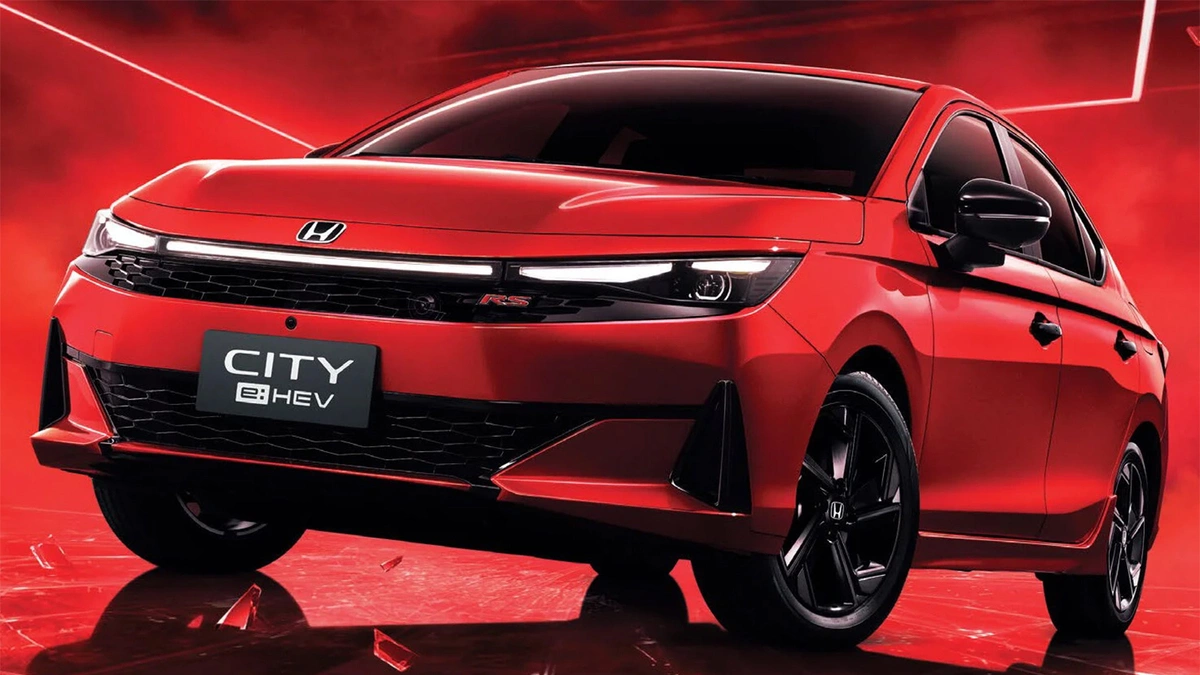
Honda City 2026 Facelift Launched in Thailand with Design Tweaks and Enhanced Features
Technology
2026年6月29日
4
VnExpress
Relations
🇻🇳Vietnam🇹🇭Thailand

Honda City 2026 Facelift Launched in Thailand with Design Tweaks and Enhanced Features

AI サマリー

Honda has launched the new City 2026 for the Thai market, featuring minor design changes, a larger 10-inch infotainment screen, and options for gasoline or hybrid powertrains. Priced from $17,000, promotional pricing is available for early buyers.

Honda has launched the new City 2026 for the Thai market, marking the first introduction in the Southeast Asian region. This facelifted model focuses on design improvements and upgraded equipment. The new City is available in both sedan and hatchback body styles, with options for either a gasoline engine or a hybrid powertrain. The City 2026 sold in Thailand emphasizes the hybrid e:HEV variants. The standard S trim retains a gasoline engine, bringing the starting price for the sedan model down to $17,000. The hybrid e:HEV models, including V, SV, and RS, are priced at $18,500, $20,600, and $22,000 respectively. The hatchback variants will be priced $300 higher across the entire product line. Compared to the previous 2024 model, the starting price of the new model has decreased by $900, while the hybrid SV and RS models have seen reductions of $2,400 and $3,000 respectively. Honda stated that these are initial promotional prices, effective until September 30. The standard S trim of the upgraded City 2026 is equipped with a 1.0-liter turbocharged gasoline engine, delivering 120 horsepower at 5,500 rpm and a maximum torque of 173 Nm from 2,000-4,500 rpm. The car uses a CVT transmission with front-wheel drive and has a claimed fuel consumption of 4.4 liters per 100 km on a mixed cycle. Meanwhile, the familiar hybrid model features a front electric motor (107 hp, 253 Nm), a lithium-ion battery, and a 1.5-liter naturally aspirated gasoline engine (97 hp, 127 Nm). Its claimed fuel consumption on a mixed cycle is 3.6 liters per 100 km. In terms of exterior design, the City 2026 features slimmer LED headlights, with LED daytime running lights forming a continuous strip across the entire width on higher trims, creating a striking accent. The grille has been redesigned to be more minimalist, with the front fascia painted in the same color as the body. The front bumper has been refined, with the central air intake pointing downwards on most versions and upwards solely on the RS trim. The taillights are L-shaped LEDs located on either side. The rear bumper has been redesigned to complement the front. On the SV and RS trims, the familiar red taillights are replaced with clear lenses. The standard S trim uses 15-inch wheels, while other trims are fitted with 16-inch wheels. The interior of the City 2026 remains largely unchanged from the previous model. The center console has undergone minor adjustments, featuring a new ambient lighting strip and a larger 10-inch infotainment screen (up from 8 inches in the previous model), integrated with a 360-degree camera, applicable to SV and RS trims. The RS trim exclusively adds an auto-dimming rearview mirror and Qi wireless charging. Honda Sensing driver-assistance features and standard safety equipment on the City 2026 remain unchanged from the previous iteration. In the subcompact sedan segment, the City competes with rivals such as the Toyota Vios, Hyundai Accent, and Mazda2.

多角的分析

経済的影響

ホンダ・シティ2026のタイでの発表は、東南アジアの自動車市場における価格競争と技術革新のダイナミクスを浮き彫りにしている。特に、ハイブリッドモデルの価格設定と、ガソリンモデルの価格を抑える戦略は、燃費効率と初期購入コストのバランスを重視する消費者のニーズに応えるものである。ベトナム市場においても、同様の改良モデルが導入される可能性があり、現地の自動車メーカーや輸入車との競争が激化すると予想される。これは、ベトナム政府が進める自動車産業育成政策や、環境規制強化の動向とも連動して、市場全体の構造変化を促す要因となりうる。

投資家心理

ホンダ・シティ2026のタイでの発表は、東南アジア自動車市場におけるホンダの競争力維持戦略の一環と見られる。価格帯を抑えつつ、デザインやテクノロジーをアップデートすることで、特に若年層や中間所得層からの需要を取り込む狙いがある。ハイブリッドモデルの投入は、環境意識の高まりと燃料費高騰への懸念に対応するものであり、投資家にとっては、ホンダの収益性向上と市場シェア維持への貢献が期待できる。ベトナム市場への展開も注目され、現地の自動車販売台数やホンダのサプライチェーンへの影響が分析のポイントとなる。

社会的影響

新型ホンダ・シティ2026の発表は、タイにおける自動車購入層、特に若年層や中間所得者層の関心を引くだろう。17,000ドルからという価格設定は、依然として多くのベトナム国民にとっては高価ではあるものの、デザインの洗練さや先進的な装備は、都市部でのライフスタイルを重視する層にアピールする可能性がある。しかし、ベトナム国内での販売価格がタイと同程度になるとは限らず、輸入関税や現地生産の有無によって大きく変動する。これは、ベトナム国民の自動車へのアクセス可能性や、地域間の経済格差といった問題とも関連してくる。

市民の声

タイで発表された新型ホンダ・シティ2026は、ベトナムの多くの市民にとって、将来的な自動車購入の選択肢として注目されるだろう。特に、燃費の良いハイブリッドモデルの導入は、ガソリン価格の変動が家計に影響を与えるベトナムにおいて、魅力的な要素となる。しかし、17,000ドル(約4億3000万ドン)からという価格は、ベトナムの平均的な所得水準から見ると依然として高額であり、多くの市民にとっては手の届きにくい価格帯である。ベトナム国内での販売価格が、タイでの価格を大幅に上回る場合、その魅力はさらに限定的になるだろう。現地の道路事情やインフラ、そして自動車購入に対する税制なども、市民の購入意欲に影響を与える要因となる。

背景・歴史的文脈

ベトナムの一党体制下では、政府は経済成長と社会安定を両立させる政策を推進してきた。自動車産業は、国内経済の活性化と雇用創ち、そして国民生活の利便性向上に寄与する重要な産業と位置づけられている。しかし、国内産業保護の観点から輸入車に対する関税が高く設定されており、これが自動車価格の高止まりの一因となっている。近年、ベトナム政府は、環境規制の強化やEV(電気自動車)へのシフトを奨励する方針を示しており、自動車メーカー各社は、この政策動向に対応した製品開発と販売戦略を模索している。ホンダ・シティのような人気車種の改良は、こうした市場の変化と、消費者のニーズの多様化を反映していると言える。

原文ソース

VnExpress

原文を読む